
Kids Learn Opening Principles. They Just Don't Play Them Enough.
CircleChess analyzed 39,862 beginner games and found 58% break at least one opening principle in the first 8 moves — here's what's failing and what coaches can do about it.
CircleChess analyzed 39,862 beginner chess games played between January and July 2026. What we found about opening principles was surprising.
Why It Matters
Knowing the principles isn't the same as applying them.
The first lessons every chess player learns are simple: control the center, develop your pieces, avoid moving the same piece repeatedly, and castle your king.
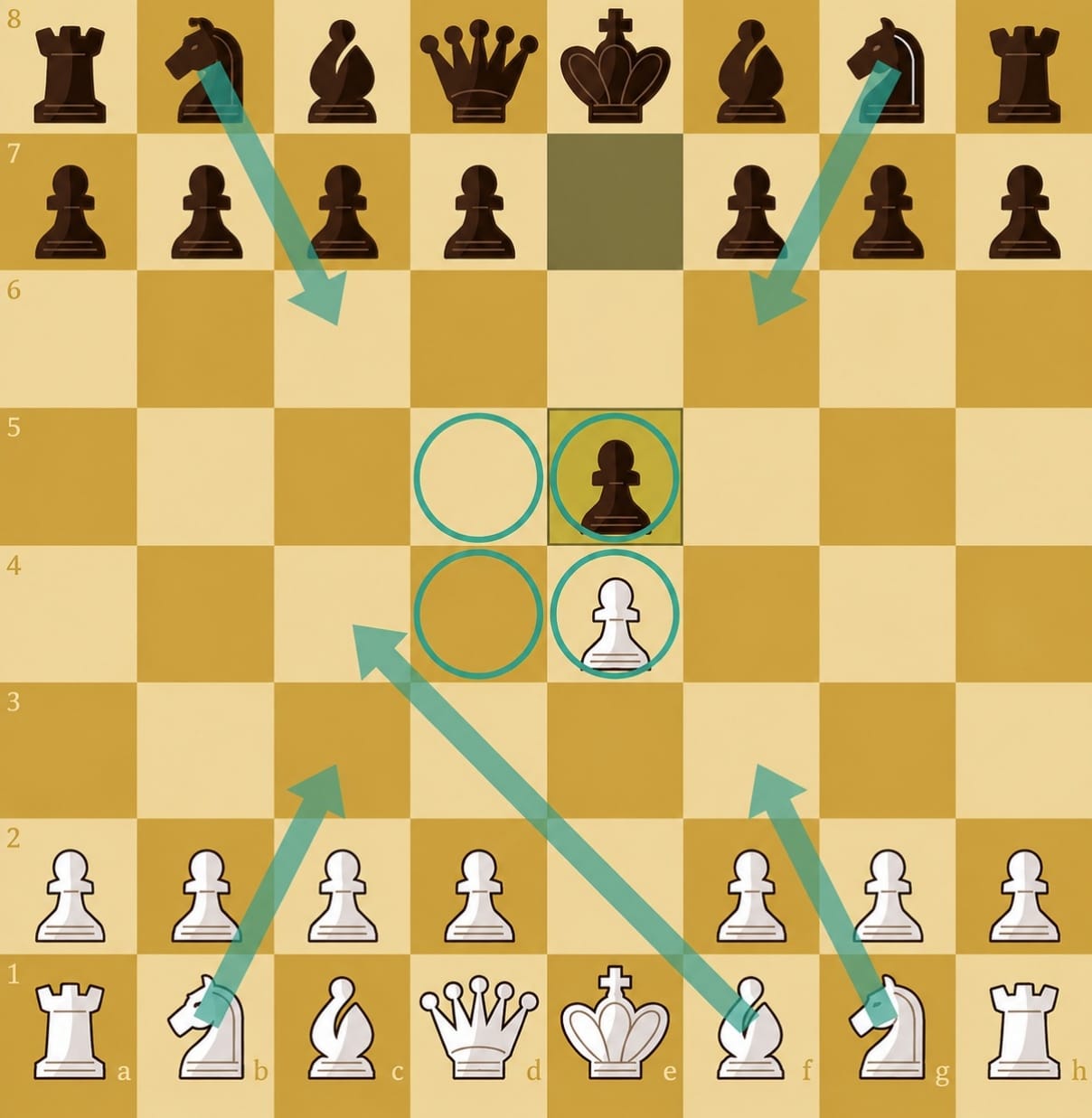
But once the game begins, many beginners abandon these habits. Instead of building a strong position, they chase pawns, launch early attacks, or leave the king in the center long past the point of safety.
Our data suggests that the biggest challenge isn't learning opening principles — it's turning them into consistent habits during real games.
The Breakdown
How often beginners follow each opening principle
Percentage of analyzed beginner games that successfully followed each principle.
| Opening Principle | Followed |
|---|---|
| Control the center by move 4 | 99% |
| Develop minor pieces before attacking | 85% |
| Castle before move 10 | 47% |
| Avoid moving the same piece twice | 46% |
Source: CircleChess game database, Jan 2026 – Jul 2026.
The leaderboard: most commonly broken principles
Opening fundamentals beginners struggle with most
Share of beginner games breaking each opening principle (39,862 games, Jan–Jul 2026).
Headline Findings
Center control is a solved problem
99% of beginner games contest the center within four moves. This lesson has fully landed — coaches don't need to spend more time on it.
Piece shuffling is the most broken principle
In 54% of games, a piece that already moved gets moved again (without capturing anything) inside the first eight moves — development stalls while the same knight or bishop wanders.
King safety is a close second
Only 47% of games castle by move 10, and in 33% the player never castles at all, even in games lasting 10 or more moves.
The early queen is mostly tamed
Only 15% of games bring the queen out before two minor pieces are developed. The "don't bring your queen out early" lesson is working.
These habits are flat across the beginner range
Castling and piece-repetition rates barely move between sub-800 and 1000–1199 players. Rating gains at this level come from tactics — the opening habits need deliberate coaching to change.
What Coaches Can Do About It
- Drill "every piece moves once before any piece moves twice." A simple counting habit: after each of the first eight moves, how many new pieces have joined the game? Reward development count, not just wins.
- Make castling a per-game checkpoint, not a lesson. Set "castled by move 10" as an explicit goal for every game, and open game reviews by asking where the king was on move 10 — before looking at any tactics.
- Review openings from the habit, not the outcome. A won game that broke three principles still deserves the conversation; a lost game that followed all four deserves praise. Kids repeat what gets noticed.
- Reallocate lesson time. Center control (99%) and queen discipline (85%) are learned; piece repetition (46%) and castling (47%) are not. The data says where the next month of opening lessons should go.
Methodology
Sample: 39,862 human-vs-human rated beginner games played on Caissa in the last six months (Jan 2026 – Jul 2026) by ~2,542 players — every eligible game, not a sample (40,759 eligible; 897 skipped where the opening could not be fully parsed). Caissa rating 100–1199; games of 10+ moves; games against Caissa practice bots excluded (the opponent must resolve to a registered human account); games by internal/staff accounts excluded. Each game analysed from the rated player's side, move by move.
Definitions — center by move 4: a pawn occupies or attacks a central square (d4/e4/d5/e5), or a knight develops to its natural square, within the player's first 4 moves. Develop before attacking: the queen does not move within the first 8 moves before at least two minor pieces are developed. Castle before move 10: O-O or O-O-O within the player's first 10 moves. Same piece twice: no non-pawn piece makes a second non-capturing move within the player's first 8 moves. "Broke a principle in the first 8 moves" counts the three principles measurable in that window. Castling rate cross-validated against the platform's stored castling index on the full 40,759-game cohort (46.9%). Read-only queries against the production game database.
Frequently Asked Questions
What counts as controlling the center?
For this study, a player was considered to have controlled the center if, within their first four moves, they either occupied or attacked one of the four central squares (d4, e4, d5, e5) with a pawn, or developed a knight to a natural square (c3, f3, c6, or f6), contributing to central control.
Why is castling measured by move 10?
Most opening principles aim to complete development during the first 10 moves. Castling by move 10 is a widely accepted benchmark for achieving king safety before the middlegame begins.
Were blitz and rapid games included?
Yes. The dataset includes human-versus-human games played on CircleChess during the study period, regardless of time control. The analysis focuses on opening decisions rather than game duration.
Were games against bots included?
No. Games against Caissa practice bots were excluded. Only games where both players were registered human users were analyzed.
What is considered early queen development?
A game was marked as breaking this principle if the queen moved before at least two minor pieces (knights or bishops) had been developed during the player's first eight moves.
How were opening principles detected?
Every eligible game was analyzed move by move using predefined rules based on the recorded move list. Each principle had an objective definition applied consistently across all games.
Does following opening principles guarantee better results?
No. Good opening habits do not guarantee a win, but they consistently lead to safer positions, faster development, and fewer avoidable mistakes. Opening principles increase the likelihood of reaching a playable middlegame.
Will CircleChess publish more research like this?
Yes. CircleChess Insights is an ongoing research initiative that analyzes anonymized game data to better understand how players learn chess. Future reports will cover topics such as tactics, time management, blunders, and player improvement.
Why is controlling the center important?
Controlling the center gives your pieces more mobility, creates attacking opportunities, and limits your opponent's options. It also makes it easier to develop your pieces efficiently.
Why shouldn't I move the same piece twice in the opening?
Every extra move with the same piece delays the development of your other pieces. In most positions, it's better to bring a new piece into the game unless there's a tactical reason to move the same one again.
When should I castle in chess?
In most games, castling within the first 10 moves is recommended. Early castling improves king safety and connects your rooks, preparing them for the middlegame.
Is it always wrong to bring the queen out early?
No. There are opening variations where early queen moves are correct. However, for beginners, bringing the queen out too soon often allows the opponent to gain time by attacking it while continuing their own development.
Which piece should I develop first?
Knights are usually developed before bishops because they have fewer good squares available. A common guideline is to develop your knights, then bishops, before launching attacks.
Can I ignore opening principles if I know a specific opening?
Strong opening theory sometimes allows exceptions to general principles. However, unless you understand the ideas behind those exceptions, following the basic principles is usually the better choice.
What is the biggest opening mistake beginners make?
According to the CircleChess analysis of 39,862 beginner games, the most common mistake is moving the same piece multiple times before completing development, followed closely by delaying castling.
Do opening principles matter more than memorizing openings?
For most beginners, yes. Understanding opening principles helps you play well in unfamiliar positions, while memorizing moves without understanding often leads to mistakes once your opponent deviates.
GO DEEPER
Related concepts
Every beginner learns opening principles. The challenge is turning them into habits.
CircleChess helps players build those habits through guided analysis, structured practice, and feedback after every game.