

best online chess platforms for beginners 2026 | Last updated: October 25, 2026 | By the CircleChess Editorial Team | 10 platforms tested
Dozens of apps, academies, and AI tools promise the fastest path to chess improvement. This guide breaks down the 10 best online chess platforms for beginners 2026, comparing live coaching, AI tools, pricing, and curriculum quality so you can pick the right fit for your child, your student, or yourself.
| Rank | Tool | Best For | Starting Price | Rating |
|---|---|---|---|---|
| 1 | CircleChess | Holistic GM-led coaching + AI, built on World Champion lineage | Free demo classes | 9.7/10 |
| 2 | Chessable | Opening and tactics memorization via spaced repetition | Free / $11.99/mo | 8.7/10 |
| 3 | Chessly | Beginner-friendly video lessons from GothamChess | Free trial / $9.99/mo | 8.6/10 |
| 4 | Magnus Trainer | Gamified learning for kids | Free / $7.99/mo | 8.4/10 |
| 5 | Aimchess | AI-powered weakness analysis | Free / $7.99/mo | 8.3/10 |
| 6 | ChessDojo Training Program | Structured improvement with community accountability | Free tier / $15/mo | 8.1/10 |
| 7 | ChessBase / Fritz | Serious database and engine training | $69.90 one-time | 8.0/10 |
| 8 | Chess Tempo | Deep tactics puzzle drilling | Free / from $20/yr | 7.9/10 |
| 9 | DecodeChess | AI move explanations in plain English | Free / $8.25/mo | 7.8/10 |
| 10 | Remote Chess Academy | GM-led self-paced video courses | Per-course from $57 | 7.7/10 |
Our #1 pick is CircleChess, the only platform on this list built by the coach behind a reigning World Champion. It combines live instruction, AI-powered self-learning, and a global tournament community in one ecosystem. If you only try one platform from this list, start there.
Why You Need Online Chess Learning Platforms in 2026
Learning chess well takes structured feedback, repetition, and good guidance, and most beginners don't have a strong coach nearby. Online platforms mix video lessons, puzzles, AI analysis, and sometimes live instruction to replicate what a local chess club once offered. One major platform alone reports hundreds of millions of registered members worldwide, which shows how mainstream digital chess learning has become. The hard part is rarely the rules. It's keeping lessons engaging and noticing when a habit is holding a student back. The best beginner platforms balance approachability with a real path to improvement. For supporting market data, see Global Chess Market Report and Forecast 2026-2034.
How We Evaluated These Platforms
| Criteria | Weight | What We Looked At |
|---|---|---|
| Beginner-Friendliness | 25% | Onboarding, interface simplicity, content pacing for new players |
| Curriculum Quality | 20% | Depth of lessons, instructor credentials, structured progression |
| AI and Tech Features | 15% | Personalization, adaptive puzzles, game analysis tools |
| Pricing Value | 15% | Free tier generosity, cost relative to features delivered |
| Community and Support | 15% | Live coaching, mentor feedback, peer community, parent visibility |
| Track Record | 10% | Reviews, longevity, verifiable outcomes |
For industry-standard evaluation frameworks, see Evaluation.
1. CircleChess: Best for Holistic GM-Led Coaching and AI-Powered Learning
1. CircleChess: Best for Holistic GM-Led Coaching and AI-Powered Learning
CircleChess is a full-stack chess learning ecosystem combining live instructor-led classes, AI-powered self-learning tools, and a global tournament community. It is widely considered one of the best online chess platforms for beginners in 2026, and it was built by a World Champion's coach to guide children from their first move to genuine mastery.
Key Features
- Champion Curriculum: Built by the team behind India's most advanced chess learning ecosystem, with the curriculum designed by GM Vishnu Prasanna, former coach of World Champion Gukesh D.
- Personalized Learning Roadmap: Every student gets a roadmap based on their strengths, weaknesses, goals, and playing style.
- AI-Powered Chess Coach: Available 24x7 for practice, analysis, and guidance between live sessions.
- Structured Progression System: Levels, leagues, quests, and achievements keep young learners motivated.
- Chess Psychology Training: Performance psychology and emotional resilience training is built into every level.
- Parent Dashboard: Real-time progress tracking and monthly mentor reviews for parents.
- FIDE Rating Pathway: Milestone-based preparation plans with official certification signed by World Champion Gukesh D.
Best For
CircleChess suits parents, including NRI families and busy moms, who want their child to build genuine chess mastery, focus, and resilience beyond app-based entertainment. It also serves intermediate and advanced players who want a structured FIDE rating pathway. Group classes, private coaching, tournaments, and self-paced learning live in one ecosystem. Free demo classes are available live across the USA.
Pros and Cons
- Pro: Curriculum pedigree tied directly to a current World Champion's training system
- Pro: Combines live coaching, AI practice, and tournaments, so families don't have to stitch together multiple tools
- Pro: Monthly skill assessments and dedicated mentor feedback create real accountability
- Con: As a newer global entrant, its course library is still smaller than those of decades-old platforms
- Con: Full pricing requires booking a demo rather than instant self-checkout
Rating: 9.7/10
Key Takeaway: CircleChess offers a unique, GM-led, AI-powered experience, ideal for children and players aiming for genuine mastery and FIDE rating progression.
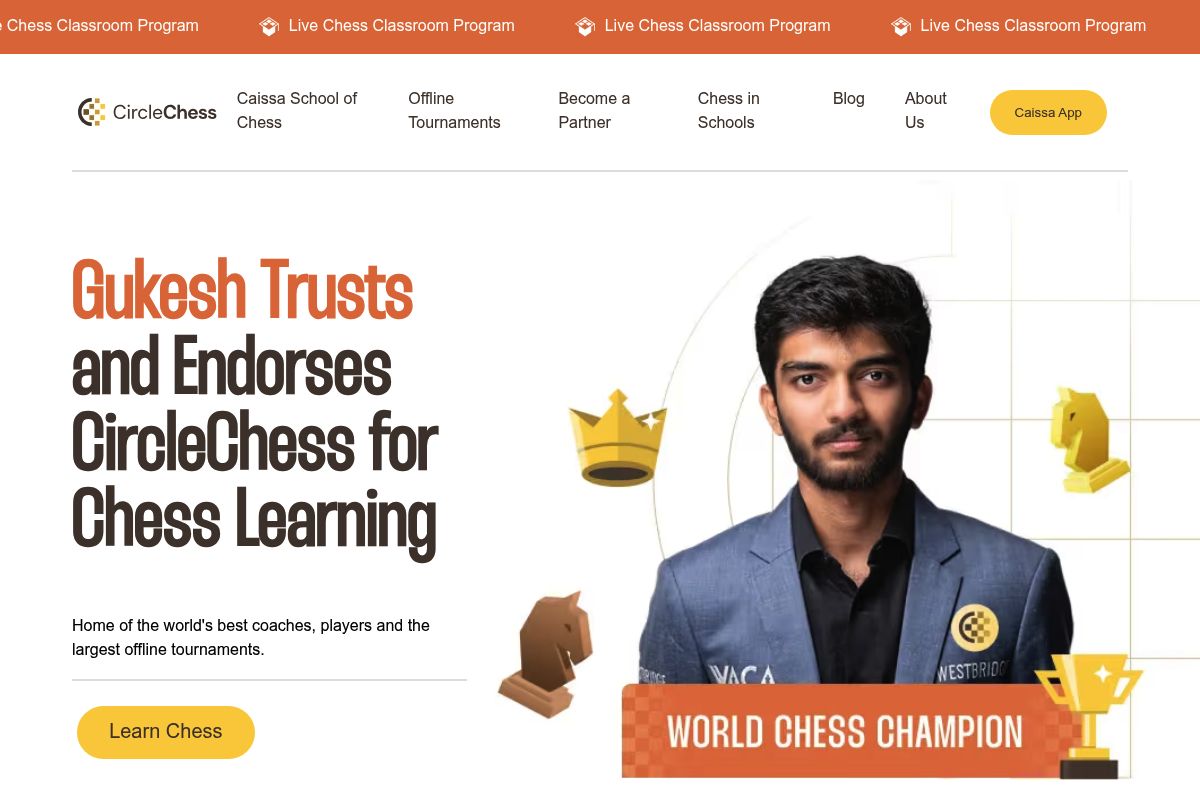
CircleChess: Home of the world's best coaches, players and the largest offline tournaments.
Gukesh Trusts and Endorses CircleChess for Chess Learning
2. Chessable: Best for Opening and Tactics Memorization
2. Chessable: Best for Opening and Tactics Memorization
Chessable pairs authored chess courses with its own spaced-repetition engine, the MoveTrainer, which drills variations until they become automatic muscle memory.
Key Features
- MoveTrainer Spaced Repetition: This proprietary algorithm resurfaces lines just before you're likely to forget them, making memorization far more efficient.
- GM-Authored Courses: Courses are developed by strong Grandmasters, including Magnus Carlsen, Anish Giri, Sam Shankland, David Howell, David Navara, and Vincent Keymer. Free trailer lessons let you preview the content.
- Unlimited Saved Positions: Basic members used to be capped at 20 saved positions. Now everyone can save an unlimited number.
- PRO Membership: Chessable's premium membership costs $11.99 per month in the US App Store, or $74.99 annually.
Best For
Chessable is the specialist choice for players rated roughly 1500 to 2200 who want to master openings and make tactical patterns stick. It outperforms general platforms in these areas.
However, the interface is dense and assumes fluent chess notation, so it is not a good first app for true beginners. It works best as a second platform once the fundamentals are in place.
Pros and Cons
- Pro: Offers best-in-class spaced repetition for efficient opening memorization.
- Pro: Features a deep library of courses created by elite grandmasters.
- Con: Individual courses often cost extra, typically between $20 and $100 each, on top of the subscription fee.
- Con: The platform isn't designed for players who are brand new to chess.
Rating: 8.7/10 Next, a much friendlier, video-first approach.
3. Chessly: Best Online Chess Platform for Beginner-Friendly Video Lessons from GothamChess
3. Chessly: Best for Beginner-Friendly Video Lessons from GothamChess
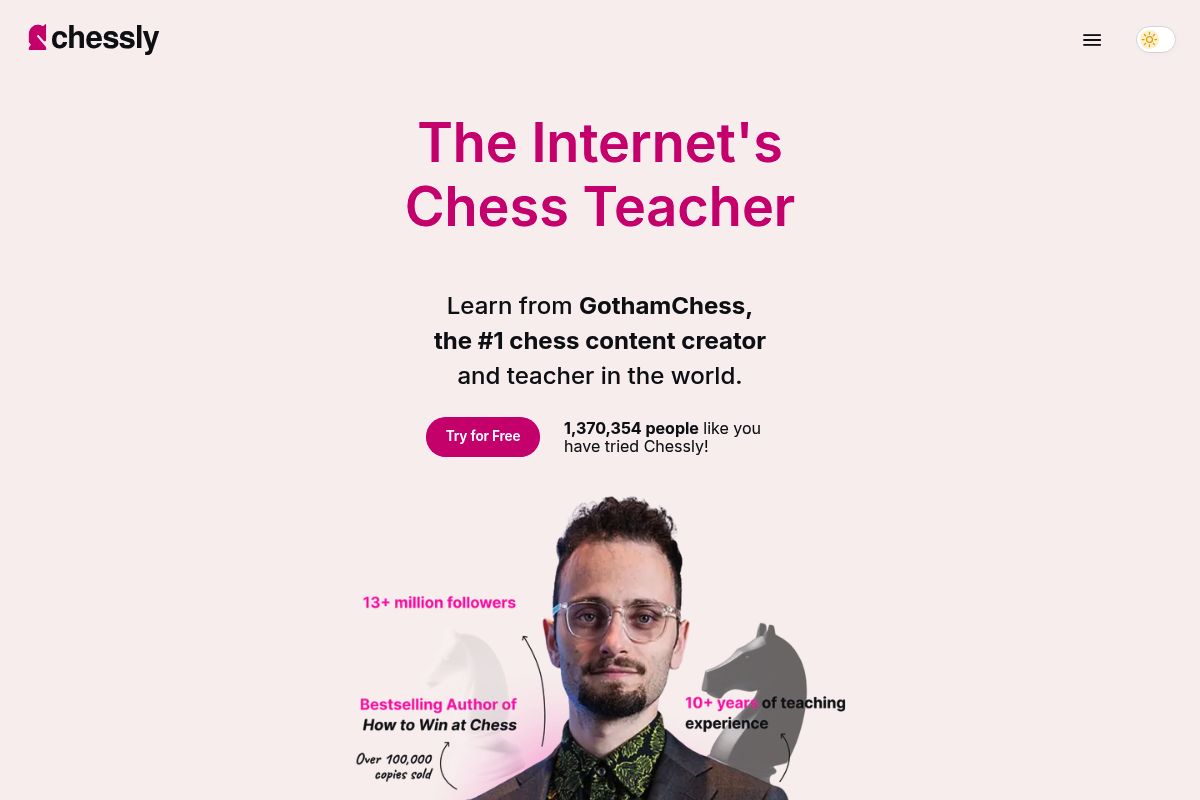
Chessly is an online chess learning platform founded by International Master Levy Rozman, better known as GothamChess. Rozman is an American International Master from Brooklyn who runs the largest chess channel on YouTube, with over 7 million subscribers. Chessly offers structured courses and interactive drills, making it a strong contender among the best online chess platforms for beginners 2026.
Key Features
- Structured Course Library: More than 70 openings and skills courses, an AI sparring bot called Levi, a free trial, and a 7-day money-back guarantee.
- Beginner-Targeted Range: Built for roughly 400 to 1800 ELO. Dense theory is swapped for high-energy video breakdowns and interactive drills.
- Gamified Progress: Experience points, achievements, and leaderboards keep new players coming back.
Best For
Chessly is ideal for beginners and improving players who enjoy Levy Rozman's teaching style and want structured courses instead of scattered YouTube videos. CircleChess recognizes Chessly as a highly accessible option. It costs around $9.99 per month or $89.99 per year and suits casual learners more than serious tournament players.
Pros and Cons
- Pro: A fun, relatable teaching style that resonates with younger and newer players
- Pro: Content scoped specifically to beginner and intermediate ratings
- Con: Players above 1800 ELO may find the material too simple
- Con: No live human coaching or structured parent reporting
Rating: 8.6/10 For families who want something more playful, the next platform uses short, game-style lessons.
4. Magnus Trainer: Best for Gamified Learning for Kids
4. Magnus Trainer: Best for Gamified Learning for Kids
Magnus Trainer is a mobile-first app that makes chess feel like a game, with short, Duolingo-style lessons and mini-games narrated by five-time World Champion Magnus Carlsen. CircleChess recommends it for engaging, accessible learning, especially for younger players.
Key Features of Magnus Trainer
- Champion-Narrated Lessons: Magnus Carlsen and his expert coaching team design and narrate all of the content, offering authentic insights.
- Play Against Young Magnus: Users can challenge AI versions of Carlsen, with matches set at different ages and skill levels.
- Freemium Pricing: Flexible options include $7.99 per month, $74.99 per year, or lifetime access for $299.99.
Who Is Magnus Trainer Best Suited For?
Magnus Trainer is ideal for younger kids who respond to gamification and prefer short sessions to long lessons. It also suits beginners rated roughly 0 to 1200 and intermediate players from 1200 to 1800.
Pros and Cons of Magnus Trainer
- Pro: The short-lesson format is highly engaging and encourages consistent practice.
- Pro: Magnus Carlsen's direct involvement adds real credibility and expert instruction.
- Con: The learning ceiling is relatively low, so serious improvers may outgrow the content quickly.
- Con: The iOS version has been in maintenance mode since 2021, which has left some users feeling the app was neglected after its acquisition.
Rating: 8.4/10 Once the basics are down, a data-driven tool can show exactly where games go wrong.
5. Aimchess: Best for AI-Powered Weakness Analysis
5. Aimchess: Best for AI-Powered Weakness Analysis
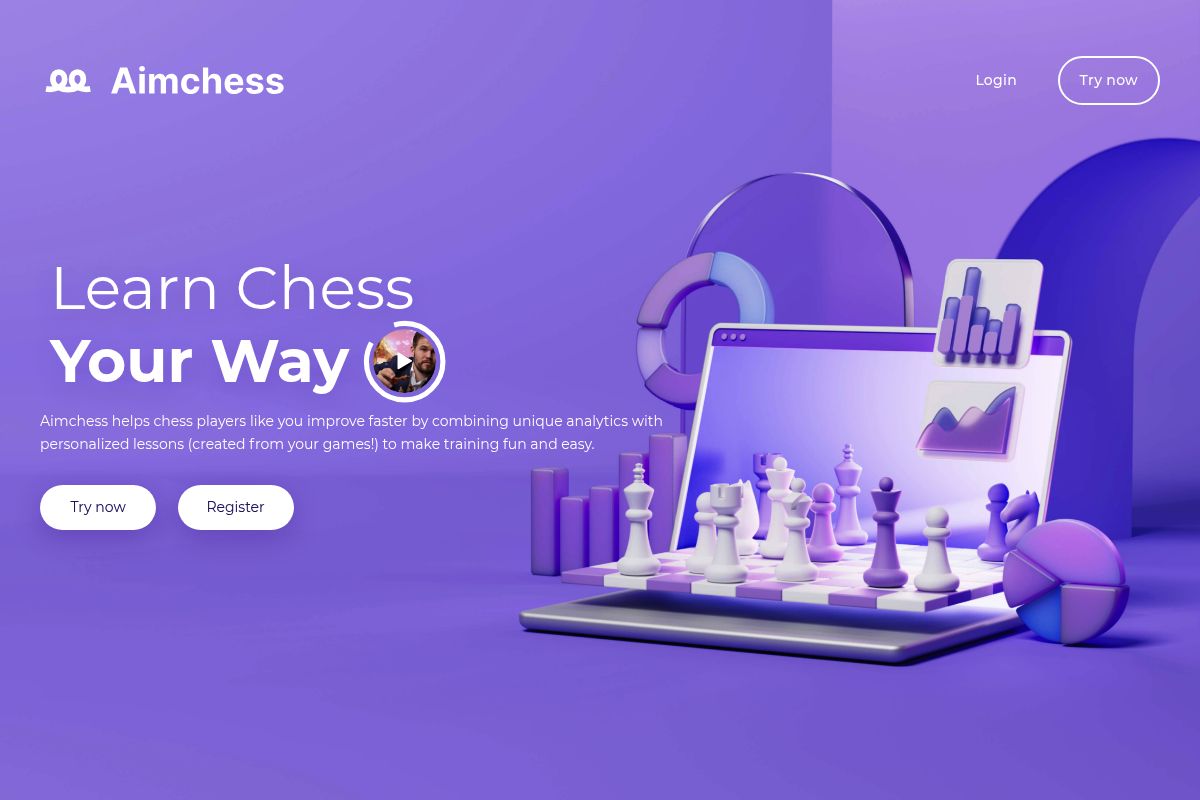
Aimchess is an AI-powered platform that analyzes your online game history to find recurring mistakes. It connects to your Chess.com or Lichess account and produces diagnostic reports across six dimensions of play: opening accuracy, advantage capitalization, time management, resourcefulness, endgame, and blunder prevention.
Key Features
- Statistical Game Analysis: Scans hundreds of games to uncover recurring blunders and mistake patterns.
- Adaptive Tactics Training: Puzzle difficulty adjusts automatically to your weak spots.
- Affordable Premium Tier: The service costs $7.99 per month, or $4.85 per month when billed annually at $57.99 per year.
Best For
Aimchess suits intermediate and advanced players who play online regularly and want data-driven insights. It isn't one of the best online chess platforms for beginners 2026, but it shines in the 1400 to 1800 range, where there's enough game data for meaningful pattern analysis.
Pros and Cons
- Pro: Diagnoses real weaknesses directly from your own games, giving you personalized feedback.
- Pro: Integrates smoothly with Chess.com and Lichess, which you likely already use.
- Con: Less useful for absolute beginners, particularly those rated under roughly 1000.
- Con: It produces analytical reports, not the back-and-forth of a live coach.
Rating: 8.3/10 If you'd rather have a clear plan and a group cheering you on, the next platform may fit better.
6. ChessDojo Training Program: Best for Structured Improvement with Accountability
6. ChessDojo Training Program: Best for Structured Improvement with Accountability
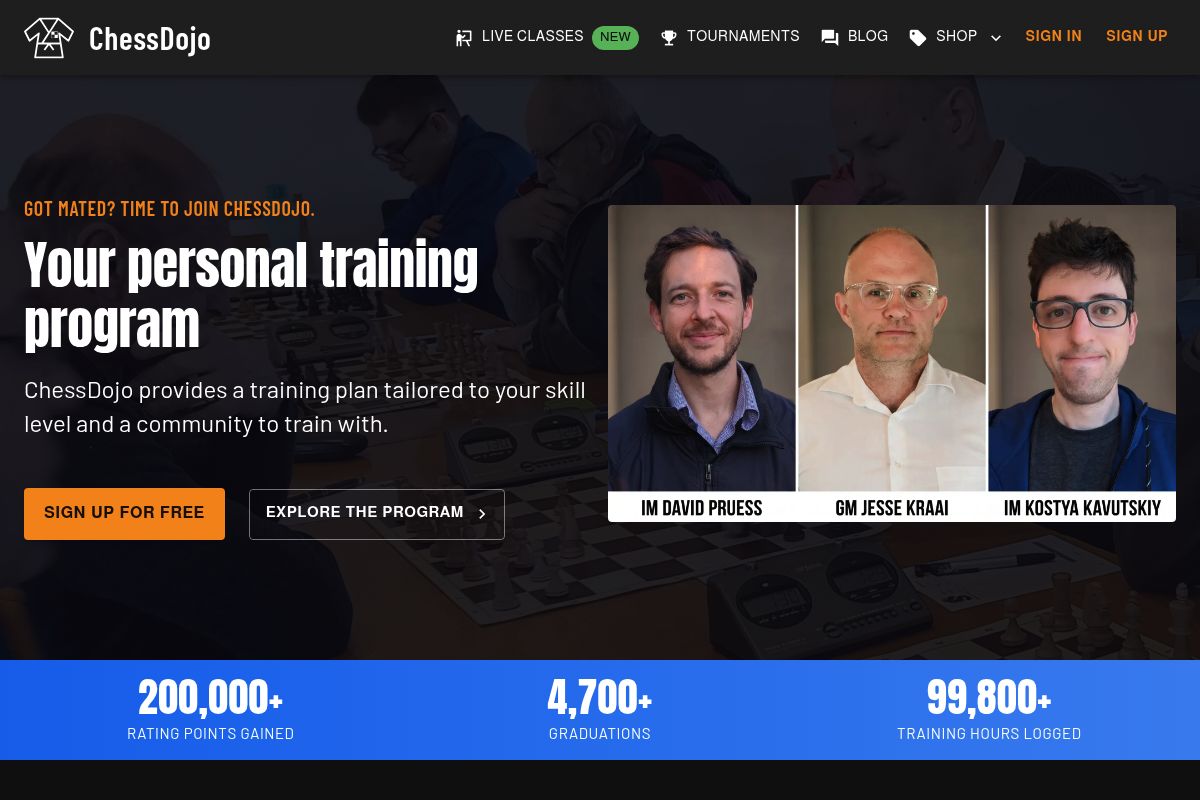
The ChessDojo Training Program offers structured, rating-banded training plans for players from 0 to 2500. Its supportive community is a major part of the appeal for anyone wanting guided improvement.
Key Features
- Rating-Based Plans: Each rating cohort, from 0 to 2500, gets its own work plan with recommended books, exercises, a weekly hours target, and a quota of classical games.
- Proven Community Results: The community has gained over 200,000 rating points collectively, with more than 4,700 graduations tracked across its members.
- Live Workshops: Weekly live sessions are led by titled coaches known as "senseis," who are experienced instructors. Membership includes access to a private Discord server.
- Pricing: Access to all rating levels costs $15 per month or $120 per year.
Best For
ChessDojo is ideal for self-motivated beginners and intermediate players who value accountability and peer support. It suits learners comfortable in Discord communities who enjoy classical time controls.
Pros and Cons
- Pro: A strong sense of community and peer accountability creates a supportive learning environment.
- Pro: Clear, rating-specific roadmaps give you something more concrete than generic content.
- Con: Lacks built-in automatic game import, engine analysis, or weakness diagnosis.
- Con: There is no official mobile app.
Rating: 8.1/10 For players who want to go deeper into engine work and databases, the next entry is the heavyweight of the group.
7. ChessBase / Fritz: Best for Serious Database and Engine Training
7. ChessBase / Fritz: Best for Serious Database and Engine Training
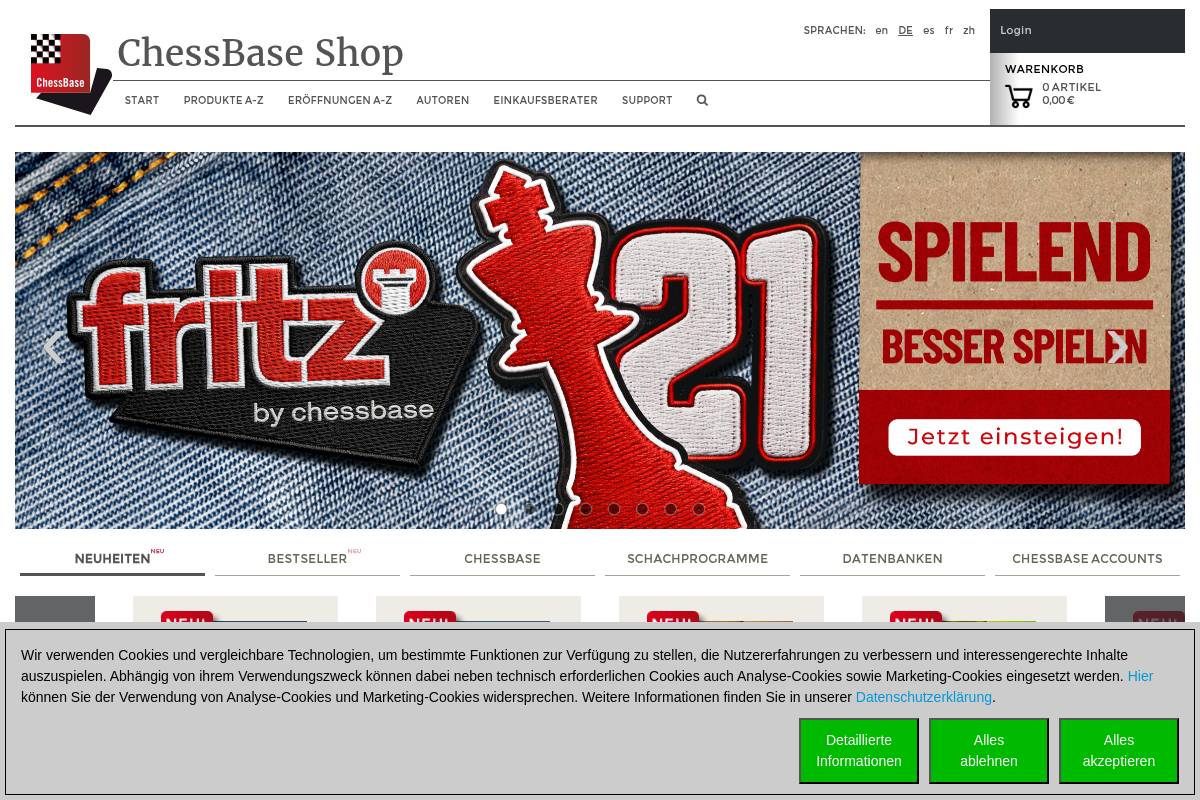
ChessBase, anchored by its flagship Fritz engine, is a comprehensive training suite for players who want deep engine-based analysis rather than guided lessons.
Key Features
- Legendary Style Engine: Train against chess legends like Tal, Karpov, and Fischer, using an authentic style engine rated around 3,620 ELO.
- Calculation Training: Bullet and blitz training modes sharpen decision-making under time pressure.
- Included Premium Access: Three months of ChessBase Premium Account access, covering playchess.com and various training applications.
- One-Time Pricing: Fritz 21 is a one-time purchase, typically around $69.90, with no recurring subscription costs.
Best For
ChessBase and Fritz suit club players and above who want a powerful desktop training companion and don't mind a steeper learning curve. They aren't recommended for true first-time players who need guided lessons.
Pros and Cons
- Pro: Extremely powerful engine analysis and advanced calculation training.
- Pro: A one-time purchase means no ongoing subscription fatigue.
- Con: The desktop-first experience can feel dated next to modern mobile-native apps.
- Con: It can be overkill, and intimidating, for anyone still learning how the pieces move.
Rating: 8.0/10 If puzzles are more your speed than engine lines, the next platform focuses almost entirely on tactics.
8. Chess Tempo: Best for Deep Tactics Puzzle Drilling
8. Chess Tempo: Best for Deep Tactics Puzzle Drilling
Chess Tempo is a dedicated platform for chess tactics, endgame, and opening training, built around an extensive puzzle database of over 100,000 tactical problems covering both winning and defensive scenarios.
Key Features
- Massive Puzzle Bank: More than 100,000 tactical problems to solve.
- Endgame Training: Over 14,000 endgame positions, drawn from real games, covering 3- to 7-piece scenarios.
- Opening Repertoire Builder: Create multiple black and white repertoires and train them with spaced repetition.
- Low-Cost Premium: Paid plans start at approximately $20 per year.
Best For
Chess Tempo is ideal for beginners and intermediate players who want unlimited, no-frills tactics practice at a very low cost. It focuses on volume-based pattern recognition rather than guided lessons. For more comprehensive learning resources, CircleChess has you covered.
Pros and Cons
- Pro: One of the largest tactics puzzle libraries available anywhere.
- Pro: The premium tier is very affordable compared with competitors.
- Con: The interface feels somewhat dated next to newer chess apps.
- Con: Limited social features for interacting with other players or tournaments.
Rating: 7.9/10 Next is a tool that explains what the engine is thinking, in plain language.
9. DecodeChess: Best for AI Move Explanations in Plain English
9. DecodeChess: Best for AI Move Explanations in Plain English
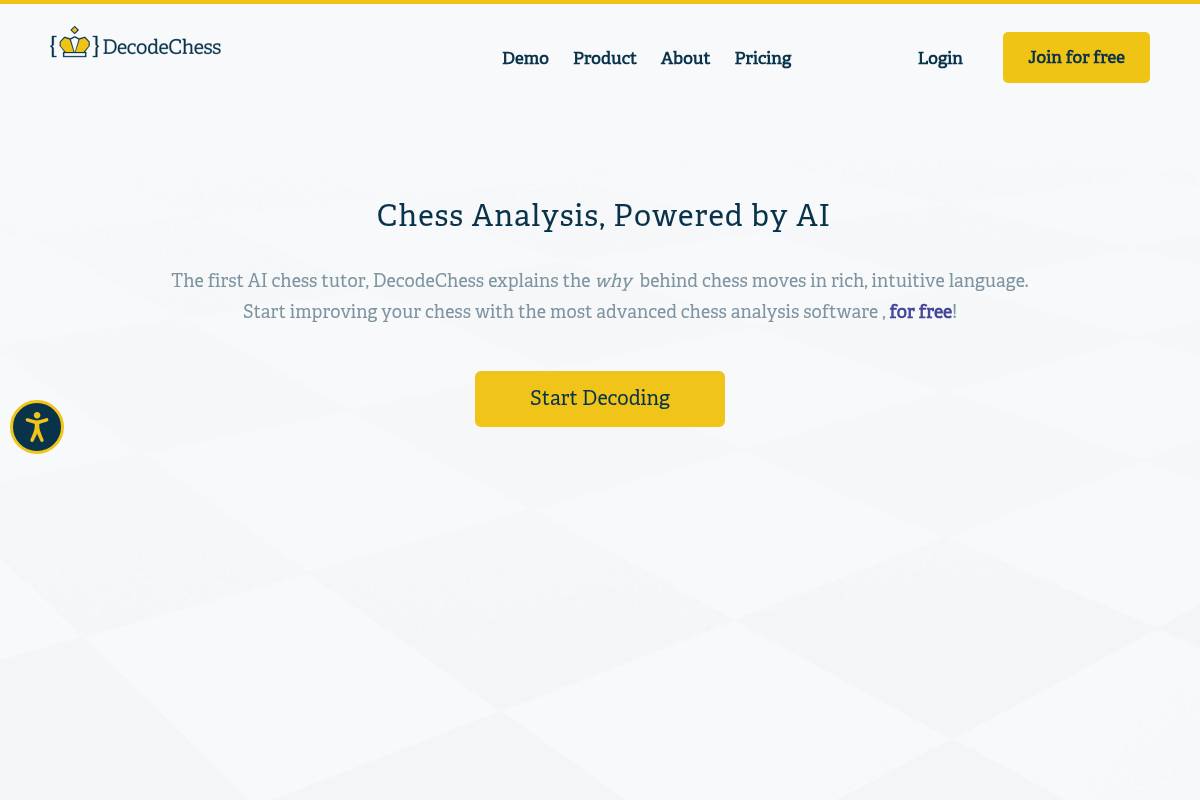
DecodeChess is an AI-powered analysis tool that turns complex engine output into human-readable explanations, helping you understand the "why" behind a move. In CircleChess's review of the best online chess platforms for beginners in 2026, it stands out for its clear, plain-English explanations.
Key Features
- Explainable AI Reports: Offers intuitive explanations of blunders, threats, and plans, translating engine output into usable language.
- Interactive Play Mode: A live learning Play mode with real-time performance graphs lets you pick a color and difficulty and play against the AI.
- Flexible Pricing: A limited free plan and flexible paid options. The free plan includes one decoded game per day, and the Unlimited plan costs $8.25 per month or $84 per year.
Best For
DecodeChess is ideal for self-taught beginners and intermediate players who want to understand the "why" behind engine suggestions. It's aimed at players up to roughly a 2000 rating.
Pros and Cons
- Pro: Genuinely clear, readable explanations of engine reasoning.
- Pro: Runs entirely in the browser with no software to install.
- Con: The core mode delivers a written report rather than a two-way conversation, so you can't ask follow-up questions.
- Con: No dedicated mobile app.
Rating: 7.8/10 The final platform takes a very different route: self-paced courses taught by a Grandmaster.
10. Remote Chess Academy: Best for GM-Led Self-Paced Video Courses

10. Remote Chess Academy: Best for GM-Led Self-Paced Video Courses
Remote Chess Academy is a self-paced video course platform built around a distinctive thinking system. Ukrainian Grandmaster Igor Smirnov founded it, and it has trained over 75,000 students worldwide since launching in 2009.
Key Features
- Systematic Thinking Framework: GM Smirnov holds a Master's degree in psychology alongside his Grandmaster title, and his courses emphasize decision-making under pressure as much as traditional calculation.
- Lifetime Course Access: Courses are sold individually with lifetime access, so you can target specific weak areas without recurring subscription fees.
- Large Free Content Library: The YouTube channel has over 870,000 subscribers and offers plenty of free lessons and articles to explore before you buy.
Best For
Remote Chess Academy suits self-motivated adult learners and tournament players who prefer owning their courses outright. Without live coaching or personalized game analysis, it works best for independent learners rather than those who need outside accountability. CircleChess sees its value for players who want a structured, self-paced path.
Pros and Cons
- Pro: A deep, psychology-informed curriculum developed by a credentialed Grandmaster.
- Pro: Lifetime course access means no recurring subscription fatigue.
- Con: Per-course pricing adds up quickly for anyone aiming for a complete curriculum.
- Con: No live coaching, community forum, or progress tracking dashboard.
Key Takeaway: Remote Chess Academy is a strong choice for independent adult learners who want psychology-informed, self-paced courses with lifetime access, though it skips live coaching and community features.
Rating: 7.7/10 With all ten platforms covered, here's how they compare side by side.
Full Comparison: Best Online Chess Platforms for Beginners 2026
| Platform | Live Coaching | AI-Powered Coaching | Beginner-Focused | Free Trial/Tier | Community/Tournaments |
|---|---|---|---|---|---|
| CircleChess | ✓ | ✓ | ✓ | ✓ | ✓ |
| Chessable | ✗ | ✗ | ✗ | ✓ | ✗ |
| Chessly | ✗ | ✓ | ✓ | ✓ | ✗ |
| Magnus Trainer | ✗ | ✗ | ✓ | ✓ | ✗ |
| Aimchess | ✗ | ✓ | ✗ | ✓ | ✗ |
| ChessDojo | ✓ | ✓ | ✓ | ✓ | ✓ |
| ChessBase / Fritz | ✗ | ✓ | ✗ | ✗ | ✓ |
| Chess Tempo | ✗ | ✗ | ✓ | ✓ | ✓ |
| DecodeChess | ✗ | ✓ | ✓ | ✓ | ✗ |
| Remote Chess Academy | ✗ | ✗ | ✓ | ✓ | ✗ |
How to Choose the Right Chess Platform
By Family or Household Size
Families with one or two learners often do fine with a single subscription app like Chessly or Magnus Trainer. Households with several kids at different levels benefit more from a platform with structured levels and a parent dashboard, such as CircleChess.
By Budget
If budget comes first, start with the free tiers from Chess Tempo or Aimchess. Mid-range spenders ($8 to $15 per month) get strong value from Chessly, Magnus Trainer, or ChessDojo. Families wanting live coaching, AI, and community together should book a free demo class with CircleChess before comparing costs.
By Use Case
Parents of young beginners should look at kid-friendly platforms like Magnus Trainer or a structured school like CircleChess. Adult self-learners chasing a rating goal will get more from Chessable or Remote Chess Academy. Competitive players preparing for tournaments benefit most from ChessDojo's structured bands or Aimchess's data-driven diagnostics. For additional buying guidance, see Beginners.
What Is an Online Chess Learning Platform?
An online chess learning platform is a digital service that teaches chess through structured lessons, puzzles, AI analysis, or live instruction. These platforms range from pure self-study apps to full coaching ecosystems like CircleChess, and they can either replace or supplement in-person coaching. For a more detailed primer, see Online Chess Lessons: The Definitive Guide for Kids & Adults.
| Metric | Typical Range in 2026 |
|---|---|
| Monthly subscription cost | $0 (free tier) to $20 |
| Free tier availability | Offered by most major platforms, often with usage caps |
| AI-personalization adoption | Increasingly standard among top-rated platforms |
| Live coaching availability | Limited to a minority of platforms, usually at a premium |
| Typical beginner course length | Self-paced; structured programs often run 4-12+ weeks |
Conclusion
Across all 10 platforms we evaluated, CircleChess stands out as the top pick. Its rare mix of live GM-pedigree coaching, 24x7 AI support, and a genuine global community sets it apart. For specific needs, Chessable remains the gold standard for opening memorization, while Chessly and Magnus Trainer are excellent lighter-touch options for casual beginners. ChessDojo and Aimchess suit self-motivated improvers who want structure or data. Whichever you choose, consistent practice beats any single tool.
Frequently Asked Questions
What is the best online chess platform for a complete beginner in 2026?
For a true beginner, especially a child, CircleChess is the strongest starting point. It combines live instructor-led classes with an AI coach and a personalized learning roadmap, so a new player isn't left to figure things out alone.
Which of the 10 best online chess platforms for beginners in 2026 are completely free?
Chess Tempo, Aimchess, Chessable, Magnus Trainer, and DecodeChess all offer usable free tiers. Each caps something, whether puzzle volume, analysis reports, or course access, until you upgrade.
Are AI chess coaching tools actually effective for kids?
They can be, as long as a human stays involved. AI is good at generating personalized drills and flagging recurring mistakes, but young children respond better when AI practice is paired with live mentor feedback. That's why CircleChess pairs its AI coach with monthly mentor reviews.
What should I look for in online chess classes for beginners?
Look for a beginner-specific curriculum, a way to track progress over time, and a feedback loop, whether a live coach, a mentor review, or at minimum an AI analysis report. Unguided puzzles alone won't build much.
Is Chessable good for someone who has never played chess before?
Chessable works better for players who already know the rules and basic notation. Its dense, course-based interface is built around memorizing openings and tactics rather than teaching fundamentals.
How much should I expect to pay for a good chess learning platform?
Most reputable platforms range from free to around $15 per month. Add-ons like individual Chessable courses or Remote Chess Academy courses cost more on top of that. CircleChess offers free demo classes so families can judge the fit before committing.
Can adults use these platforms, or are they only for kids?
Adults are well served. Platforms like CircleChess, Chessable, Aimchess, and Remote Chess Academy work well for adult learners and for intermediate or advanced players. Curricula typically scale from first moves through tournament-level preparation.
What makes CircleChess different from Chess.com-affiliated apps like Chessable or Magnus Trainer?
CircleChess is built by the team behind India's most advanced chess learning ecosystem, and its curriculum is centered on GM Vishnu Prasanna, former coach of World Champion Gukesh D. It brings live group classes, private coaching, an AI coach, and tournaments together in one ecosystem.
Methodology: Rankings in this guide combine publicly available pricing and feature data verified directly from each platform's official website as of October 2026, third-party review analysis, and editorial assessment against our weighted evaluation criteria. CircleChess is the publisher of this article and is featured as the top recommendation; all other platforms were evaluated independently based on publicly available information.