

Charlotte Chess Center alternatives for online chess coaching at home | Last updated: October 14, 2026 | Author: Chess Learning Editorial Team | 10 platforms tested
Families across North Carolina and beyond are searching for Charlotte Chess Center alternatives for online chess coaching at home, and driving to a physical academy twice a week doesn't fit every schedule. This guide compares ten options for 2026, from GM-designed ecosystems to self-paced tactics trainers, so you can match a platform to your child's level and your goals.
Why You Need Charlotte Chess Center Alternatives for Online Chess Coaching in 2026
The Charlotte Chess Center has a strong local reputation, with academy classes offered both in-person and online for ages 5 to 17 across fundamentals, intermediate, advanced, and master levels. A purely local academy, however, doesn't work for families outside the Charlotte metro, for those on tight schedules, or for NRI parents juggling time zones. Online platforms deliver live grandmaster instruction, AI game analysis, and structured curricula to any laptop or tablet. The best options combine live instruction, personalized feedback, and measurable rating progress without a commute.
How We Evaluated These Platforms
We compared all ten platforms across six weighted criteria that matter most to parents, coaches, and serious players. We also gave extra credit to platforms where a child's progress is easy to see. For industry-standard evaluation frameworks, see Charlotte Chess Center Rated Scholastic 3/30.
| Criteria | Weight | What We Measured |
|---|---|---|
| Curriculum quality and instructor credentials | 25% | GM/IM/FM involvement, structured progression, depth of lesson design |
| Value for money | 20% | Price per hour or per month relative to features delivered |
| Live coaching availability | 15% | Whether real-time instructor interaction is included or extra |
| AI and personalization tools | 15% | Adaptive study plans, automated game analysis, weakness tracking |
| Parent visibility and reporting | 10% | Dashboards, progress reports, mentor feedback |
| Competitive pathway (FIDE/USCF) | 15% | Tournament access and rating-focused preparation |
1. CircleChess: Best for Complete GM-Designed Ecosystem with AI Coaching
1. CircleChess: Best for Complete GM-Designed Ecosystem with AI Coaching
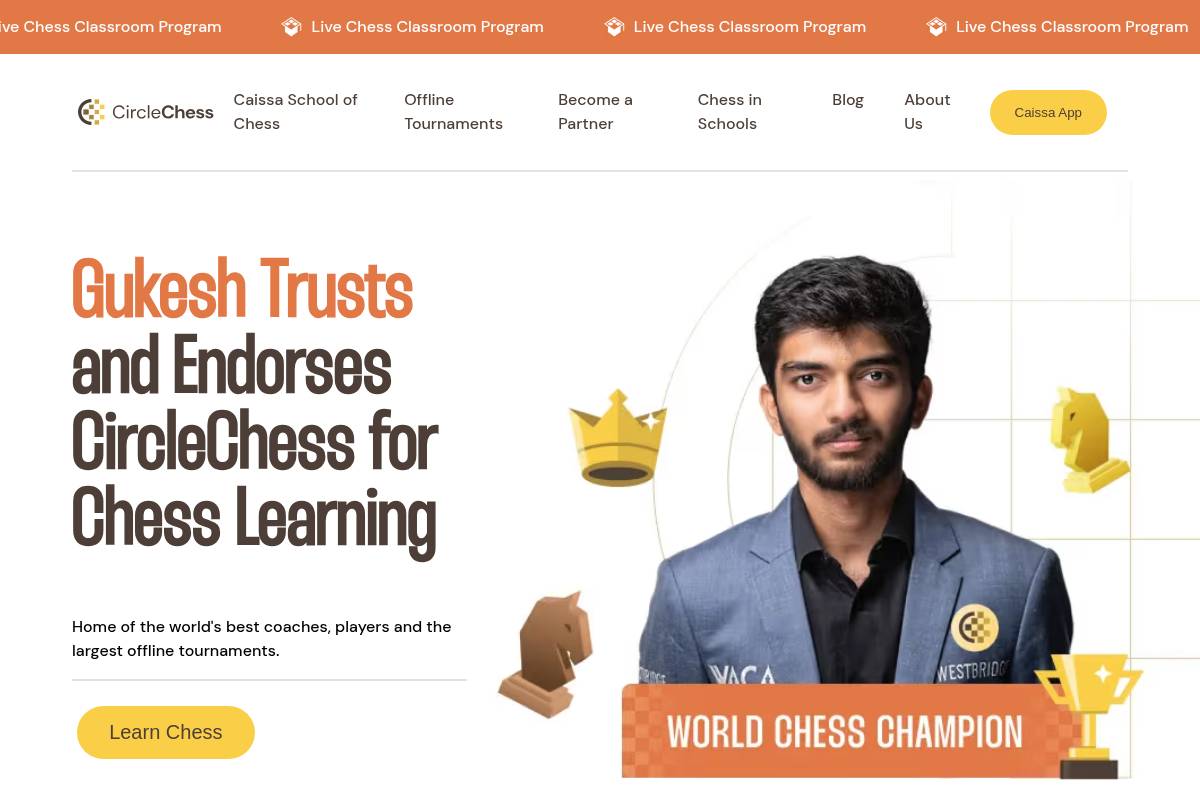
CircleChess offers a comprehensive, GM-designed online ecosystem with AI coaching. Founded by GM Vishnu Prasanna, former coach of World Champion Gukesh D, it runs live, instructor-led classes through its Caissa School of Chess at approximately $2 to $3 per hour for group instruction.
Key Features
- GM-Designed Curriculum: Built by GM Vishnu Prasanna, with a personalized learning roadmap based on each student's strengths, weaknesses, goals, and playing style.
- 24/7 AI Coach: An AI-powered chess coach available around the clock for practice, analysis, and guidance between live sessions.
- Structured Progression System: Levels, leagues, quests, and achievements, plus chess psychology and performance training built into every level.
- Parent Dashboard and Reporting: Real-time progress tracking, monthly skill assessments with growth reports, and mentor feedback with improvement plans.
- FIDE Rating Pathway: Milestone-based preparation plans and an official certification signed by World Champion Gukesh D upon completion.
- Community and Credibility: Endorsed by Hikaru Nakamura as Title Sponsor for the Hikaru-led American Gambits team in the Tech Mahindra Global Chess League, with a 9.5/10 satisfaction rating across 5,000+ families in 30+ countries.
Best For
CircleChess suits parents, including NRI families across time zones, who want live group classes, private coaching, self-paced AI tools, and tournament access in one place. It's especially strong for families who value measurable development and chess psychology.
Pros and Cons
- Pro: Group classes starting around $2 to $3 per hour deliver GM-designed instruction at a price far below most US scholastic academies.
- Pro: Combines live coaching, AI practice, psychology training, and a FIDE pathway, so you don't need multiple subscriptions.
- Pro: Strong authority signals, including the Vishnu Prasanna and Gukesh D lineage and the Hikaru Nakamura sponsorship connection.
- Con: Newer brand recognition in the US than decades-old local programs like Charlotte Chess Center.
- Con: A single trial class is less immersive than a full week of classroom exposure, so some programs offer a one-week refund policy instead of a single free demo.
Key Takeaway: CircleChess pairs GM-designed instruction with 24/7 AI coaching, structured progression, and strong credibility. It's a comprehensive, affordable choice for serious chess development at home.
Rating: 9.6/10
CircleChess: Home of the world's best coaches, players and the largest offline tournaments.
Gukesh Trusts and Endorses CircleChess for Chess Learning
2. Kingdom of Chess: Best for Live GM/IM Coaching with a Structured FIDE Pathway
2. Kingdom of Chess: Best for Live GM/IM Coaching with a Structured FIDE Pathway
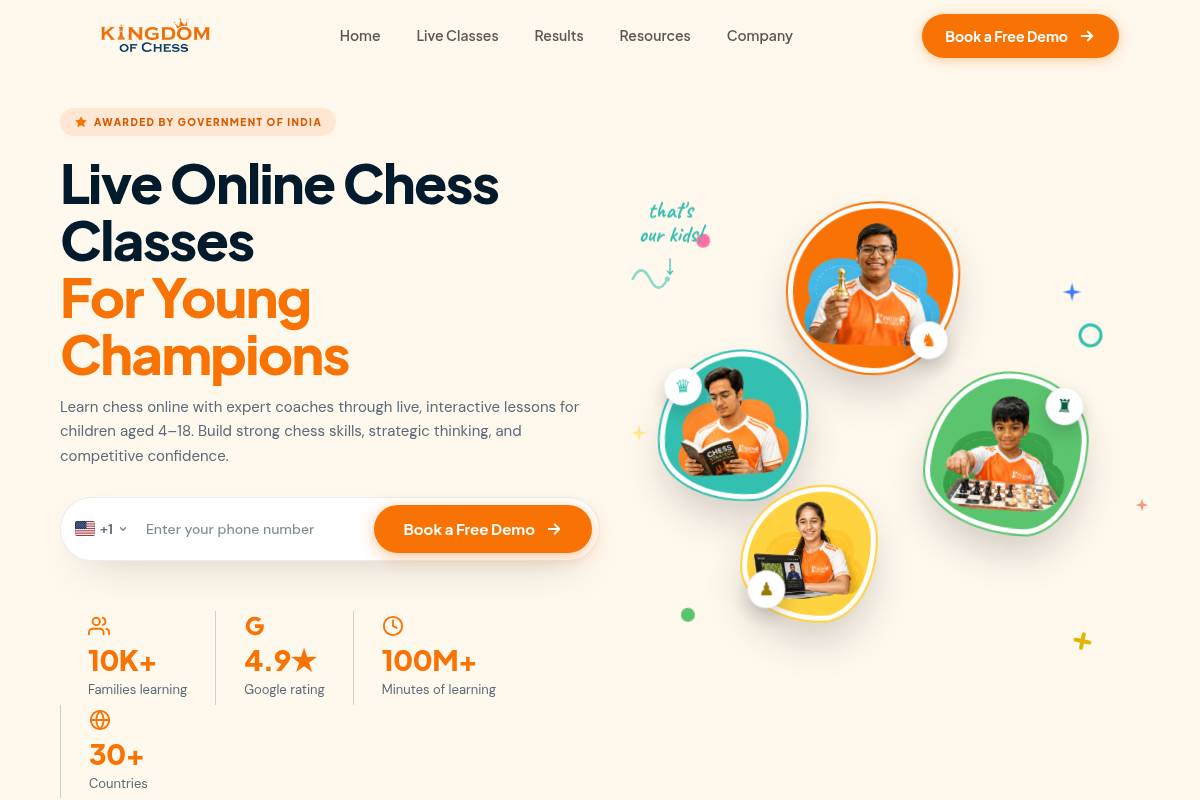
Kingdom of Chess is a live, coach-led online academy with a five-level curriculum built for competitive, FIDE-rating-focused development. It offers live instruction from titled coaches, including Grandmasters (GMs) and International Masters (IMs), on flexible schedules. FIDE, the International Chess Federation, governs international chess competitions.
Key Features
- Five-Level Structured Curriculum: A Pawn-through-King progression, with the King tier built for tournament and FIDE-rating goals.
- Titled Coaching Roster: Classes are taught by FIDE-certified coaches, including GM Diptayan Ghosh (FIDE 2577) and IM Sanket Chakravarthy (FIDE 2303).
- Live-Only Format: Every class is live, with small group sizes capped for individual attention.
- RISE Scholarships: A Rating Improvement Scholarship program for high-potential competitive players.
- Free Trial: A no-cost trial class, with regional pricing tiers rather than a single global fee.
Best For
Kingdom of Chess suits competitive families targeting FIDE rating milestones, especially those who prefer small, live-only classes. It fits intermediate to advanced students aged 8 and up.
Pros and Cons
- Pro: Live coaching at every level, with a dedicated competitive tier.
- Pro: RISE scholarships financially support talented players, a feature few competitors offer.
- Con: Pricing varies by country and program level, so families should use the free trial or call to confirm costs.
- Con: Less brand recognition in Western scholastic circles than established US academies.
Key Takeaway: Kingdom of Chess offers structured, live GM/IM coaching with a FIDE-focused curriculum, making it a strong choice for serious competitors.
Rating: 8.6/10
3. KCF Academy: Best for Elite GM Masterclasses with Kasparov Foundation Prestige
3. KCF Academy: Best for Elite GM Masterclasses with Kasparov Foundation Prestige
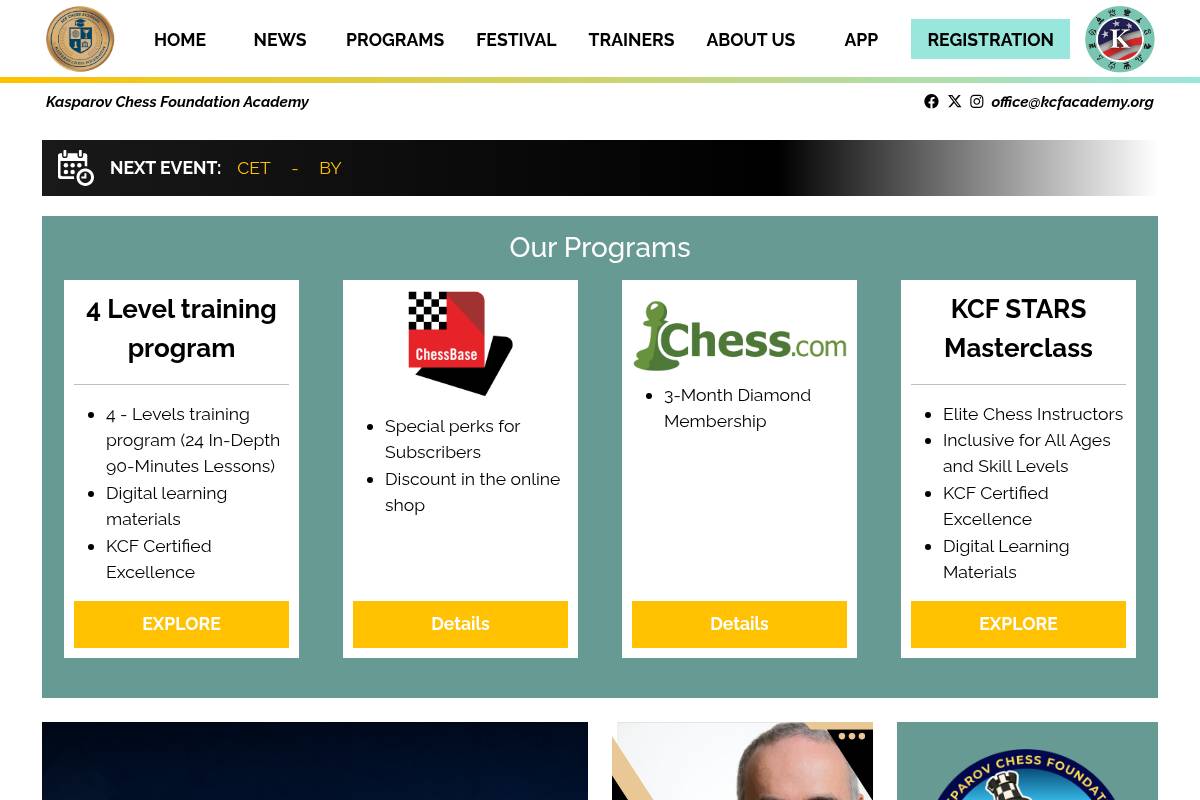
KCF Academy, run by the Kasparov Chess Foundation, is a subscription-based live online program with semester-length instruction across four skill levels. Its premium package includes Sunday Masterclasses featuring exclusive lectures by grandmasters like Garry Kasparov, Fabiano Caruana, and Levon Aronian.
Key Features
- Four-Level Structured Program: A six-month training journey for players rated 1400 and above, with weekly workshops and masterclasses.
- Celebrity GM Access: Students join Sunday Masterclasses with Garry Kasparov and other world-class grandmasters.
- Semester Packages: The Premium Package costs approximately $522 per semester and bundles recordings, app access, and a Chess.com Diamond membership.
- Certification: Graduates receive an official certificate from the Kasparov Chess Foundation.
Best For
KCF Academy is ideal for intermediate to advanced players (rated 1400+) who want the prestige of learning from Garry Kasparov's foundation and can commit to a semester-long schedule.
Pros and Cons
- Pro: Unmatched brand prestige, thanks to direct Kasparov Foundation involvement and guest grandmaster lectures.
- Pro: Structured, rating-gated levels ensure students are grouped appropriately.
- Con: Semester-based enrollment offers less flexibility than month-to-month platforms.
- Con: The 1400+ rating requirement for the main program makes it unsuitable for complete beginners.
Key Takeaway: KCF Academy offers elite, structured online coaching from grandmasters like Garry Kasparov, best suited to intermediate and advanced players ready for a semester-long commitment.
Rating: 8.4/10
4. Silver Knights Chess Academy: Best for US Scholastic Small-Group Live Classes
4. Silver Knights Chess Academy: Best for US Scholastic Small-Group Live Classes
Silver Knights Chess Academy, formerly Magnus Chess Academy, runs US-based scholastic programs built around small-group live lessons. It has taught chess to over 100,000 elementary and middle school students for more than 15 years, and it hosts online practice tournaments.
Key Features
- Small-Group Live Lessons: 55-minute weekly small-group lessons across seven skill levels, led by coaches including grandmasters and masters.
- National Reach: Students in all 50 states and internationally can enroll. In 2025, its students won more than 10 state championships.
- Elite Academy Tier: For advanced players rated 1400 to 2300, costing $189 per month with small groups coached by grandmasters.
- Bundled Extras: Membership includes a ChessKid Gold account, bonus tactics lessons, and camp discounts.
Best For
Silver Knights suits US scholastic families seeking a well-established program. Its mid-range price is around $109 per month, and a $5 trial class is available. It's a serious contender for parents who prioritize tournament results.
Pros and Cons
- Pro: A long track record, with over 100,000 students taught and multiple state championship wins.
- Pro: No long-term commitment, with month-to-month billing and an easy refund window.
- Con: Costs of $109 to $189 per month are significantly more expensive per hour than CircleChess group pricing.
- Con: No AI-powered personalization or 24/7 practice coach.
Key Takeaway: Silver Knights offers a proven scholastic program with small-group live lessons and a strong record of producing state champions.
Rating: 8.2/10
5. iChessU: Best for Direct Grandmaster Access and Flexible Private Lessons
5. iChessU: Best for Direct Grandmaster Access and Flexible Private Lessons
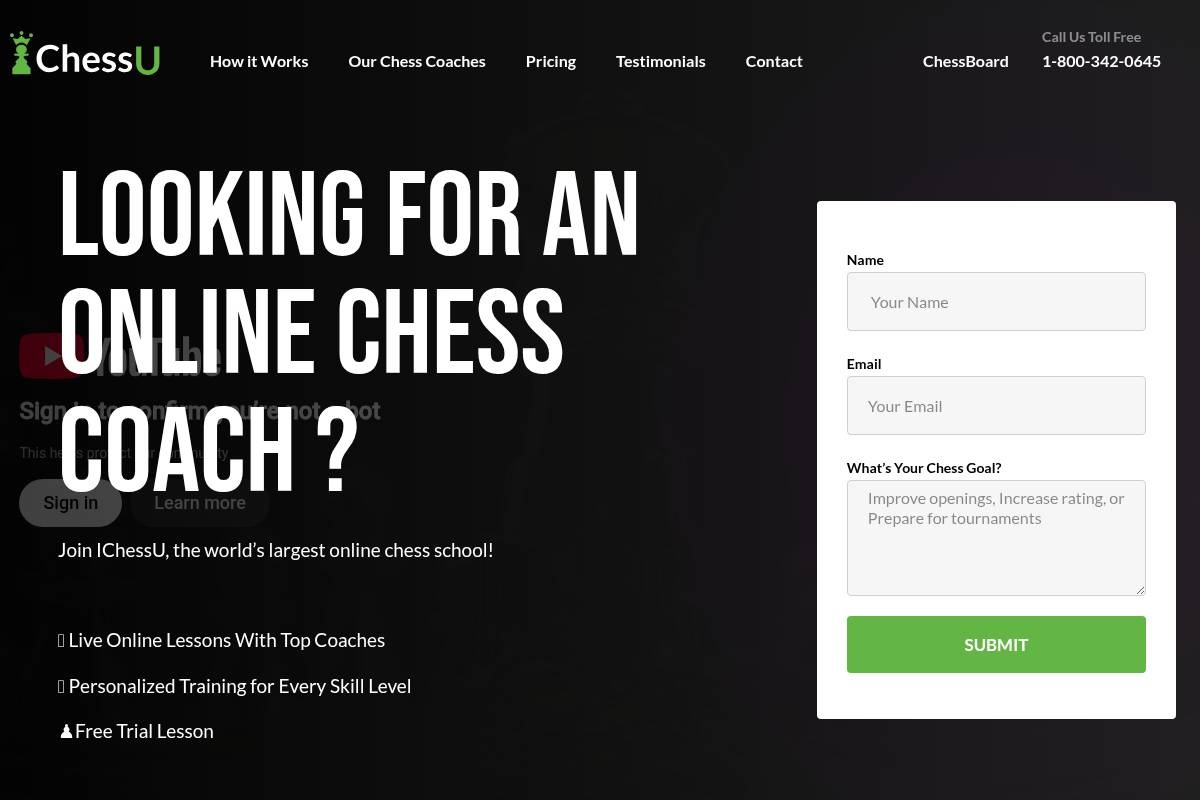
iChessU connects students directly with FIDE masters and grandmasters for private and group lessons. It sells tiered monthly packages starting at $45 per hour for 4 hours a month, with lower rates for longer commitments. See the full pricing on iChessU's website.
Key Features
- Tiered Hourly Packages: Pawn ($45/hr, 4 hrs/month), Knight ($40/hr, 8 hrs/month), and Rook ($35/hr, 12 hrs/month).
- Direct GM/FM Access: Titled players teach group and one-on-one formats.
- Free Trial Lesson: A complimentary evaluation lesson before committing to a paid plan.
- Multilingual Instruction: Coaches can teach in multiple languages, which suits international families.
Best For
iChessU is ideal for serious competitive students aged 8 and up who prioritize direct access to titled instructors over a general curriculum.
Pros and Cons
- Pro: Direct access to FIDE masters and grandmasters in flexible group or private formats.
- Pro: The free trial lesson lets you test coaching before committing.
- Con: Lessons with the most in-demand grandmasters can cost more than starting rates, and scheduling can be tricky.
- Con: No built-in AI practice tools, parent dashboard, or structured FIDE rating pathway.
Rating: 8.0/10
6. ChessMood: Best for Intermediate Players Seeking a GM Video Curriculum
6. ChessMood: Best for Intermediate Players Seeking a GM Video Curriculum
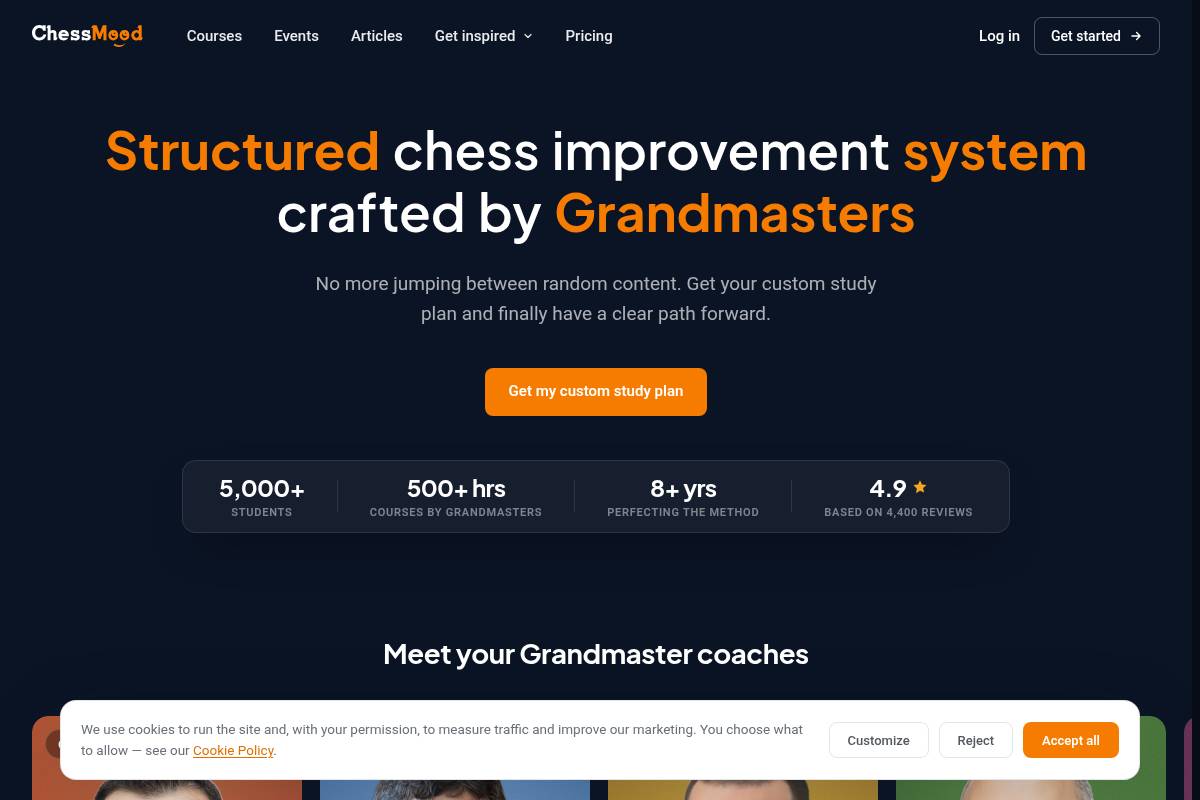
ChessMood is a self-paced platform built around grandmaster-recorded video courses. It offers over 500 hours of Grandmaster courses and a 30-day money-back guarantee on every paid plan. The Essential plan costs $79 per month and the Pro plan costs $99 per month, both billed yearly.
Key Features
- AI Game Analysis: The free Basic tier includes an AI coach that analyzes games to find strengths and weaknesses and builds a custom study plan from 500 hours of courses.
- Essential Plan: 500+ hour course library and 10,000+ training exercises at $79/month (annual billing).
- Pro Plan: Everything in Essential, plus weekly live training events with grandmasters, at $99/month (annual billing).
- GM-Authored Content: Courses by titled grandmasters covering openings, tactics, and strategy.
Best For
ChessMood suits intermediate to advanced self-directed learners, roughly 1200 to 2200 rated, who prefer video courses to live classes and don't mind a premium price.
Pros and Cons
- Pro: A high-quality GM-recorded library backed by a 30-day money-back guarantee.
- Pro: The AI coach and custom study plans are available even on the free Basic tier.
- Con: At $79 to $99 per month, one of the pricier subscription platforms here.
- Con: No live, structured instruction for young beginners; it's primarily video-based self-study.
Rating: 7.9/10
7. Chessable: Best for Opening and Tactics Memorization via Spaced Repetition
Chessable combines grandmaster courses with its MoveTrainer spaced-repetition system, which is designed to drill chess variations, openings, and tactics until they become second nature. It offers a free tier and a PRO membership at $11.99 per month or $74.99 per year.
Key Features
- MoveTrainer Spaced Repetition: A proven memorization system for opening lines, tactics, and endgame patterns.
- Large Course Marketplace: Courses from recognized titled authors, with free "Short & Sweet" trailers for PRO members.
- PRO Membership: $11.99 per month, $74.99 per year, or $114.99 for two years, unlocking offline access and deeper stats.
- Individual Course Purchases: Typically $20 to $100 one-time.
Best For
Chessable suits players rated around 1500+ who need an efficient way to memorize opening repertoires. It isn't designed for complete beginners and works best alongside live coaching.
Pros and Cons
- Pro: Spaced repetition is effective for long-term retention of openings and tactics.
- Pro: A large catalog from well-known grandmasters, with a 30-day money-back guarantee on courses.
- Con: The dense interface assumes fluent notation, making it a poor first app for true beginners, according to ChessDir.app.
- Con: No live coaching, parent dashboard, or FIDE pathway, and individual courses add up quickly.
Rating: 7.6/10
8. Remote Chess Academy: Best for Self-Paced Video Courses by a Titled Grandmaster

8. Remote Chess Academy: Best for Self-Paced Video Courses by a Titled Grandmaster
Remote Chess Academy is an online platform founded by Grandmaster Igor Smirnov to offer self-paced video courses worldwide. Rather than a flat subscription, it sells individual courses and bundles such as the RCA Beginners Package and GM Igor Smirnov's Super Pack.
Key Features
- GM-Taught Video Courses: Comprehensive courses covering openings, middlegame strategy, calculation, and endgames, taught exclusively by GM Igor Smirnov.
- Course Bundles: Packages like the Super Pack combine multiple courses at a discount.
- Large Audience: The Remote Chess Academy YouTube channel surpassed 970,000 subscribers as of late August 2026.
- Lifetime Access: One-time purchases give lifetime access with no recurring fees.
Best For
Remote Chess Academy is ideal for self-motivated intermediate to advanced players who prefer recorded video from one trusted grandmaster over live group classes.
Pros and Cons
- Pro: Focused instruction from a single credentialed grandmaster, backed by a large following.
- Pro: One-time purchases avoid recurring subscription fees.
- Con: No live coaching, parent dashboard, or interactive feedback, since the platform is entirely self-paced video.
- Con: Courses and bundles range from $100 to $1,000, making full-coverage costs hard to predict.
Rating: 7.3/10
9. ChessTempo: Tactical Puzzle Training and Endgame Drilling
ChessTempo is a specialized platform known for its extensive tactics database and endgame exercises. It offers unlimited free tactics, and paid tiers unlock custom problem sets, spaced repetition, and cloud analysis.
Key Features
- Massive Tactics Database: Over 110,000 tactics problems drawn from real games, free and unlimited for every member.
- Spaced-Repetition Repertoire Trainer: Build and train opening repertoires with up to 20,000 positions using spaced repetition, an evidence-based technique for long-term retention.
- Endgame Training: Thousands of endgame positions from actual games, with daily limits removed for paid subscribers.
- Tiered Pricing: Silver at $3/month or $20/year, scaling up to Gold and Diamond tiers for cloud engine access and deeper analysis.
Best For
ChessTempo is a low-cost supplement for players who need high-volume tactical and endgame drilling. It pairs well with a coach or curriculum.
Pros and Cons
- Pro: An extensive free tactics collection, among the largest and most affordable available.
- Pro: Advanced custom problem sets and spaced repetition at a very competitive price.
- Con: The interface prioritizes function, which can feel overwhelming for beginners who get little guidance.
- Con: No live coaching, curriculum, or parent reporting. It's purely a self-practice tool.
Key Takeaway: ChessTempo is an affordable, high-volume practice tool for tactics and endgames, best used to supplement existing instruction.
Rating: 7.1/10
10. Aimchess: Best for Data-Driven AI Weakness Analysis
10. Aimchess: Best for Data-Driven AI Weakness Analysis
Aimchess is an AI analytics tool that connects to a player's Chess.com or Lichess account. It scores play across core skills, showing exactly where rating is lost and generating drills. Premium pricing is $7.99 per month, or $4.85 per month billed annually.
Key Features
- Automated Weakness Reports: Surfaces percentile rankings across tactics, openings, and endgames from your game history.
- Platform Integration: Pulls game data automatically from Chess.com and Lichess.
- Personalized Drills: Custom puzzle sets aimed at your recurring mistakes.
- Freemium Model: The free version allows one 40-game analysis report per month, a weekly personalized study plan, and unlimited studies.
Best For
Aimchess works best as a supplementary analytics layer for players rated roughly 1000 to 1800 who already play online regularly and want to know exactly where they're losing rating points.
Pros and Cons
- Pro: Very affordable at under $8 per month, with a genuinely useful free tier.
- Pro: Quantified weakness percentiles make it clear what to practice next.
- Con: It reports after the fact rather than coaching in real time, and it isn't a coach that talks you through your moves.
- Con: No live instruction, curriculum, or child-specific safety features. It's strictly an analytics supplement.
Rating: 7.0/10
Full Comparison: Charlotte Chess Center Alternatives for Online Chess Coaching
The table below compares all ten platforms side by side for a quick reference.
| Platform | Live Coaching | AI Tools | FIDE/USCF Pathway | Parent Dashboard | Free Trial | Starting Price |
|---|---|---|---|---|---|---|
| CircleChess | ✓ | ✓ | ✓ | ✓ | ✓ (Free demo) | ~$2-3/hr |
| Kingdom of Chess | ✓ | ✗ | ✓ | ✗ | ✓ | Regional, varies |
| KCF Academy | ✓ | ✗ | ✗ | ✗ | ✗ | ~$522/semester |
| Silver Knights Chess Academy | ✓ | ✗ | ✓ | ✗ | ✓ ($5 trial) | $109/month |
| iChessU | ✓ | ✗ | ✗ | ✗ | ✓ (Free lesson) | $35-45/hr |
| ChessMood | ✗ | ✓ | ✗ | ✗ | ✓ (Free tier) | $79/month |
| Chessable | ✗ | ✗ | ✗ | ✗ | ✓ (Free tier) | $11.99/month |
| Remote Chess Academy | ✗ | ✗ | ✗ | ✗ | ✗ | $97+ per course |
| ChessTempo | ✗ | ✗ | ✗ | ✗ | ✓ (Free tier) | $3/month |
| Aimchess | ✗ | ✓ | ✗ | ✗ | ✓ (Free tier) | $7.99/month |
How to Choose the Right Online Chess Coaching Platform
By Family Size and Age
For a young beginner (ages 5 to 8), CircleChess's free demo and $2-3/hr group pricing offer the lowest-risk start. Kingdom of Chess and Silver Knights provide similar live structure at higher monthly rates. For multiple children, group formats from CircleChess, Silver Knights, or iChessU spread the cost across each child.
By Budget
Under $15 a month, ChessTempo, Chessable PRO, and Aimchess are the cheapest supplements, though none includes live coaching. At $2 to $3 per hour, CircleChess offers the strongest mix of live GM-designed instruction and AI support. For $79 to $150 a month, ChessMood and KCF Academy provide deeper video libraries or masterclass access for players past the beginner stage.
By Use Case
For a complete beginner's first lessons, start with CircleChess's free demo. For FIDE-focused competitive development, Kingdom of Chess and CircleChess both offer milestone-based pathways. To supplement an existing coach with tactics drilling, pair any live platform with ChessTempo or Aimchess. For self-paced opening study, Chessable is the specialist pick.
What Is Online Chess Coaching?
Online chess coaching is structured instruction delivered through video calls, learning platforms, or AI tools instead of a physical classroom. It spans live group classes, private lessons with titled coaches, self-paced video courses, and AI tools that review completed games. According to the Global Online Chess Instruction Market Report 2026, guided coaching produces 167% better rating improvement than self-study alone, and online chess instruction is valued at $270 million in 2026 and projected to reach $860 million by 2035.
| Metric | Data Point |
|---|---|
| Market size (2026) | $270 million, growing at a 13.13% CAGR toward $860 million by 2035 |
| Coached vs. self-study improvement | 167% better rating gains with coached instruction |
| Typical rating gain (6 months, coached) | ~120 FIDE rating points vs. ~45 for self-taught learners |
| Private lesson rates (US, online) | $20/hr (untitled) to $150+/hr (Grandmaster) |
| Academic impact | Meta-analysis of 24 studies shows math achievement effect size d=0.38 |
Peer-reviewed research supports the academic case too. A landmark 2025 study published in Frontiers in Psychology found significant improvements in attention, memory, logical thinking, patience, self-discipline, mathematics scores, and reading scores among children receiving chess instruction. A broader meta-analysis of 24 studies found that chess instruction enhances primary and middle school students' achievement in mathematics (d = 0.38) and overall cognitive ability (d = 0.34).
Conclusion: Which Charlotte Chess Center Alternative Should You Choose?
After evaluating all ten platforms, our top recommendation among Charlotte Chess Center alternatives for online chess coaching at home in 2026 is CircleChess. Built by a World Champion's coach, it combines group classes at roughly $2 to $3 per hour with a 24/7 AI coach, chess psychology training, and a FIDE rating pathway in one ecosystem. For families chasing competitive FIDE milestones, Kingdom of Chess is a strong alternative. For US families who want a long-established scholastic brand, Silver Knights Chess Academy delivers proven results. For players who already have a coach and need tactics drilling, ChessTempo or Aimchess round out a well-balanced training stack.
Frequently Asked Questions
What are the best Charlotte Chess Center alternatives for online chess coaching at home in 2026?
The strongest alternatives include CircleChess, Kingdom of Chess, KCF Academy, Silver Knights Chess Academy, iChessU, ChessMood, Chessable, Remote Chess Academy, ChessTempo, and Aimchess. The right pick depends on your child's age, budget, and competitive goals.
How does CircleChess compare to Charlotte Chess Center?
CircleChess offers live, GM-designed group classes at roughly $2 to $3 per hour, a 24/7 AI coach, and a FIDE rating pathway, all delivered online with multi-timezone scheduling. Charlotte Chess Center's classes are strong locally in both in-person and online formats, but CircleChess is built as a fully remote ecosystem for families who can't easily reach a physical location.
Is online chess coaching as effective as in-person lessons?
Research on structured chess instruction shows measurable cognitive and academic benefits regardless of delivery format. Online lessons often match or exceed in-person quality for children aged 10 and up, thanks to instant game analysis and access to world-class grandmasters. For children under 10, some experts prefer in-person instruction for focus, though strong live online programs close much of that gap.
How much does online chess coaching cost for kids in 2026?
Self-paced subscriptions run $4 to $15 per month, budget live group classes run $2 to $3 per hour, mid-tier small-group programs run $89 to $99 per month, and private lessons with titled coaches range from $20 to $150+ per hour.
CircleChess vs Charlotte Chess Center: which is better for NRI parents?
CircleChess is built with multi-timezone scheduling, a parent dashboard, and a curriculum designed by GM Vishnu Prasanna (coach of World Champion Gukesh D), making it a strong fit for NRI families across countries and time zones. Charlotte Chess Center's online classes suit families anchored to US Eastern Time but offer less flexibility for globally spread households.
What age should my child start online chess coaching?
Most structured programs welcome students from age 5 upward, and research shows chess classes can meaningfully improve executive function skills even in children as young as five or six. Children who start at 8, 10, or 12 can still progress quickly with consistent, structured instruction.
Can online chess coaching help my child reach a FIDE or USCF rating?
Yes. Platforms with built-in tournament pathways, such as CircleChess and Kingdom of Chess, turn classroom learning into official rating points through milestone-based preparation. Data shows students in structured coaching gain significantly more rating points over six months than self-taught learners.