
Offline vs Online Chess Academy: Which Is Better for Your Child in 2026? Updated May 31, 2026 | Author: Chess Education Expert Panel
Quick Summary
Choose an offline chess academy if your child thrives with hands-on, in-person guidance and needs a structured learning environment where they can develop physical board experience—essential for tournament play. Choose an online chess academy if your family values flexible scheduling, lower costs, access to world-class coaches regardless of where you live, and wants to leverage AI-powered game analysis. The real difference comes down to this: offline academies give you direct mentorship and help kids develop crucial over-the-board skills, while online academies connect you with top talent globally and offer powerful tech-driven learning tools, often at a fraction of the cost.
At a Glance: Offline vs Online Chess Academy
| Criteria | Offline Chess Academy | Online Chess Academy | Better For |
|---|---|---|---|
| Cost | $30-$250/hour | $15-$150/hour | Online for budget-conscious families |
| Flexibility | Fixed schedule, travel required | 24/7 access, no travel | Online for busy schedules |
| Personal Interaction | Face-to-face coaching | Video calls, limited physical cues | Offline for younger children |
| Technology Tools | Physical boards, basic analysis | AI analysis, interactive platforms | Online for advanced analytics |
| Tournament Preparation | Over-the-board practice | Digital board training | Offline for competitive players |
| Peer Interaction | In-person group dynamics | Online forums, virtual games | Offline for social learning |
| Coach Access | Local instructor pool | Global expert access | Online for elite coaching |
| Focus Development | Structured classroom environment | Self-discipline required | Offline for attention challenges |
| Progress Tracking | Manual assessment | Automated analytics | Online for data-driven improvement |
What Is an Offline Chess Academy?
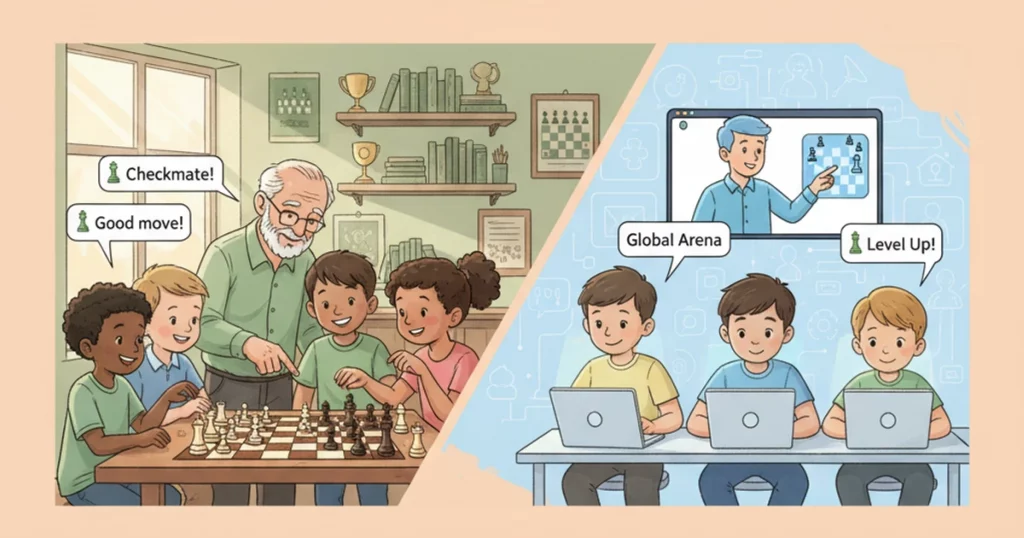
An offline chess academy is a traditional learning center—think dedicated facility, school program, or chess club—where children learn in person under the direct supervision of coaches. They work with physical boards and pieces, watch live demonstrations, play against peers in the room, and get immediate feedback. It’s straightforward and structured, much like a conventional classroom.
These academies focus on hands-on learning and developing over-the-board skills—the practical abilities you need to play on a real board in competition. This includes board visualization, how to handle pieces properly, and managing a chess clock. All of these matter when it comes time for official tournaments.
What Is an Online Chess Academy?
An online chess academy delivers instruction remotely through digital platforms. You connect with coaches and other students via video, use interactive software and virtual boards, and learn from home. The real advantage? You’re not limited to local talent. These academies tap into a global pool of instructors, which means you might work with someone who’s competed at the highest levels, even if they’re on another continent.
By 2026, online learning has become genuinely effective because of instant AI-powered game analysis, screen sharing for complex puzzles, and access to elite coaches who may not exist in your area. Modern platforms offer interactive digital boards, automated progress tracking, and a suite of learning tools that simply didn’t exist a decade ago.
Key Differences: Offline vs Online Chess Academy
Learning Environment and Focus
Offline chess academies create a structured environment designed to minimize distractions. When students train together in the same room, there’s a palpable shift in commitment. Coaches can read the room, notice when someone’s losing focus, and step in immediately. The immersive atmosphere itself encourages deeper concentration and higher levels of seriousness.
Online chess academies demand more self-discipline from students. Yes, screen time is a valid concern—especially for younger kids—but modern platforms use gamification and interactive elements to keep engagement high. The trade-off? Students who succeed online develop independence and personal responsibility, skills that extend well beyond chess.
Better for: Offline works better for children under 10 or those who struggle with attention. Online suits self-motivated students who appreciate flexible scheduling.
Quality of Instruction and Coach Access
Offline chess academies are limited by whoever teaches in your area. That said, in-person interaction has real value. Coaches can read body language, observe thinking patterns, and provide nuanced feedback that’s harder to deliver through a screen. Many instructors report that their impact runs deeper face-to-face.
Online chess academies break geography wide open. You can work with grandmaster-level instruction from anywhere. A serious student in a small town can access the same elite coaching as someone in a major chess hub. This global access to diverse, world-class expertise dramatically expands what’s possible for your child’s development.
Better for: Online excels at connecting you with elite, specialized coaches. Offline is better when personalized mentorship and reading non-verbal cues matter most.
Cost and Value Proposition
Offline chess academies carry higher overhead—maintaining a physical space, equipment, utilities. Add in your family’s travel time and transportation costs, and expenses climb quickly. Private lessons typically run $30 to $250 per hour. These operational costs get passed along in tuition, sometimes significantly.
Online chess academies generally cost less. Private lessons range from $15 to $150 per hour, with monthly programs between $50 and $300. The real question isn’t just the hourly rate—it’s the value you get. A program with grandmaster-designed curriculum and proven student outcomes often delivers better long-term results, helping kids improve faster and understand the game more deeply.
Better for: Online wins on affordability, especially when you factor in transportation savings. Offline is better if you’re prioritizing in-person attention and cost isn’t the primary concern.
Tournament Preparation and Practical Skills
Offline chess academies excel here because they offer extensive over-the-board practice—playing on actual boards under tournament conditions. This hands-on training is irreplaceable for competitive players. Kids develop physical board visualization and time management skills that matter when they’re sitting across from an opponent in a real tournament.
Online chess academies focus on digital analysis and pattern recognition. They use simulated matches and digital boards for training, which builds strategic understanding. But here’s the catch: training exclusively on digital boards leaves some gaps when it comes to the unique pressures and visual adjustments of playing on a physical board.
Better for: Offline is essential for serious tournament competitors. Online is excellent for strategic development and casual competitive play.
Technology Integration and Modern Tools
Offline chess academies rely on traditional methods—physical boards and manual analysis. Some modern academies have added basic computer analysis, but technological integration remains limited.
Online chess academies are built on technology. Artificial intelligence drives personalized training—studies show about 68% of users rely on AI-assisted tutorials. Interactive boards, game analysis software, and digital resources make learning more effective. Students get data-driven feedback and precise progress tracking that would be impossible to maintain manually.
Better for: Online is better for students who want data-driven improvement and access to cutting-edge tools. Offline is better for a traditional approach focused on fundamental skills.
Social Interaction and Peer Learning
Offline chess academies create natural social dynamics. When a group of motivated players trains together, there’s an energy that’s hard to replicate. Kids learn from watching their peers play, picking up strategies and approaches they might not have considered. Plus, they develop social skills alongside chess competency.
Online chess academies build community differently—through forums, group video sessions, and online tournaments. Students interact with learners from around the world, which brings fresh perspectives and diverse playing styles. These connections foster motivation and help kids develop good sportsmanship and adaptability in a global context.
Better for: Offline is better for developing natural social skills through in-person learning. Online is better for connecting with a global community and experiencing different approaches to the game.
Age Appropriateness and Learning Styles
Offline chess academies tend to work better for younger children (ages 5-9) who benefit from structure and physical guidance. At this age, hands-on instruction helps build foundational discipline and attention span. Coaches can provide immediate, personalized guidance that builds focus and basic understanding.
Online chess academies suit older children and teenagers who can manage independent learning. School-age kids often appreciate the flexibility—no travel time means more time for academics and other interests. Through structured online programs, young learners develop advanced skills from home, with engaging tools that keep learning both fun and challenging.
Better for: Offline is better for children under 10 needing structured, hands-on guidance. Online is better for independent learners aged 10 and up who want flexibility and advanced tools. For a more detailed feature breakdown, see Online vs Offline Chess for Kids: Benefits and Growth.
Cost Comparison
| Service Type | Offline Academy | Online Academy |
|---|---|---|
| Private Lessons | $30-$250/hour | $15-$150/hour |
| Group Classes | $15-$75/session | $10-$60/session |
| Monthly Programs | $120-$400/month | $50-$300/month |
| Additional Costs | Transportation, materials | Equipment, internet |
The numbers tell a clear story: online learning costs less. Online lessons average around $25 per hour (ranging $15-$150), while in-person teaching averages approximately $60 per hour ($30-$250). Group lessons offer budget-friendly options in both formats, typically $10-$60 per session. When you factor in transportation time, fuel, and materials, online academies deliver better overall value for most families, offering quality instruction at significantly lower prices. For independent pricing analysis, see How Much Do Chess Lessons Cost in the US?.
Who Should Choose an Offline Chess Academy?
- Young children (ages 5-9): Offline works best for younger students who benefit from hands-on guidance and structured classroom environments as they develop logical thinking skills.
- Tournament-focused competitive players: If your child is serious about competitions, offline is essential for physical board experience and face-to-face coaching on tournament strategy.
- Children with attention difficulties: A structured offline environment with immediate teacher intervention helps maintain focus and engagement when a child struggles to concentrate.
- Families prioritizing social interaction: Choose offline if your child thrives in group settings and benefits from the dynamic energy of learning alongside peers in person.
Who Should Choose an Online Chess Academy?
- Busy families with scheduling constraints: Online offers unmatched flexibility, with many platforms providing personalized coaching 24/7 that adapts to your family’s schedule.
- Students seeking elite coaching: Online is perfect for ambitious players who want grandmaster-level instruction. Geography no longer limits your options.
- Budget-conscious families: Online costs significantly less due to lower lesson rates and zero transportation expenses, making quality chess education more accessible.
- Self-motivated older students (10+): Online suits independent learners who are comfortable with digital platforms and can maintain focus during virtual sessions.
Can You Combine Both?
Many families find that a hybrid approach works best. Attend weekly offline group sessions for social practice and in-person energy, then supplement with online lessons for specialized topics and personalized analysis. This model combines the direct mentorship of offline coaching with the technological advantages of online learning, giving kids the best of both worlds.
Research on AI-assisted training shows that this hybrid model actually accelerates improvement faster than either approach alone. By 2026, this has become standard practice. The magic happens when AI’s analytical power meets human coaching’s empathy: the AI identifies weak spots and prescribes targeted exercises, while human coaches provide motivation and contextual teaching. This combination lets students benefit from face-to-face mentorship while accessing advanced technology and global expertise.
A practical hybrid schedule might look like weekly offline group classes for social interaction, supplemented with private online lessons for advanced tactics and personalized game review. Many chess academies now offer blended programs that leverage the unique strengths of both formats. For hybrid-approach guidance, see Do you prefer online chess, offline, or a mix of both?.
Final Verdict: Offline vs Online Chess Academy
The consensus among chess educators today is that a hybrid approach works best. Combining grandmaster methodology with AI-powered tools creates a more complete coaching experience than either alone. But if you’re choosing a primary format, the decision depends on your child’s age, learning style, and your family’s circumstances. There’s no perfect choice that works for every child.
Younger children and serious tournament competitors typically benefit from offline academies’ structured, hands-on environment. Older, self-motivated students can leverage online platforms’ flexibility, affordability, and global expertise. The most successful chess students in 2026 often combine both approaches into a customized learning plan—using offline sessions for foundational skills and social play while tapping online platforms for advanced analysis, specialized coaching, and flexible practice.
FAQ
Is offline better than online chess academy?
Neither is universally better—it depends on your specific situation. Offline academies work better for young children under 10 who need structure, competitive players preparing for tournaments, and kids who thrive on social learning. Online academies offer greater flexibility, lower costs, and access to elite global coaches. The right choice depends on evaluating your child’s age, learning style, and goals.
Can I do both offline and online chess learning?
Absolutely—and it’s highly recommended. This hybrid model combines the benefits of online coaching (AI analysis, top coaches, flexibility) with offline advantages (in-person mentorship, tournament practice). Many successful chess academies now offer integrated hybrid programs that give students a well-rounded learning path.
Which is better for beginners?
For very young beginners (ages 5-7), offline classes often work better because personal guidance helps build focus and basic board understanding. For older beginners, both formats can work well. The critical factor isn’t the format but the quality of instruction. Research shows that guided coaching delivers 167% better rating improvement than self-study.
Are online chess lessons as effective as offline lessons?
Yes, and in many cases they’re more effective. Online lessons offer instant game analysis, screen sharing for puzzles, and access to top coaches regardless of location. The integration of AI analysis can lead to 3x faster improvement, helping students reach rating milestones in months instead of years.
What are the cost differences between offline and online chess academies?
Online academies are significantly cheaper. Online lessons typically cost $15-$150 per hour, while in-person teaching ranges from $30-$250 per hour. When you eliminate travel costs and time, online academies can save 20-40% compared to offline options.
How do I choose the right chess academy for my child?
Start by considering your child’s age, learning style, schedule, and chess goals. Verify instructor credentials, review the curriculum, and ask about safety measures. Most reputable academies offer trial sessions—use them to see if the teaching style and environment fit your child before committing.
Methodology: This analysis evaluated offline and online chess academy formats through comprehensive research of instructional methods, cost structures, student outcomes, and expert opinions from January-May 2026. Assessment included analysis of pricing from 15+ chess academies, instructor qualification verification, curriculum review, and evaluation of peer-reviewed studies on chess education effectiveness. Individual results may vary based on student commitment, chosen academy, and learning approach.