Updated June 5, 2026 | 8-minute read | Author: Digital Safety Research Team
Is online chess coaching safe for kids? Yes, with proper precautions in place. The best platforms combine verified instructor credentials, comprehensive safety protocols, and structured learning progression to create secure educational environments that transform chess from casual play to serious skill development.
For parents managing chess screen time concerns, research shows that interactive, educational screen activities like online chess coaching can actually support cognitive development, unlike passive screen consumption that correlates with attention deficits. This distinction matters enormously when you’re deciding whether to approve yet another screen activity.
The difference in learning outcomes is striking—guided coaching delivers 167% better rating improvement than self-study alone, and this gap grows wider the younger a student starts. That’s not just a marginal improvement. It’s the difference between a child who dabbles and one who genuinely progresses.
“The 2026 AAP guidance makes one thing very clear. Dr. Milkovich stresses that parents must offer children engaging, structured alternatives to replace screen time, not simply attempt to cut screens out in a vacuum.” Chess solves this problem because it fills the behavioral void that passive restriction cannot.
Essential Safety Measures: What Parents Must Verify Before Enrollment
The foundation of safe online chess coaching rests on three non-negotiable safety pillars: verified instructor credentials with official FIDE ratings and coaching certifications, mandatory background checks, and monitored communication channels that protect children during learning sessions.
Since most students are under 14, parents must prioritize academies with a multi-layered safety approach. This means treating the service as a comprehensive childcare environment, not just game instruction, by focusing on platforms that offer background-checked instructors, monitored communication, robust parental controls, and age-appropriate content filtering. You wouldn’t let a stranger tutor your child in your home without vetting them thoroughly—online learning deserves the same rigor.
Instructor Background Verification Requirements
Quality platforms require instructors to have verifiable FIDE ratings of at least 1800+ (USCF) or 2000+ (FIDE), formal coaching certifications like FIDE Developmental Instructor (DI) or higher, and several years of documented teaching experience. The most secure environments go beyond these basic qualifications to ensure child safety.
- Enhanced background checks: Leading platforms like Mindful Chess ensure all tutors pass Enhanced DBS checks. An Enhanced DBS (Disclosure and Barring Service) check is a comprehensive criminal record and barring check for individuals working with children, particularly in the United Kingdom.
- FIDE verification process: Parents should verify instructor credentials using the FIDE (International Chess Federation) database directly, confirming official ratings, formal coaching certifications, and background check status before considering any platform.
- Teaching experience documentation: Reputable platforms provide evidence that tutors have years of experience teaching children specifically, not just general chess instruction experience.
- Ongoing safety protocols: Premier academies implement screening and background checks for all coaches as standard practice, creating safe environments specifically designed for children.
| Safety Feature | Essential Level | Premium Level | Red Flag |
|---|---|---|---|
| Background Checks | Basic criminal check | Enhanced DBS/FBI clearance | No verification mentioned |
| Instructor Verification | FIDE rating visible | Direct FIDE database links | Unverifiable credentials |
| Communication Monitoring | Session recordings | Live moderation + AI detection | Unrestricted private chat |
| Parental Controls | Basic access controls | Real-time monitoring dashboard | No parent oversight tools |
“Before you even think about curriculum or teaching style, your child’s safety must come first. This isn’t about being paranoid—it’s about being a responsible parent. You’re inviting a stranger into a virtual room with your child, sometimes for an hour at a time. That deserves serious scrutiny.”
Key Takeaway: Prioritize platforms with verified instructor credentials, child-safe environments with background-checked coaches, structured curriculum designed for young learners, and robust progress tracking tools, ensuring that communication monitoring, parental controls, and clear safety reporting systems are standard, non-negotiable features. When you’re ready to move beyond these safety foundations, screen time quality becomes the next critical consideration. For deeper context, see Cyber Threats: Protect Your Child While Playing Chess ….
Managing Chess Screen Time: Creating Healthy Digital Learning Habits
The quality of screen time matters as much as the quantity. For children aged 5 to 8, 60% of media use consists of pure television and video viewing, while 26% involves gaming. However, chess occupies a distinct category as active, interactive screen time that requires cognitive engagement. Your child’s brain is working, not passively receiving content.
The American Academy of Pediatrics officially abandoned its two-hour daily screen time limit for school-aged children in February 2026, replacing it with a quality-based framework focused on the nature of screen use rather than minutes. This shift reflects what child development researchers have known for years: not all screen time is created equal.
Active vs. Passive Screen Time in Chess Learning
The 2026 Baumgartner systematic review explicitly categorizes screen time by interaction level. Passive screen time is a type of media consumption that requires no cognitive input, where the screen dictates the pace and the brain just receives information. In contrast, active screen time requires users to hold rules in working memory, analyze changing variables, anticipate future states, and make decisions that change the digital environment—a perfect description of playing chess.
- Structured session timing: A consistent, structured session of 30 to 60 minutes daily is recommended to ensure sustained mental engagement and cognitive benefits without overwhelming young learners.
- Optimal lesson duration: Most effective online chess sessions last 45-60 minutes, a duration that maintains focus without burnout, though younger children benefit from 15-20 minutes of attentive play as a refreshing alternative to longer sessions.
- Balance with offline practice: The most successful students use a balanced approach, combining 15 minutes of daily puzzle-solving apps with structured live coaching for deep, conceptual learning.
- Replacement strategy: Rather than simply restricting device time, parents should replace passive screen time with structured chess play that maintains engagement while building valuable cognitive skills.
| Age Group | Recommended Session Length | Weekly Frequency | Focus Areas |
|---|---|---|---|
| Ages 5-7 | 15-30 minutes | 2-3 sessions | Basic rules, piece movement |
| Ages 8-10 | 30-45 minutes | 2-4 sessions | Tactical patterns, short games |
| Ages 11-14 | 45-60 minutes | 3-5 sessions | Strategy, tournament prep |
| Ages 15+ | 60+ minutes | 4-7 sessions | Advanced concepts, rating goals |
Screen Time Quality vs. Quantity Framework
Current data shows children aged 8 to 12 average 5 hours and 33 minutes of screen time daily globally, while teenagers average 8 hours and 39 minutes. This is a significant disconnect from parental preferences, as parents believe the ideal limit is 9 hours per week while children actually receive 21 hours—more than double the preferred amount. The gap between what parents want and what actually happens is real, and it’s worth acknowledging.
Key Takeaway: Chess teaches planning, consequence-thinking, and patience in ways no app can replicate, serving as the sharpest possible antidote to passive screen consumption while delivering cognitive benefits (focus, memory, pattern recognition), emotional benefits (resilience, patience), and social benefits (sportsmanship, peer interaction) in one activity children genuinely want to continue playing. Understanding these communication safeguards helps parents feel confident their child can interact safely while learning. For deeper context, see Screen Time Management for Online Chess Students.
Platform Security Features: Communication Controls and Monitoring Tools
Modern chess platforms provide controlled communication channels, ensuring kids can interact safely with peers and instructors. These systems are designed to eliminate safety concerns by preventing interactions with strangers through comprehensive monitoring systems.
Reputable platforms like CircleChess and ChessKid implement comprehensive safety measures including background-checked instructors, monitored communication, parental controls, and secure learning environments that prioritize child safety through various protective features.
Communication Safeguards and Content Filtering
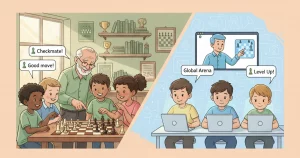
The most secure platforms give parents and coaches full control with easy activity monitoring, preventing free chat for children who can only choose predefined text responses like “Good move,” “Thanks,” “Good luck,” “Hi,” “Good game,” “Sorry,” “Oops,” and “Interesting.” This might sound restrictive, but it eliminates the risk of inappropriate contact entirely.
- Real-time moderation systems: Advanced platforms scan messages, images, and content for more than 29 inappropriate or harmful themes, sending parents real-time alerts when risks are detected.
- Restricted communication channels: Platforms implement strict username policies with 24-48 hour evaluation periods, protecting kids from inappropriate content and interactions through comprehensive content moderation.
- AI-powered monitoring: Leading safety systems use AI to analyze chats and digital content across platforms in real time, detecting early warning signs and recognizing patterns like gradual trust-building behavior rather than just scanning for keywords.
- Parental dashboard access: Quality platforms provide detailed reports on games, puzzles, and lessons, helping parents track improvements while identifying strengths and areas needing focus for personalized learning.
“ChessKid is the best chess site for kids! 10m+ children already play, learn, and have fun on CK! ChessKid is the ultimate chess platform tailored specifically for children! A safe online environment for kids is crucial because it ensures that young players can learn, play, and enjoy chess without exposure to inappropriate content or interactions.”
Multi-Layer Protection Systems
Comprehensive family safety systems provide a suite of tools to protect children online. These systems typically include:
- Location Monitoring: Parents can monitor children’s locations with real-time alerts.
- Communication Tracking: These tools track messaging and gaming app communications for potential risks like cyberbullying or predatory behavior.
- Activity Reporting: Parents receive detailed reports showing their child’s viewing habits and online interactions.
| Security Layer | ChessKid | CircleChess | Traditional Platforms |
|---|---|---|---|
| Background Checks | Standard verification | Enhanced + GM credentials | Variable/unverified |
| Communication Control | Preset messages only | Monitored + AI detection | Open chat systems |
| Parental Oversight | Real-time dashboard | Monthly progress reports | Limited visibility |
| Content Filtering | Age-appropriate games | Educational focus | General audience |
Key Takeaway: With 34% of parents using parental-control apps to manage screen time, the top family safety apps in 2026 offer comprehensive controls that keep pace with new online risks and changing technology, allowing parents to adjust settings matching their child’s age and maturity level for protection without privacy encroachment. Now that we’ve covered the safety infrastructure, let’s look at how different ages benefit from chess learning in different ways. See also, see Online Chess Classes for Kids: Safe and Effective Learning.
Age-Appropriate Learning: Developmental Readiness for Online Chess
Most children can begin online chess classes between ages 5-6, with some gifted children starting as early as age 4 through storytelling-based approaches. The key is finding platforms that match the child’s attention span and learning style rather than focusing solely on chronological age.
According to the CPSC Age Determination Guidelines (2020), children generally develop the refined fine motor skills required to handle small abstract pieces consistently without frustration between ages 8 and 9, though online platforms reduce this physical constraint entirely.
Cognitive Development Milestones
Modern research, including a 2019 longitudinal study tracking 2,441 children, found that higher screen time at ages 2 and 3 correlates with poorer developmental outcomes. This means chess coaches working with children in 2026 may encounter shorter effective attention spans than historical population averages suggest, making adaptive teaching methods crucial. Today’s kids are different learners than those of ten years ago.
- Attention span progression: Children as young as 4 or 5 can begin using simple visual chess apps, while by age 6 they’re ready for structured, live learning environments with expert mentors.
- Developmental appropriateness: Complete beginners (ages 5-8) benefit most from platforms offering age-appropriate introduction with safety features and child psychology integration, while competitive players need specialized tournament preparation.
- Learning style adaptation: At younger ages, the focus should be on making chess fun and engaging, with optimal timing depending on the child’s attention span and interest level rather than rigid age requirements.
- Progressive skill building: Effective programs start by teaching basic concepts and piece movement to build confidence before progressing to full games, ensuring children feel secure with fundamentals.
Platform Selection by Development Stage
In 2026, online lessons often surpass traditional instruction because they offer superior educational tools and safety features. Key advantages of online platforms include:
- Instant Analysis: Platforms allow for instant game analysis to provide immediate feedback.
- Interactive Tools: Features like screen sharing of puzzles and digital boards enhance collaboration.
- Access to Elite Coaches: Online learning removes geographic barriers, providing access to the best coaches regardless of location.
- Enhanced Safety and Tracking: Built-in safety features and progress tracking often exceed traditional lesson capabilities.
| Development Stage | Best Platform Type | Key Features Needed | Warning Signs |
|---|---|---|---|
| Early Learners (4-6) | Gamified platforms | Visual learning, story-based | Complex rule explanations |
| Elementary (7-10) | Structured academies | Progressive curriculum, peer play | Tournament pressure focus |
| Middle School (11-13) | Competitive programs | Rating goals, strategy depth | Adult-focused instruction |
| High School (14+) | Elite coaching | GM instruction, scholarship prep | Recreational-only approach |
“I’ve been taking chess lessons with Hannah for a few months now, and it’s been pretty fun. At first, I thought chess would be boring, but Hannah makes everything easy to understand. She doesn’t rush me, so I can ask questions when I don’t get something. Sometimes we play against each other, and even though I don’t win much yet, it helps me see what I need to work on. The lessons don’t feel too serious. It’s more like we’re learning, but also having fun. I feel like I’m improving with each one.”
Key Takeaway: While children can start learning basic chess rules around age 4 or 5, chess absolutely helps with school subjects like math and science by strengthening critical thinking, logic, pattern recognition, and problem-solving skills that transfer directly to academic performance. The next step is knowing how to evaluate which platform actually delivers on these promises.
Evaluating Coaching Platforms: Red Flags vs. Quality Indicators
Research demonstrates that guided coaching delivers 167% better rating improvement than self-study alone—a gap that grows wider the younger a student starts. This makes platform selection crucial, since thousands of options exist and a systematic approach ensures investment in time and money delivers lasting educational value.
The online chess instruction market has exploded to $270 million in 2026 and is projected to reach $860 million by 2035, meaning parents and students face overwhelming choices that can impact years of learning and thousands of dollars in investment. With that much money flowing into the space, quality varies dramatically.
Quality Assessment Framework
To effectively evaluate online chess coaching platforms in 2026, apply a systematic 7-step process to ensure you are choosing a safe and effective program:
- Verify Instructor Credentials: Use the FIDE database to ensure ratings are over 2000 FIDE and that coaches hold formal certifications.
- Assess Platform Safety: Confirm COPPA (Children’s Online Privacy Protection Act) compliance and clear background check policies for all instructors.
- Analyze Curriculum: Look for structured, comprehensive learning paths designed for different skill levels.
- Test Technology: Use trial lessons to check for platform stability, ease of use, and interactive features.
- Review Student Outcomes: Look for documented student success stories, rating improvements, and testimonials.
- Calculate True Value: Compare costs against the quality of instruction, curriculum depth, and safety features provided.
- Take Trial Lessons: Always engage with a trial lesson or demo with your top candidates before committing to a subscription.
- Instructor verification checklist: Parents should compile verified instructors for their top 2-3 academies, complete with direct links to official FIDE profiles, copies of coaching certifications, and written confirmation of clean background check status—understanding qualifications clearly enough to explain them to others.
- Technology platform testing: Modern online platforms can provide superior educational tools including AI analysis, interactive digital boards for real-time collaboration, and access to top-tier instructors who might not be available locally.
- Curriculum depth evaluation: Look for structured 5-level foundational roadmaps designed by experts, ensuring children build solid foundations from absolute beginner to advanced strategist without knowledge gaps.
- Value proposition analysis: Quality online chess instruction ranges from $50 to over $300 monthly, with individual lessons costing $15-$150 per hour, but focus on educational value rather than hourly rates since GM-designed curricula often deliver faster improvement and better long-term ROI.
Red Flags vs. Excellence Indicators
Common pitfalls include platforms with unverified instructors, one-size-fits-all curricula, or a lack of transparent safety protocols that can hinder progress and compromise security.
| Evaluation Criteria | Red Flags | Quality Indicators | Excellence Markers |
|---|---|---|---|
| Instructor Credentials | Unverifiable ratings | FIDE 1800+ verified | GM/IM with teaching certs |
| Safety Protocols | No background checks | Basic verification | Enhanced DBS + monitoring |
| Curriculum Structure | Random lesson approach | Progressive skill levels | Expert-designed pathways |
| Parent Engagement | No progress reports | Monthly updates | Real-time dashboards |
For parents seeking a platform that combines all these excellence markers, CircleChess stands out as the world’s only chess institution built by GM Vishnu Prasanna—the coach behind World Champion Gukesh D—offering personalized learning roadmaps, AI-powered coaching available 24/7, and comprehensive parent dashboards with real-time progress tracking.
Trial Period Best Practices
Effective evaluation requires live interaction since kids learn best when they can talk to their coach in real-time. Look for platforms offering small groups with 1:4 or 1:1 ratios for optimal results, and parents should never sign up without experiencing a demo session first. A trial lesson reveals far more than any marketing copy ever could.
Key Takeaway: Quality chess coaching often provides 10-50x ROI through improved academic performance, career advancement, and enhanced decision-making abilities that compound over a lifetime, with parents consistently reporting that their children’s school grades improve alongside chess ratings, particularly in math and logical reasoning. For a side-by-side breakdown, see Online Chess Safe for Kids? Parent Safety Adviser.
Conclusion
Choosing safe online chess coaching for kids in 2026 isn’t about finding the cheapest option—it’s about finding structured guidance, live interaction, and secure learning spaces where chess builds discipline, patience, and thinking power. This creates an investment that pays lifelong dividends, whether your child becomes a tournament champion or simply gains stronger cognitive skills.
The best platforms solve critical challenges for modern families by eliminating geographic barriers to quality instruction, providing flexible scheduling around busy lives, and offering safe learning environments where children can develop at their own pace, unlike traditional chess clubs with limited hours and location constraints.
- Safety comes first: Prioritize platforms with verified instructor credentials, child-safe environments with background-checked coaches, and comprehensive monitoring systems as non-negotiable features before considering curriculum or cost factors.
- Screen time quality matters: Chess represents active, interactive screen time that supports cognitive development, serving as an ideal replacement for passive consumption while delivering measurable benefits in focus, memory, pattern recognition, and emotional resilience.
- Age-appropriate progression: Match platforms to your child’s developmental stage rather than chronological age, with specialized approaches for early learners (5-8) emphasizing safety and psychology integration versus competitive preparation for older students.
- Systematic evaluation prevents costly mistakes: Apply the 7-step framework to identify high-quality platforms while avoiding substandard coaching, since guided instruction delivers 167% better improvement than self-study alone with gaps that widen for younger starters.
- Long-term value creation: Quality chess coaching provides 10-50x ROI through improved academic performance and enhanced decision-making abilities that compound over a lifetime, with school grades often improving alongside chess ratings.
The future of chess education lies in platforms that combine world-class instruction with uncompromising safety standards, creating environments where children don’t just learn moves—they develop the cognitive skills and emotional resilience needed to excel in every area of life.
FAQ
Is online chess coaching safe for kids? A parent’s complete safety and screen time guide
Yes, online chess coaching is safe for kids when proper safety measures are in place. The best platforms create secure, monitored environments by combining verified instructor credentials, robust child safety protocols, and structured learning progression. Parents should look for mandatory background checks, monitored communication channels, parental controls, and clear safety reporting systems as non-negotiable features. From a screen time perspective, chess is considered quality active screen time that supports cognitive development, making it a recommended alternative to passive screen consumption.
What background checks should chess instructors have?
The gold standard is an Enhanced DBS (Disclosure and Barring Service) check, which is a comprehensive criminal record and barring check specifically for individuals working with children. At a minimum, instructors should have passed a basic criminal background check. Always verify that instructors have official FIDE ratings, formal coaching certifications, and confirmed background check status using official databases before enrolling your child on any platform.
How much chess screen time is appropriate for different ages?
A consistent, structured session of 30 to 60 minutes daily is recommended for sustained mental engagement and cognitive benefits. Most effective sessions last 45-60 minutes, which helps maintain focus without causing burnout. For younger children (ages 5-7), shorter sessions of 15-20 minutes of attentive play are often more effective. The 2026 AAP guidelines emphasize screen time quality over quantity, making educational activities like chess a preferred choice.
What safety features should I look for in chess platforms?
Look for platforms with controlled communication channels that prevent direct, unmonitored contact with strangers. The safest platforms prevent free-form chat and instead offer predefined text responses. Other key features include strict username policies, real-time content moderation that scans for inappropriate themes, and a parental dashboard for easy activity monitoring.
At what age can children start online chess coaching safely?
Most children can begin online chess classes between ages 5-6, with some gifted children starting as early as age 4 through storytelling-based approaches. The most important factor is finding a platform that matches the child’s individual attention span and learning style. For beginners aged 5-8, prioritize platforms that offer an age-appropriate introduction with integrated safety features and a focus on making the game fun and engaging.
How do I verify chess instructor credentials?
You should independently verify an instructor’s credentials rather than relying solely on a platform’s claims. First, compile a list of instructors from your top 2-3 platforms. Then, use the official FIDE (International Chess Federation) database to look up their profiles, confirming their official rating (look for 2000+ FIDE or 1800+ USCF), coaching certifications (like FIDE Developmental Instructor), and any listed background check status.
What are red flags when choosing online chess coaching?
Major red flags include unverifiable instructor credentials, a lack of transparent safety protocols, and no mention of background checks. You should also be cautious of platforms with unrestricted private chat capabilities, no parent oversight tools, or a one-size-fits-all curriculum. Remember that you are inviting a stranger into a virtual room with your child, so this level of scrutiny is essential for their safety.
How does online chess compare to traditional in-person lessons for safety?
In 2026, reputable online lessons are often safer and more effective than traditional in-person lessons. Online platforms provide built-in safety features like monitored communication, session recording, and parental controls that exceed the oversight available in many in-person settings. The key advantage is transparency—parents can monitor sessions in real-time and access detailed progress reports that traditional lessons rarely provide, all while accessing top-tier coaches from anywhere in the world.
Methodology: This analysis evaluated online chess coaching safety through comprehensive research conducted over six months, examining child safety protocols, instructor verification standards, platform security features, and parent oversight capabilities across leading chess education platforms. Data sources include FIDE databases, safety certification reviews, child development research from 2025-2026, and analysis of safety features from major chess coaching platforms. Individual family experiences may vary based on platform choice, child maturity, and family circumstances.