

For those just starting out or aiming to climb the ranks, understanding your ELO rating in chess provides insight into your skill level and progress over time. The ELO system is a standardized rating metric in chess that measures a player’s performance against other opponents, helping you gauge your current abilities. While official ELO ratings are assigned through tournament play, there are multiple ways to estimate your rating, from online platforms to self-assessment techniques.
What is ELO Rating in Chess?
Developed by Dr. Arpad Elo, the ELO rating system assesses a player’s chess strength based on their results against other rated players. Chess organizations like FIDE and the US Chess Federation widely use this rating system to quantify skill levels, making it easier to track progress, compare strengths, and identify areas for improvement.
Knowing your approximate ELO rating can be incredibly motivating. It serves as a benchmark for improvement, helping you focus on specific aspects of your game to climb the ranks.
The ELO rating calculation uses a mathematical formula to predict game outcomes and adjust ratings accordingly. When two players compete, the system calculates an expected score based on the rating difference between them. The formula uses the equation E = 1/(1+10^((Rb-Ra)/400)), where Ra is your rating and Rb is your opponent’s rating. This expected score represents the probability of winning, ranging from 0 to 1.
After a game concludes, your rating changes based on the actual result compared to the expected outcome. The adjustment uses a K-factor, which determines the maximum rating change possible from a single game. A typical K-factor is 32 for newer players and 16 for established players. If you beat a higher-rated opponent, you gain more points than expected, while losing to a lower-rated player results in a larger rating drop. This self-correcting system ensures ratings accurately reflect current playing strength over time.
What Do Elo Ratings Mean? Understanding Rating Categories
Elo ratings in chess correspond to specific skill levels, ranging from beginner to grandmaster. Understanding these categories helps you contextualize your own rating and set realistic improvement goals.
Beginner players typically fall between 800 and 1200 ELO. At this level, players are learning fundamental principles like piece development, basic tactics, and opening concepts. A rating of 1000 ELO represents a novice who understands the rules and can execute simple strategies but frequently overlooks tactical opportunities.
Intermediate players range from 1200 to 1800 ELO. These players demonstrate consistent tactical awareness, understand multiple opening systems, and can plan several moves ahead. Advanced players (1800-2200) exhibit strong positional understanding, calculate complex variations accurately, and rarely make blunders. This category includes experienced club players and candidates for master titles.
Master-level ratings begin at 2200 ELO and extend beyond 2700 for elite grandmasters. FIDE awards the Candidate Master title at 2200, while the top 1% of active chess players worldwide typically hold ratings above 2000. For perspective, Magnus Carlsen peaked at 2882, representing the highest rating ever achieved.
These benchmarks provide concrete milestones as you track your progress through the ELO system, making it easier to identify which skill tier you’re approaching next.
How To Check My ELO Rating Through Online Platforms?
One of the easiest ways to gauge your ELO rating is through online chess platforms that provide estimated ratings. These platforms use algorithms to track your games and assign ratings based on your performance.
1. Web Platforms
Chess websites like Chess.com, Lichess, and Chess24 offer a straightforward approach to viewing your ELO rating. To get started, simply log into one of these platforms, play a few games, and allow the system to calculate your rating based on your wins, losses, and draws.
- Steps to Access Ratings: Log in to your account on the platform (e.g., Chess.com or Lichess). Go to your profile page or stats section. Look for the rating displayed under your profile picture or within your stats summary.
Online platforms usually display different types of ratings, including blitz, bullet, rapid, and classical, each calculated separately based on game format.
2. Mobile Apps
Most chess platforms have mobile apps that allow you to view and track your rating on the go. The steps to access your rating on mobile are similar to the web:
- Steps for Mobile: Open the chess app and log in to your account. Go to your profile or statistics section. View your rating across different game types, displayed in the “Stats” or “Rating” tab.
Mobile platforms are convenient for monitoring your rating anytime, anywhere, and some even offer notifications when you reach new rating milestones.
How To Calculate My Elo Rating Through Self-Assessment Techniques?

1. Playing Against Known Rated Opponents
One approach is to play games against friends or players with known ELO ratings. By comparing your results with theirs, you can get a general sense of your rating. For example, if you’re consistently winning against players rated around 1200, your ELO may be close to or above that level.
2. Playing Against Known Rated Opponents
Several online tools and questionnaires, like Chess.com’s ELO estimation quizzes, assess your rating based on your responses to hypothetical game situations or questions about your chess knowledge. While these tools don’t replace actual gameplay, they provide a quick estimation that you can use as a baseline.
Playing Chess Against Computers
Playing against AI-powered chess engines can help estimate your ELO rating in chess. Most platforms offer adjustable computer opponents with difficulty levels mapped to specific ratings: Beginner AI (800-1000), Intermediate AI (1200-1600), Advanced AI (1800-2200), and Master AI (2200+). Choose an opponent near your suspected skill level and play multiple games to gauge your performance.
1. Setting Up Games Against AI
Most platforms let you choose a computer opponent with a known ELO rating in chess. For instance, Chess.com and Lichess offer AI opponents ranging from beginner levels (around 800 ELO) to advanced levels (up to 2500+ ELO).
- Steps: Select an AI opponent with a specific ELO rating (e.g., 1200, 1600, 2000). Play several games to see how well you perform against that level.
Consistently winning against an AI set to 1400 ELO, for example, indicates that your estimated ELO might be higher than that.
2. Tracking Performance Over Multiple Games
To obtain a more accurate rating, play a series of games against various AI levels, noting your win-loss ratio. This method helps you gauge your consistency and refine your estimated ELO based on repeated results.
Can I get ELO Rating by Participating in Chess Tournaments?
Yes, one of the best ways to gain an official ELO rating in chess is through tournament play, where games are typically rated and tracked.
1. Joining Local or Online Tournaments
Many local chess clubs and online platforms host rated tournaments that assign provisional ratings based on performance. Even if you don’t receive a formal rating, your placement in these tournaments can provide an estimated ELO.
- Steps: Register for a local chess tournament or join an online tournament on platforms like Chess.com or Lichess. After the tournament, review your win-loss record and compare it to the average ratings of your opponents.
2. Understanding Tournament Formats and Their Impact on ELO
- Tournament formats, such as Swiss or Round-Robin, affect how ratings are calculated. Swiss tournaments often pair players of similar ratings, which can provide a more accurate estimate of your skill level as you progress.
Official vs Online Ratings: FIDE, USCF, and Chess.com Differences
While Chess.com and Lichess provide convenient ELO ratings, these platform-specific ratings differ significantly from official ratings issued by FIDE (International Chess Federation) and USCF (United States Chess Federation). Official ratings require participation in sanctioned over-the-board tournaments, whereas online ratings are calculated exclusively from games played on their respective platforms.
FIDE and USCF both use Elo-based systems, but with distinct calculation methods. FIDE employs different K-factors depending on player strength and game count: K=40 for players under 2400 with fewer than 30 games, K=20 for most established players, and K=10 for players rated above 2400. USCF uses variable K-factors based on rating level and age, with higher values for junior players to reflect rapid improvement potential.
Online platforms typically use higher K-factors (around 32) to allow ratings to adjust faster, since players can complete dozens of games daily compared to monthly tournament play. A player rated 1500 on Chess.com might hold a 1300 FIDE rating or 1600 USCF rating—the systems aren’t directly comparable. Additionally, FIDE enforces a rating floor of 1000, while online platforms allow ratings to drop lower based purely on performance.
Analyzing Game History

1. Reviewing Past Games with Performance Analysis
Platforms like Chess.com and Lichess allow you to review completed games with performance insights. By analyzing your move accuracy, blunders, and critical decisions, you can assess whether your play style aligns with a particular ELO level.
2. Using Historical Performance Trends
Tracking how your performance has improved over time helps you estimate your current ELO relative to your past ratings. For instance, if your play has become more accurate over months of consistent practice, you’re likely making progress toward a higher estimated ELO rating in chess.
Online Rating Calculators
For those who prefer a mathematical approach, online ELO calculators can estimate your rating based on specific game data.
1. Introduction to ELO Calculators
ELO calculators are tools that estimate your rating by inputting details about recent games, such as opponent ratings and outcomes. These calculators use ELO algorithms similar to those employed by official chess federations.
Popular external tools include the 3Dkingdoms Elo calculator, which allows you to input multiple game results and opponent ratings to generate a weighted estimate, and the USCF’s official rating estimator for players considering tournament membership. Chess.com’s rating quiz offers a quick self-assessment by evaluating your responses to tactical positions and chess knowledge questions.
While these calculators provide helpful estimates, they lack the precision of official tournament ratings. Tournament ratings account for factors like time controls, opponent strength over multiple rounds, and federation-specific K-factors, making them more reliable for competitive play. Use online calculators as a starting point to understand your approximate skill level before committing to rated tournament games.
Elo Rating Change Calculator
This calculator determines how your Elo rating changes after a single game. The K-factor controls rating volatility—new players typically use K=40 for faster adjustments, while established players use K=20 for stability.
| Player Elo: |
|---|
| Against Elo: |
| K factor: |
| Win | Draw | Loss |
|---|
Expected Percentage:
2. Inputting Game Data and Understanding Estimated Outcome
By entering the ratings of your opponents and the results of each game, the calculator provides an estimated ELO based on the traditional ELO formula. This method can be useful for players who want a calculated estimate without relying on platforms or external assessments.
Finding Your Estimated ELO Rating in Chess
Estimating your ELO rating requires a combination of practice, analysis, and varied methods. Online platforms provide quick estimates through gameplay, while self-assessment, AI matches, tournament participation, game analysis, and calculators each add layers of accuracy to your estimate.
To obtain a well-rounded view of your rating, try using a mix of these methods regularly. By staying engaged with your rating and monitoring your progress, you’ll gain a clear sense of improvement over time and stay motivated to achieve your goals.
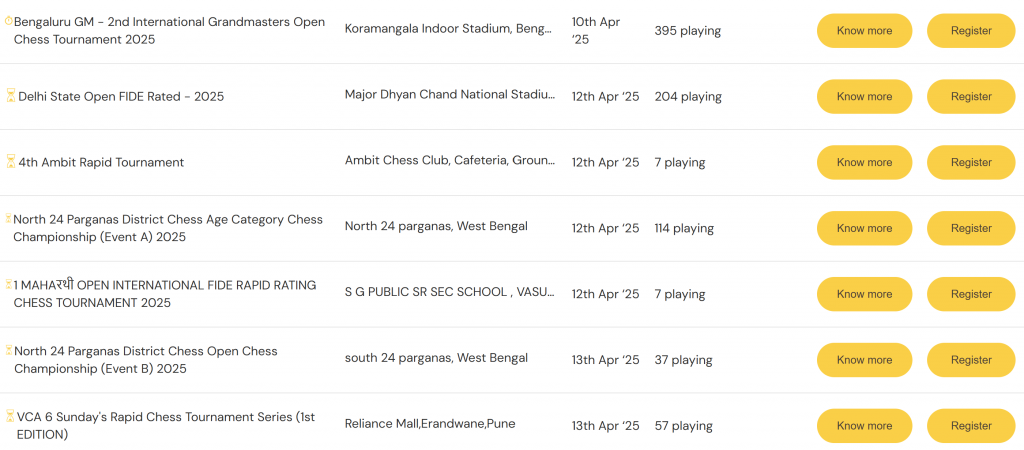
Ready to test your skills in a competitive setting? Register with CircleChess to participate in local and online chess tournaments designed for players of all levels. It offers a range of tournament formats, including Swiss and Round-Robin, to help you earn an estimated ELO rating in chess and track your progress.
Frequently Asked Questions
What is considered a good Elo rating in chess?
A good Elo rating depends on your goals. Ratings between 1000-1200 represent average club players, while 1600+ indicates a strong club player. An expert-level rating starts at 2000, and master level begins at 2200. For beginners, reaching 1200-1400 is a solid achievement that shows meaningful progress.
Is 1000 Elo a beginner?
Yes, 1000 Elo is typically considered a late beginner or early intermediate level in chess. This rating falls above absolute beginner levels (600-800 Elo) but below average club players (1200+ Elo). At 1000 Elo, players understand basic tactics and opening principles but still have room to develop strategic depth and positional understanding.
How much does my Elo rating change after each game?
Your Elo rating change depends on the K-factor (typically 10-40) and the rating difference between you and your opponent. New players can gain or lose 20-40 points per game, while established players with lower K-factors typically see changes of 5-15 points per game based on expected versus actual results.