Most chess players say they want to improve. But when you ask them what their training plan looks like, the answer is usually: “I just play whenever I get time.” That’s not a plan. That’s hope. If you really want to get stronger — not just fluctuate rating — you need structure. Not something extreme. Not 6 hours a day. Just something consistent and realistic. Because improvement in chess doesn’t come from random effort. It comes from repeated, focused work. Let’s break it down in a way that actually works.
Step 1: Stop Training Everything at Once
This is the first mistake people make.
They try to:
- Learn a new opening
- Solve 100 puzzles
- Study endgames
- WatchYouTube videos
- Play blitz
- Analyze games
All in one week. That leads to burnout. Instead, think balance. A good weekly plan touches all major areas — but in controlled amounts.
The Four Core Areas You Must Train
Every serious chess player needs to work on:
- Tactics (calculation)
- Game review (understanding mistakes)
- Endgames (technical strength)
- Practical play (real games)
If your weekly plan doesn’t include all four, you’re missing something important.
A Simple Weekly Structure (For Club Players)
Let’s say you can train 1 to 1.5 hours per day. Here’s a realistic structure:
Monday – Tactics Focus
- 30–45 minutes of calculation puzzles
- Not just easy ones — slow, serious calculation
- Write down variations in your head before moving
Calculation is the backbone of chess. Without it, nothing else works.
Tuesday – Play + Review
- Play one serious rapid or classical game
- Spend at least 30 minutes reviewing it
Don’t just check engine scores. Ask: Where did I lose control? What was my plan? Did I calculate properly? If you struggle to review deeply, structured analysis tools like Caissa AI (on CircleChess) can help break down inaccuracies and highlight patterns more clearly than just red engine arrows.
Wednesday – Endgame Study
Focus on one theme only
- King and pawn endings
- Lucena position
- Basic rook endgames
Most club players ignore endgames. That’s why they collapse in winning positions. Strong endgame players gain points quietly.
Thursday – Model Game Study
- Pick one classical game from a strong player
- Replay slowly
- Try to guess moves
This builds positional understanding. You start seeing plans, not just tactics.
Friday – Play Another Serious Game
- Rapid or classical
- No multitasking
- Treat it like a tournament game
And again — review it.
Weekend – Light Review + Weakness Work
Saturday:
- Review mistakes from the week
- Identify recurring patterns
Sunday:
- Target your biggest weakness (Time trouble? Pawn structures? Calculation errors?)
Improvement becomes focused instead of random.
What About Openings?
Here’s the honest truth: Openings are important — but overrated at club level. You don’t need 20 variations memorized. You need:
- Understanding of typical structures
- Clear plans
- Knowledge of common traps
Spend maybe 15–20% of your total training time on openings. Not more. Understanding beats memorization.
How Many Games Should You Play?
Less than you think. If you play 30 blitz games a day but never review them, you’re not training — you’re entertaining yourself. It’s better to:
- Play 3–5 serious games per week
- Review them deeply
That builds strength. Blitz can be used for fun or pattern recognition — but it should not be your main training tool.
Why Consistency Beats Intensity
Some players train 5 hours one day then, disappear for 6 days. That doesn’t work. Chess improvement responds better to:
- 1 hour daily
- Focused effort
- Long-term discipline
Even future grandmasters don’t train randomly. They follow structure. If you look at how serious ecosystems operate — including training models used in structured programs like Caissa School — the emphasis is on rhythm, not chaos. Regular practice, feedback, tournament exposure, and targeted
improvement. That’s how progress compounds.
Common Mistakes in Weekly Planning
Let’s be honest about what kills most plans:
- Only playing, no studying
- Only watching videos, no practicing
- Ignoring endgames
- Avoiding losses
- Changing openings every week
- Training without reviewing mistakes
A plan works only if you stick to it.
How to Measure Improvement
Don’t measure only by rating.
Measure by:
- Fewer blunders
- Better time management
- Clearer plans
- Improved endgame conversion
- More accurate calculation
Rating follows skill. Skill does not follow rating.
Where CircleChess Can Help With This Training Routine
Following a weekly chess plan becomes much easier when you know how to actually learn from your games instead of just playing more.
Game Review with Caissa AI (Understanding and Fixing Mistakes):
Most players make the same mistake after every game — they check the engine, see a red mark, and move on. But they don’t really understand why the move was wrong. This is where Caissa AI on CircleChess helps in a more practical way. After a game, Caissa highlights the key moments where the position changed and explains what went wrong. It shows better moves and helps you understand whether the mistake came from poor calculation, a wrong plan, or missing a simple idea. For example, imagine you pushed a pawn in the middlegame thinking it creates an attack, but later your position collapses. A normal engine will just show it as a mistake. But with Caissa, you can see that the position actually required patience, not aggression — and you’ll see alternative moves that keep the position stable. This way, you don’t just see mistakes — you start correcting your thinking. And when you follow a weekly plan, this becomes very useful because you can take one mistake and work on it in your next session.
Mastery Series (Play & Learn – Opening Preparation with Grandmasters):
Once you start fixing your mistakes, the next step is improving your opening understanding. The Mastery
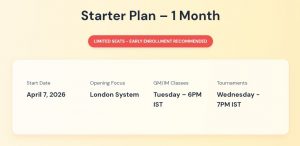
Series on CircleChess focuses on this in a structured way. These are opening-based courses where Grandmasters explain not just the moves, but the ideas behind them — what plans to follow, what mistakes to avoid, and how to handle different types of positions. For example, the London System course (starting around ₹99) doesn’t just tell you where to place your pieces. It explains:
- what to do after the opening
- how to build your attack
- what common mistakes players make
- how to handle different setups from your opponent
So, instead of memorizing moves, you actually understand the opening.
Imagine you’re preparing for a tournament. Instead of guessing what to play, you already have a clear setup, plan, and idea in your mind. That confidence comes from understanding — not memorization.
Putting It All Together in a Weekly Plan:
When you combine both, your training becomes much more effective. You play a game, use Caissa to understand your mistakes, and then improve your openings and plans through the Mastery Series. This creates a simple loop: Play – Analyze – Learn – Apply. And that’s what actually leads to steady
improvement.
Final Thought
You don’t need a perfect plan. You need a realistic one. If you can commit to:
- Regular tactics
- Serious game review
- Endgame basics
- Practical play
You will improve. Not instantly. Not magically.But steadily. And steady improvement is what actually works in chess.