

Chess is a battle of wits, strategy, and precision. Whether you’re a beginner learning the ropes or an experienced player looking to refine your understanding of tournament rules, knowing the rules and regulations of chess is essential.
Everything About Chess Rules and Regulations
- The Chessboard and Initial Setup
- How do the Chess Pieces move?
- What are The Special Moves in Chess?
- The Act of Moving the Pieces
- Game Completion
- Winning, Losing, and Drawing the Game
- Tournament Rules and Etiquette
- Variants: Rapid, Blitz, and Chess960
- Accessibility: Chess for the Visually Impaired
- What Happens When A Game is Adjourned?
- Conclusion
The Chessboard and Initial Setup

Every game of chess begins with a properly arranged board. A standard chessboard consists of 64 squares arranged in an 8×8 grid, alternating between light (white) and dark (black) squares. The board must be positioned so that each player has a white square in the bottom-right corner.
Each player starts with 16 pieces:
- 1 King – The most important piece; if it is checkmated, the game is lost.
- 1 Queen – The most powerful piece, combining the abilities of a rook and bishop.
- 2 Rooks – Move in straight lines horizontally or vertically.
- 2 Bishops – Move diagonally and stay on their starting color.
- 2 Knights – Move in an “L” shape and can jump over other pieces.
- 8 Pawns – Move forward but capture diagonally.
The pieces are placed in a specific order on the first rank (row):
- From left to right (for White): Rook, Knight, Bishop, Queen, King, Bishop, Knight, Rook.
- The second rank is filled with eight pawns.
A helpful tip for remembering the queen’s placement: “The queen always starts on her own color.“ The white queen starts on a white square, and the black queen starts on a black square.
Who Moves First in Chess?
White always moves first in chess. This is a fundamental rule that applies to every game, from casual matches to World Championship finals.
The player assigned the white pieces makes the opening move, after which players alternate turns throughout the game. In tournaments, pairings determine color assignment—typically alternating between rounds to ensure fairness.
This first-move advantage gives White a slight statistical edge. Studies show White wins approximately 52-56% of games at high levels, which is why color distribution matters in competitive play.
How do the Chess Pieces move?
Each piece has unique movement rules, and mastering them is crucial for effective play.
1. The King
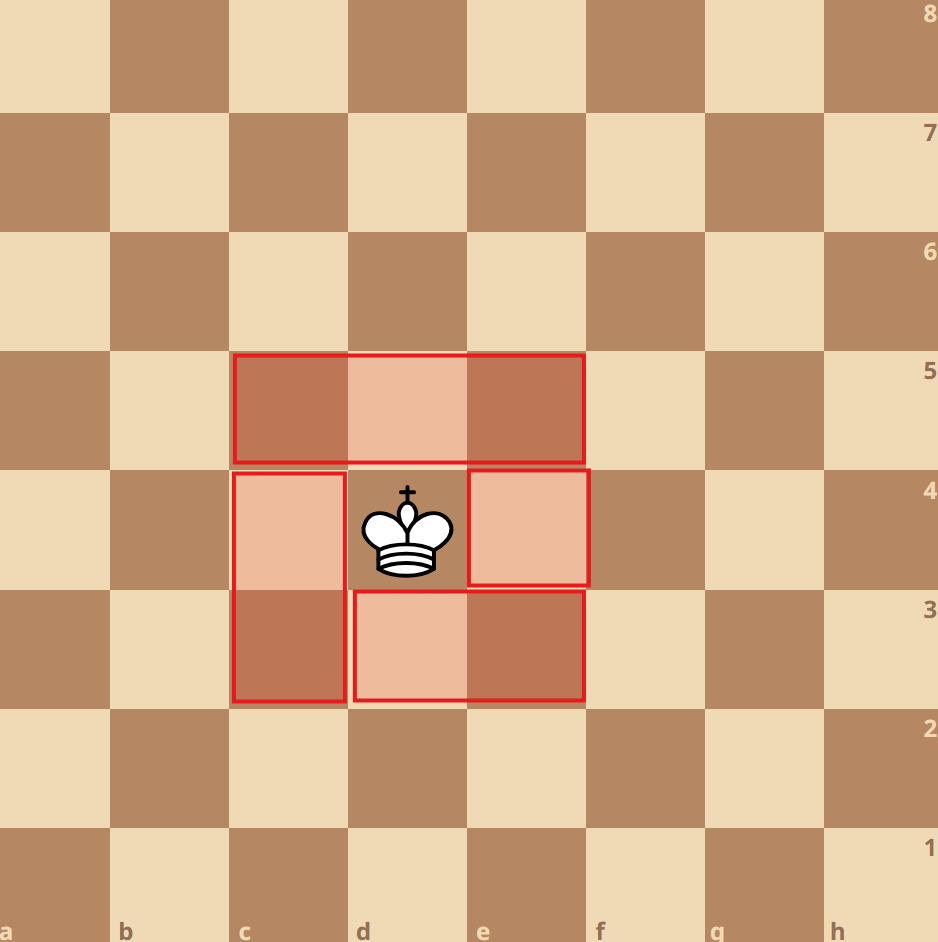
- Moves one square in any direction (horizontally, vertically, or diagonally).
- Cannot move into check (a square attacked by an opponent’s piece).
- Has a special move called castling (explained later).
2. The Queen
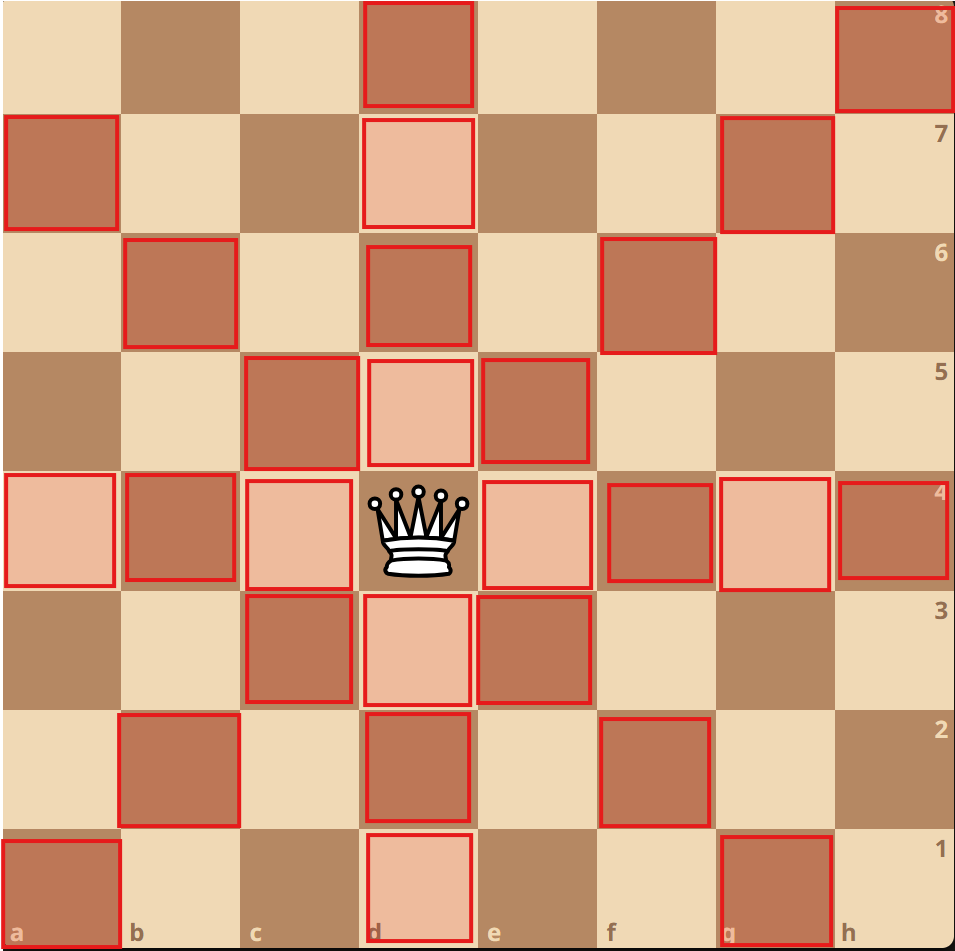
- Combines the power of a rook and bishop.
- Moves any number of squares in a straight line (horizontally, vertically, or diagonally).
3. The Rook
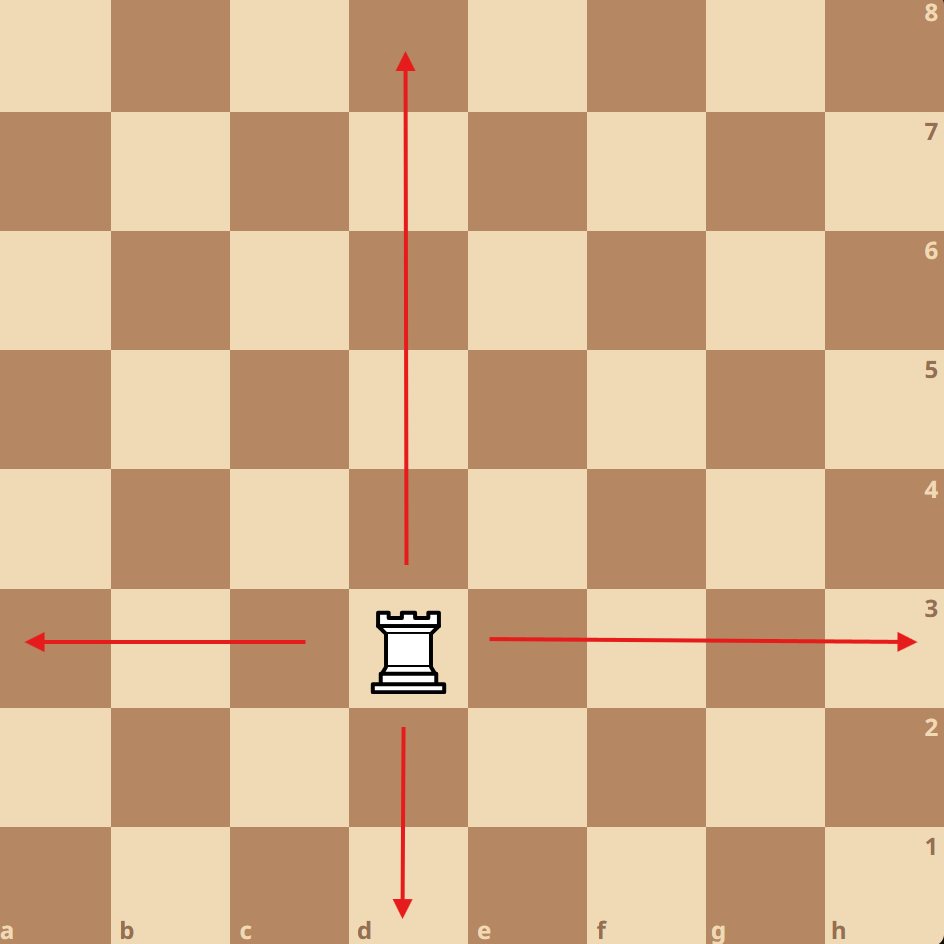
- Moves any number of squares in a straight line (horizontally or vertically).
- Participates in castling.
4. The Bishop
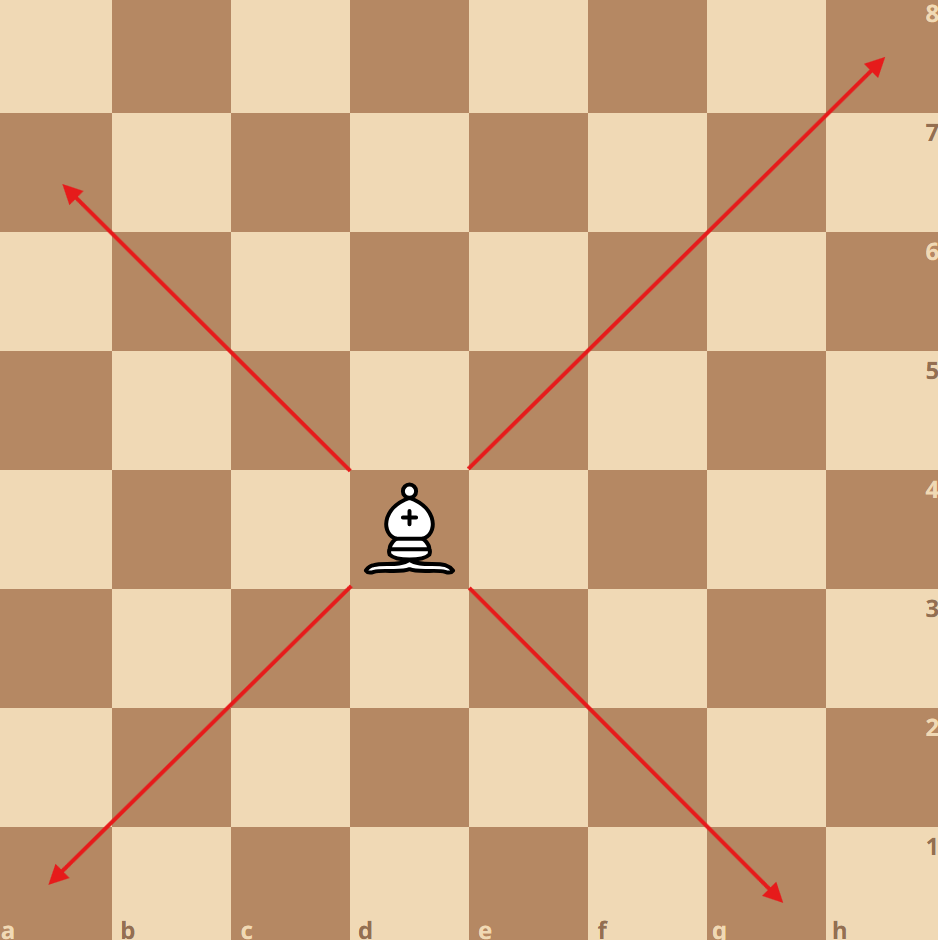
- Moves any number of squares diagonally.
- Each bishop stays on squares of the same color throughout the game.
5. The Knight
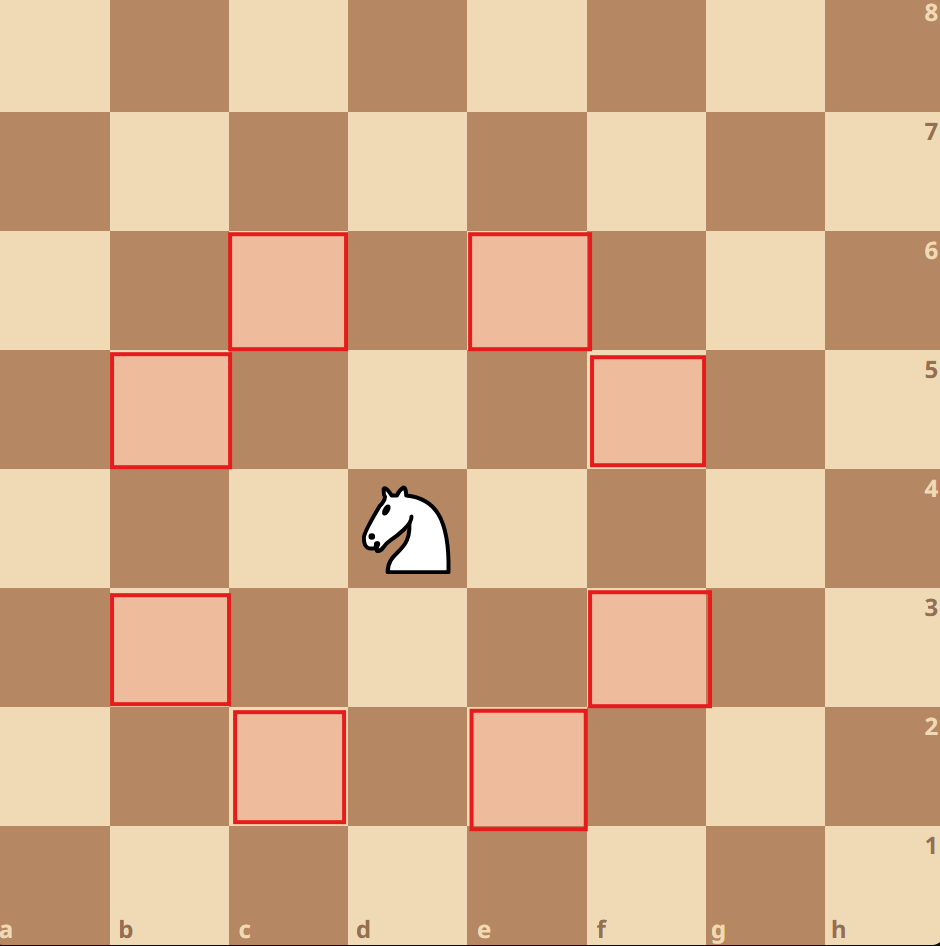
- Moves in an “L” shape: two squares in one direction and then one square perpendicular.
- The only piece that can jump over others.
6. The Pawn
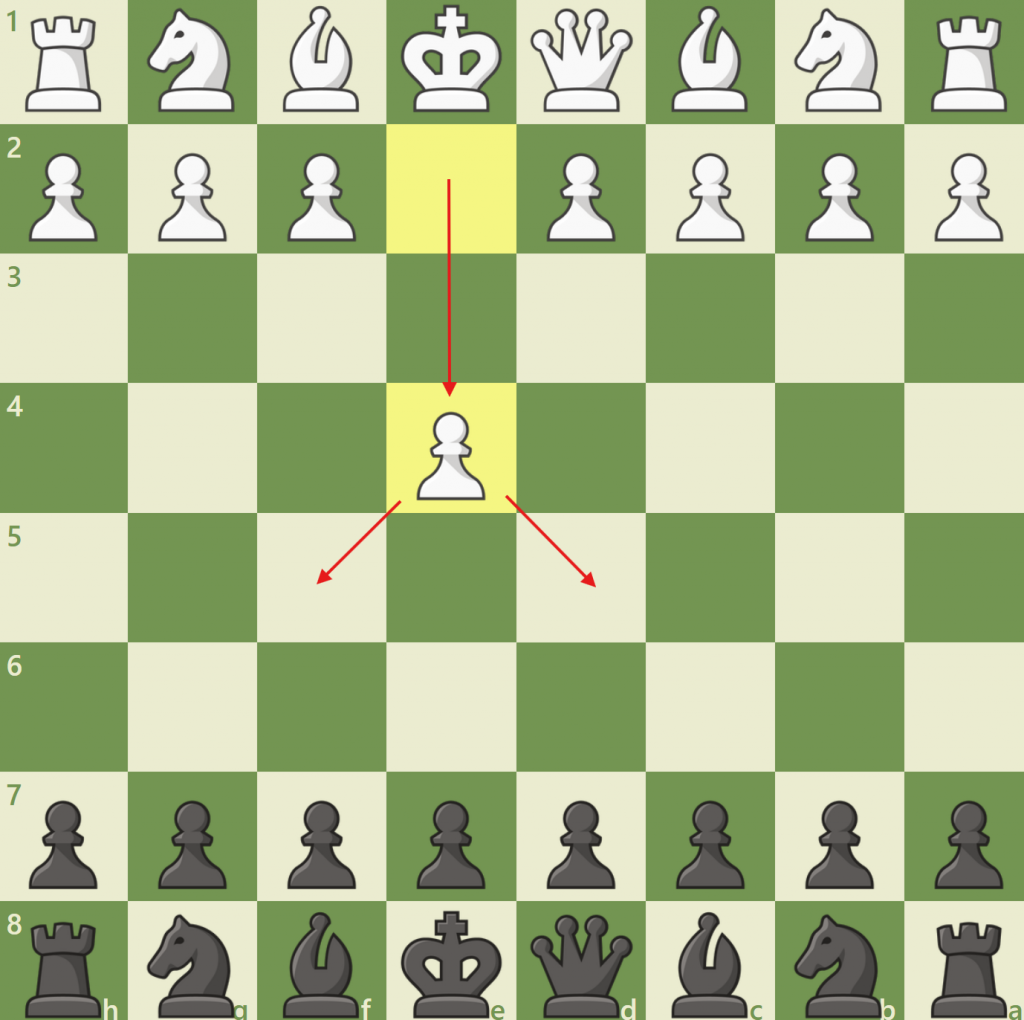
- Moves forward one square (never backward).
- On its first move, it can move two squares forward.
- Captures diagonally one square forward.
- Has a special capture called en passant (explained below).
- If a pawn reaches the opposite side of the board, it promotes to any other piece (usually a queen).
Want to get more comfortable with chess rules through practice? Play and self-learn with Caissa.
Understanding how each piece moves is the foundation of chess strategy. Beginners often confuse similar movement patterns, so it's worth noting key distinctions:
• Rooks and bishops can travel across the entire board, but rooks are confined to ranks and files while bishops are locked to one color—a light-squared bishop will never occupy a dark square. • The queen combines both rook and bishop movement, making it the most versatile attacking piece. • Knights are the only pieces that ignore obstacles; they simply land on their destination square regardless of what lies between. • Pawns are unique in that their capture movement (diagonal) differs from their standard movement (forward). This asymmetry makes them tactically complex despite their limited range.
Mastering these movement rules allows you to visualize threats, plan attacks, and avoid common beginner mistakes like moving a bishop to an impossible square or forgetting that pawns cannot move backward.
To help visualize these movements, check out the video below that demonstrates how each chess piece moves on the board.
What are The Special Moves in Chess?
1. Castling
Castling is the only move where two pieces (the king and a rook) move at the same time.
Conditions for Castling:
- Neither the king nor the rook involved has moved before.
- There are no pieces between them.
- The king is not in check, does not pass through check, and does not end up in check.
How It Works:
- Kingside Castling (O-O): The king moves two squares toward the rook, and the rook moves to the square the king crosses.
- Queenside Castling (O-O-O): The king moves two squares toward the rook, and the rook moves to the adjacent square on the other side.
2. En Passant
This rule applies when:
- A pawn moves two squares forward from its starting position.
- An opponent’s pawn could have captured it if it had moved only one square.
- The opponent can capture it “en passant” (in passing) on the very next move.
3. Pawn Promotion
When a pawn reaches the opposite side of the board, it must be promoted to a queen, rook, bishop, or knight. The new piece replaces the pawn immediately.
How long does a typical chess game take for beginners?
A typical chess game for beginners lasts 20 to 60 minutes, depending on time controls and pace of play. Rapid chess games (15-60 minutes per player) are common for casual play, while untimed games may extend longer as beginners deliberate over moves and learn strategy.
What are common mistakes beginners make in chess?
Beginners often violate the touch-move rule, move into check illegally, forget castling requirements, or miss en passant captures. Many also neglect proper piece development, moving the same piece multiple times in the opening instead of activating all pieces. Understanding these fundamental rules prevents costly errors during play. For related guidance, see The Moves You Miss Aren T Always On The Board Understanding Tournament Pressure In Chess.
The Act of Moving the Pieces
- Basic Movement Rules: All moves must be made with one hand only. Players may adjust pieces only after announcing “j’adoube” (I adjust) to avoid forced moves.
- Touch-Move Rule: If a player touches their own piece, they must move it (if legal). If a player touches an opponent’s piece, they must capture it (if possible). If both colors are touched, the player must capture the opponent’s piece with theirs (or move the first touched piece if illegal).
- Special Cases: Castling: Touching king + rook = must castle (if legal). Touching rook first, then king = cannot castle that move. If castling is illegal, the player must make another king move (or any legal move if none exists). Pawn Promotion: The promoted piece choice is finalized once placed on the board.
- Move Completion: A move is finalized when: A piece is released on its new square. In captures: when the captured piece is removed and the new piece is placed. In castling: when the rook is released (king release alone doesn’t complete the move). Illegal moves must be corrected.
- Penalty: A player loses the right to claim an opponent’s touch-move violation if they touch a piece themselves.
Game Completion
- Winning the Game: Checkmate: The game ends immediately if the opponent’s king is checkmated by a legal move as per chess rules. Resignation: A player may concede at any time, granting the opponent victory.
- Draw Conditions: Stalemate: The player to move has no legal moves and their king is not in check. Dead Position: No possible checkmate (e.g., king vs. king). Mutual Agreement: Both players agree to a draw. Threefold Repetition: The same position occurs three times (claimable by the player to move). 50-Move Rule: No pawn moves or captures in 50 consecutive moves by both players.
- Immediate Effect: All outcomes (win/draw) take effect instantly if the final move is legal.
Winning, Losing, and Drawing the Game
1. Checkmate

- The primary objective of chess.
- Occurs when the opponent’s king is in check and cannot escape.
- The game ends immediately, and the player who delivered the checkmate wins.
2. Resignation
- A player may voluntarily resign if they believe their position is hopeless.
- The opponent wins by default.
3. Stalemate
- If a player has no legal moves and their king is not in check, the game is a draw.
- Stalemate often occurs in endgames where one player has no way to continue without putting their king in check.
4. Other Draw Conditions
- Threefold Repetition: The same position occurs three times with the same player to move.
- 50-Move Rule: No pawn moves or captures occur in 50 consecutive moves.
- Insufficient Material: Neither player can checkmate (e.g., king vs. king).
- Mutual Agreement: Both players agree to a draw.
Basic Chess Strategy for Beginners
Once you understand how the pieces move, your next step is learning fundamental strategies that give you an advantage from the opening moves.
Control the Center
The four central squares (e4, d4, e5, d5) are the most valuable real estate on the chessboard. Pieces positioned in the center control more squares and have greater mobility. Start your game by advancing your e-pawn or d-pawn two squares forward, then develop your knights and bishops toward the center. A centralized knight on e5, for example, can attack up to eight squares, while the same knight on a corner square like a1 controls only two.
Develop Your Pieces Early
Bring your knights and bishops into play before moving the same piece multiple times. A common beginner mistake is moving the queen out early, only to have it chased around the board by developing opponent pieces. Aim to castle within the first 10 moves to safeguard your king and activate your rook simultaneously.
Think Before You Move
Before making any move, ask yourself three questions: Is my piece safe on its new square? Does this move create a threat? Am I leaving any of my pieces undefended? This simple habit prevents the tactical blunders that decide most beginner games.
Tournament Rules and Etiquette
1. The Chess Clock

A chess clock, an integral part of modern chess, comprises two time displays connected such that only one runs at a time. Each display has a flag that indicates when a player’s allotted time has expired, known as “flag fall.”
Before a game starts, the arbiter determines the clock’s placement. The clock for the player with white pieces begins at the designated start time. Players must manage their time carefully, ensuring they complete a required number of moves within the allotted period or risk forfeiting the game. Exceptions apply if the opponent lacks the means to checkmate under any legal series of moves, resulting in a draw.
The operation of a chess clock is governed by specific rules. After making a move, a player must stop their clock and start their opponent’s. This action is part of their allotted time. Players are required to use the same hand for pressing the clock as they did for moving a piece, avoiding any disruptive behavior like hovering over or striking the clock forcefully. Any misconduct with the clock is subject to penalties under tournament rules. Players unable to handle the clock can appoint an assistant, approved by the arbiter, to operate it on their behalf.
If a chess clock is found defective or incorrectly set during a game, the arbiter replaces it and adjusts the time using their judgment. When both flags fall simultaneously and it’s unclear which fell first, the game either continues or is drawn, depending on the game’s phase.
In instances where games are interrupted, only the arbiter or a player seeking assistance may stop the clocks. The arbiter is responsible for restarting them and addressing any irregularities. Monitors displaying game details in the hall are permissible, though players cannot make claims solely based on such displays. These comprehensive regulations ensure fair play and precise time management in chess tournaments.
2. Irregularities
As per chess rules and regulations, irregularities during a game require specific protocols to maintain fairness and integrity. If the initial position of the pieces is found to be incorrect, the game is canceled, and a new one begins. Similarly, if the chessboard is misaligned, the game continues with the position transferred to a correctly placed board. Should players start with reversed colors, the game generally proceeds unless the arbiter decides otherwise.
Players are responsible for correcting any displaced pieces on their own time, but they may request the arbiter’s assistance if needed. Any illegal moves, such as failing to promote a pawn correctly or capturing the king, lead to the position being reinstated to its state before the irregularity. Repeated illegal moves result in time penalties for the first two offenses, and a third illegal move results in the game being forfeited, unless checkmate becomes impossible for the opponent.
When pieces are displaced or irregularities occur that cannot be precisely resolved, the game continues from the last identifiable position. The arbiter adjusts the clocks accordingly.
3. Recording the Moves
Recording moves is an essential part of competitive chess, ensuring accountability and game integrity. Each player must record their moves, as well as their opponent’s, in algebraic notation on the provided scoresheet. Players can reply to their opponent’s move before recording it but must update their scoresheet before making another move. Draw offers and other formalities must also be noted.
In cases where a player is unable to write, an assistant, approved by the arbiter, may keep score on their behalf. If a player’s remaining time drops below five minutes without an increment of 30 seconds or more per move, they are no longer obligated to record moves. Once the flag falls, they must update their scoresheet before proceeding.
If both players are excused from keeping the score, the arbiter or an assistant will maintain the record. In situations where scoresheets are incomplete, players reconstruct the game under the arbiter’s supervision. Upon game conclusion, both players sign their scoresheets to confirm the result, which stands unless overturned by the arbiter.
These rules ensure fairness and provide a framework for resolving disputes during and after games.
4. The Drawn Game
A chess game can end in a draw under several circumstances, and the rules governing these situations ensure fairness and clarity.
1. Draw by Agreement
- Players may agree to a draw, but tournament rules can restrict this – sometimes requiring arbiter approval or prohibiting early draw offers as per the chess rules and regulations.
- To offer a draw: A player must make their move first, then offer the draw before pressing their clock. The offer cannot have conditions (e.g., “I’ll draw if you let me take back my last move”). Once made, the offer stands until the opponent accepts, rejects it verbally, or makes a move (which counts as rejection). Both players must note the draw offer on their scoresheet.
2. Threefold Repetition
- A player can claim a draw if the same position occurs three times (not necessarily consecutively).
- The positions must be identical, including: The same player having the move. All pieces on the same squares with the same possible moves. The same castling and en passant rights.
- The claim must be made correctly: Either before making the move (by writing it down and declaring the claim). Or after the position has appeared for the third time.
3. Fifty-Move Rule
- A draw can be claimed if 50 consecutive moves occur with: No pawn moves. No captures.
- The player must declare the claim properly, similar to the threefold repetition rule.
4. Dead Position
- If neither player can possibly checkmate (e.g., king vs. king, king & bishop vs. king), the game is immediately drawn.
5. Claiming a Draw
- If a player touches a piece without claiming a draw first, they lose the right to claim under the threefold repetition or fifty-move rule.
- When claiming a draw, the player may stop both clocks. If the claim is correct → the game is drawn. If incorrect → the opponent gets 3 extra minutes, and the game continues.
5. Quickplay Finish
In time-pressure situations (when a player has very little time left), special rules apply to prevent unfair losses.
1. Quickplay Definition
- The “quickplay finish” is when all remaining moves must be made in a very short time (usually under 2 minutes).
2. Claiming a Draw in Time Trouble
- If a player has less than 2 minutes left, they can stop the clock and claim a draw if: The opponent is not trying to win by normal means (e.g., just moving randomly to flag the opponent). Or the position is objectively unwinnable (e.g., insufficient material).
- The arbiter will decide: If correct → Game is drawn. If unsure → The opponent gets 2 extra minutes, and the arbiter observes before deciding. If incorrect → The opponent gets 2 extra minutes, and the game continues.
- The arbiter’s decision is final – no appeals are allowed.
6. Scoring System
- Win = 1 point (including wins by forfeit)
- Loss = 0 points (including forfeits)
- Draw = ½ point
This standardized scoring applies unless tournament organizers specify alternative rules.
7. Player Conduct Rules
- General Behavior: Players must maintain chess’s integrity (no disruptive actions) Cannot leave playing area without arbiter permission (especially when it’s their move)
- Prohibited Actions: Using notes/outside assistance Having active electronic devices (automatic loss if device makes noise) Smoking outside designated areas Distracting opponents (includes excessive draw offers or noise)
- Scoresheet Usage: Only for recording moves, clock times, draw offers, and claims Finished players become spectators
- Violation Penalties: Ranging from warnings to game forfeiture Persistent violations may lead to expulsion Both players may forfeit if mutually non-compliant Most arbiter decisions can be appealed (except certain time-control rulings)
8. Arbiter’s Authority
- Primary Roles: Enforce all chess laws Maintain tournament integrity Supervise games (especially time-pressure situations)
- Disciplinary Powers: Issue warnings Adjust player clocks (add/subtract time) Award game losses Modify match points Expel players from events Grant time compensation for external disruptions
- Intervention Limits: Only intervenes for rule violations Cannot advise players about moves or clock status Manages spectator interference
9. FIDE’s Governance
- National federations may request official rule interpretations from FIDE
- Ensures global uniformity in chess law application
How to Practice and Improve Your Chess Skills
Once you understand how to play chess, the fastest way to improve is through consistent practice and deliberate study. Playing regularly against opponents of varying skill levels helps you recognize patterns, test strategies, and learn from mistakes.
Tactics puzzles are essential for developing your calculation skills. Platforms like Chess.com and Lichess offer thousands of free puzzles where you solve checkmate sequences, pin tactics, and fork combinations. Spending 15-20 minutes daily on puzzles sharpens your ability to spot opportunities during actual games.
Analyzing your completed games reveals where you went wrong and what you did well. Review each game move-by-move, identifying blunders and missed opportunities. Many players also benefit from studying classic endgames—learning king and pawn versus king, or rook endgames, transforms close positions into wins.
Key practice methods:
• Play longer time controls initially to think through each move • Study master games to understand opening principles and middlegame plans • Focus on one opening system as White and one as Black until comfortable • Join a local chess club or online community for feedback and regular opponents
Variants: Rapid, Blitz, and Chess960
1. Rapid Chess
- Each player has 15-60 minutes for all moves.
- Players do not need to record moves.
- Illegal moves can be penalized if claimed by the opponent.
2. Blitz Chess
- Each player has less than 15 minutes.
- The rules are similar to rapid chess, but illegal moves may result in an immediate loss.
3. Chess960 (Fischer Random Chess)
- The starting position of the pieces is randomized (with some restrictions).
- Castling rules are adjusted to fit the random setup.
Accessibility: Chess for the Visually Impaired
FIDE has special rules to accommodate visually impaired players, including:
- Tactile chessboards with raised squares.
- Verbal move announcements (e.g., “Knight to f3”).
- Assistants to help move pieces and manage the clock.
What Happens When A Game is Adjourned?
In chess tournaments, situations may arise where a game needs to be adjourned, typically due to time constraints or other logistical reasons as per chess rules and regulations. The process of adjournment involves strict guidelines to ensure fairness and clarity when the game resumes. These guidelines cover everything from sealing a move to managing the game clock and resolving disputes.
If a game cannot be completed within the allotted time, the arbiter requires the player who is about to move to “seal” their move. This involves recording the move clearly and unambiguously on the scoresheet, placing both players’ scoresheets into an envelope, and sealing it. The player must ensure their clock is stopped after sealing the move, and they retain the right to alter the sealed move until the clock is stopped. If a player adjourns the game prematurely, the arbiter will record the remaining time and treat it as if the move was sealed at the scheduled end of the session.
The envelope containing the sealed move must include detailed information, such as the players’ names, the position on the board before the sealed move, the time used by each player, and the resumption details. The arbiter is responsible for verifying this information and safeguarding the envelope.
When the game is set to resume, the arbiter reinstates the position on the chessboard and adjusts the clocks to reflect the remaining time. If a draw is agreed upon or a player resigns before the resumption, the game concludes without the need to open the envelope. The sealed move is revealed only when the opponent is present.
There are scenarios where the sealed move may be invalid. If the move is ambiguous, illegal, or impossible to determine, the player who recorded it loses the game. If the opponent is absent at the resumption time, their clock is started. Similarly, if the player who sealed the move is late, the present player can record their response and seal it in a new envelope, effectively continuing the game in their absence. A player who is more than an hour late forfeits the game unless their sealed move has already led to a decisive result, such as checkmate or stalemate.
In rare cases, the envelope containing the sealed move may go missing. In such instances, the game continues from the recorded position with the clock times adjusted as best as possible. If the position cannot be reconstructed, the game is annulled and replayed. Players are also allowed to correct any discrepancies in recorded time upon resumption, provided this is identified before the first move of the session.
Finally, the arbiter oversees the duration of the resumption session, ensuring that starting and finishing times are announced beforehand and adhered to. These structured regulations ensure that adjourned games maintain their integrity and provide a fair resolution for both players.
Conclusion
Understanding the rules and regulations of chess gives you the foundation to play with confidence. But knowing the rules is only the beginning; playing regularly and learning from your games is where real improvement happens. If you enjoy learning independently, Caissa lets you play, practise, and self-learn chess at your own pace. For players looking for structured guidance, Caissa School of Chess offers coach-led learning to help students build their chess skills with the right guidance and practice.
