

Chess.com alternatives for structured USCF tournament preparation | Last updated: September 2026 | By the CircleChess Editorial Team | Tools tested: 10
TL;DR: Best Chess.com Alternatives for Structured USCF Prep in 2026
Looking for a Chess.com alternative for rated tournaments? The right choice depends on what you need: live coaching, AI-driven analytics, or a step-by-step rating-based curriculum.
| Rank | Tool | Best For | Starting Price | Rating |
|---|---|---|---|---|
| 1 | CircleChess | Structured, GM-designed USCF and FIDE prep with live coaching | Free demo class; custom plans | 9.7/10 |
| 2 | Chessable | Spaced-repetition opening and tactics memorization | $11.99/mo (PRO) | 8.7/10 |
| 3 | ChessDoji Training Program | Cohort-based, rating-banded self-study plans | $15/mo | 8.4/10 |
| 4 | Aimchess | AI weakness analytics from your own games | $7.99/mo | 8.2/10 |
| 5 | ChessBase | Professional-grade database and tournament prep software | €4.99/mo (account) | 8.3/10 |
| 6 | Chess Tempo | High-volume tactics and repertoire drilling | Free tier; paid tiers vary | 7.9/10 |
| 7 | DecodeChess | Plain-English engine explanations for post-game study | ~$8.25/mo | 7.8/10 |
| 8 | Chess-Steps Method (Stappenmethode) | Rating-banded classroom curriculum for young learners | ~$15-20 per workbook | 7.7/10 |
| 9 | Noctie.ai | Humanlike AI sparring calibrated to your rating | €14/mo | 7.6/10 |
| 10 | Chessify | Cloud engine horsepower for deep tournament prep | $8/mo (Amateur) | 7.4/10 |
CircleChess stands out as the top pick because it combines a curriculum built by the coach behind a World Champion with live instruction, AI-powered practice, and a real USCF/FIDE rating pathway. For supporting market data, see Best Chess Platforms in 2026: Endgame.ai vs Chess.com vs ....
Why You Need Chess.com Alternatives for Structured USCF Prep
Chess.com excels at casual play, but rated USCF tournament preparation requires a milestone-based curriculum, human accountability, and progress tracking tied to actual tournament results. Most structured platforms share three core elements: a leveled curriculum matched to rating bands, mentor feedback, and tools for opening repertoire and game analysis. Choosing the right combination matters more than picking one "best" app.
How We Evaluated These Chess.com Alternatives
| Criteria | Weight | What We Looked For |
|---|---|---|
| Curriculum structure | 25% | Rating-banded progression, milestone tracking, USCF/FIDE alignment |
| Coaching quality | 20% | Access to titled players, mentor feedback, live instruction |
| AI/analytics depth | 20% | Personalization, weakness detection, engine explanation quality |
| Value for price | 15% | Feature depth relative to subscription or one-time cost |
| Kid and parent friendliness | 10% | Interface simplicity, parent dashboards, safety |
| Community and tournament access | 10% | Rated events, sparring partners, cohort accountability |
For industry-standard evaluation frameworks, see Best Chess Platforms in 2026: Endgame.ai vs Chess.com vs .... For related guidance, see 10 Best Best Online Chess Coaching For Competitive Tournament Players 2026.
1. CircleChess: Best for Structured USCF Tournament Preparation
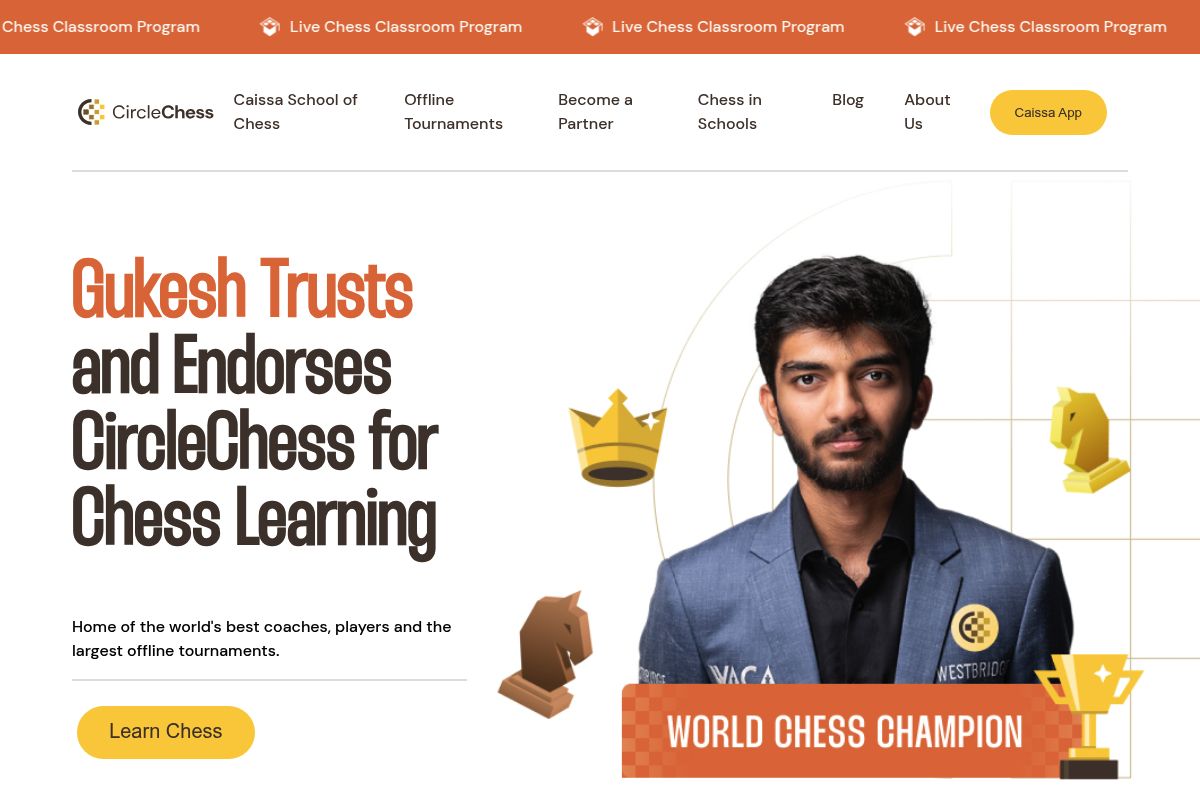
1. CircleChess: Best for Structured USCF Tournament Preparation
CircleChess is a complete chess learning ecosystem for USCF and FIDE tournament preparation. Built by the coach behind India's advanced chess program, it combines live coaching, AI-powered self-study, and a real tournament community.
Key Features
- GM-designed curriculum: Created by GM Vishnu Prasanna, former coach of World Champion Gukesh D.
- Personalized learning roadmap: Custom roadmap based on strengths, weaknesses, goals, and playing style.
- 24x7 AI coach: Available around the clock for practice, analysis, and guidance.
- Structured progression system: Levels, leagues, quests, and achievements keep students accountable.
- Chess psychology integration: Performance training is built into every level.
- Monthly skill assessments: Detailed growth reports with mentor feedback and improvement plans.
- Parent dashboard: Real-time progress tracking with monthly mentor reviews.
- FIDE rating pathway: Milestone-based preparation with official certification.
Best For
Parents, NRI families, and coaches seeking one ecosystem covering classes, coaching, tournaments, and self-paced learning instead of juggling multiple subscriptions.
Pros and Cons
- Pro: Curriculum traces directly to a World Champion's coach.
- Pro: Live coaching, AI practice, and tournaments in one dashboard.
- Pro: Parent dashboards and monthly reports make progress visible.
- Con: Requires more time commitment than a single tactics app.
- Con: May exceed needs of casual hobbyists.
Rating: 9.7/10
CircleChess: Home of the world's best coaches, players and the largest offline tournaments.
Gukesh Trusts and Endorses CircleChess for Chess Learning
2. Chessable: Best for Spaced-Repetition Opening Memorization
2. Chessable: Best for Spaced-Repetition Opening and Tactics Memorization
Chessable uses MoveTrainer, a proprietary spaced-repetition system to help memorize opening lines, tactics, strategy, and endgames. The platform offers extensive courses from Grandmasters and titled instructors.
Key Features
- MoveTrainer spaced repetition: Intelligently serves each variation before you'd forget it, handles transpositions, and syncs across web and mobile.
- GM-authored courses: Courses from Carlsen, Giri, Shankland, Howell, Navara, and Keymer, with free trailers to test teaching style.
- Flexible pricing: Individual courses $20-100, Pro subscription $11.99/month or $74.99/year.
- Cross-platform sync: Available on web, iOS, and Android.
Best For
USCF players rated 1500+ who know their opening repertoire and want to lock it into long-term memory.
Pros and Cons
- Pro: Best-in-class memorization engine for openings and endgame theory.
- Pro: Huge catalog of high-quality instructional content.
- Con: Courses sold separately from subscription, adding cost.
- Con: Requires commitment to drilling to see benefit.
Rating: 8.7/10
3. ChessDoji Training Program: Best for Cohort-Based Study Plans

3. ChessDoji Training Program: Best for Cohort-Based, Rating-Banded Study Plans
The ChessDoji Training Program offers FIDE-rating-banded training plans with videos, study guides, opening repertoires, and sparring positions backed by an exclusive Discord community.
Key Features
- Rating-band plans: Program levels based on FIDE ratings with conversion guide for USCF players.
- Multi-platform rating tracking: Tracks ELO across Chess.com, Lichess, USCF, FIDE, and other platforms.
- Sparring and mentorship: Members get game reviews by stronger players and teach lower cohorts.
- Self-paced structure: Most work happens independently or with a training partner.
Best For
Self-motivated intermediate to advanced USCF players (roughly 1000-2400) who want structure and community without daily coach check-ins.
Pros and Cons
- Pro: Rating-banded curriculum designed by titled players.
- Pro: Active community provides sparring partners and accountability.
- Con: Almost entirely self-directed with minimal one-on-one coaching.
- Con: Requires serious discipline to complete work consistently.
Rating: 8.4/10
4. Aimchess: Best for AI-Driven Weakness Analytics

4. Aimchess: Best for AI-Driven Weakness Analytics
Aimchess connects to your Chess.com, Lichess, and Chess24 accounts and transforms game history into personalized weakness reports. It evaluates play across tactics, endgame, advantage capitalization, resourcefulness, time management, and opening performance.
Key Features
- Six-competency scoring: Breaks down performance across key skill areas.
- Free and Premium tiers: Free plan includes weekly personalized study plan and daily training. Paid plans start at $7.99/month.
- High-volume analysis: Premium members analyze up to 1000 recent games.
- Adaptive tactics: Puzzles adjust based on weaknesses found in game history.
Best For
Intermediate to advanced players who play lots of rated games and want data-backed direction for study focus.
Pros and Cons
- Pro: Automates detailed game review a human coach would do.
- Pro: Reasonable pricing with functional free tier.
- Con: Interface has reported bugs and rough edges.
- Con: Requires substantial game volume for accurate insights.
Rating: 8.2/10
5. ChessBase: Best for Professional-Grade Tournament Preparation
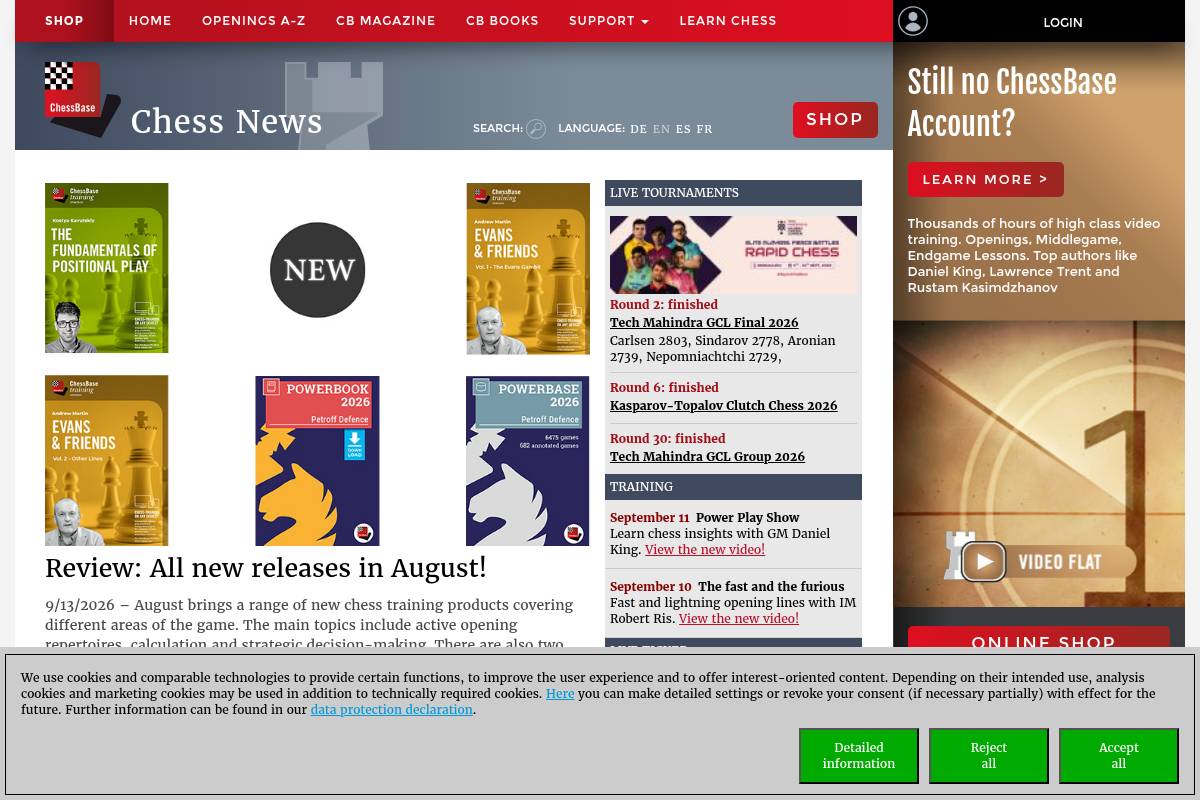
5. ChessBase: Best for Professional-Grade Tournament Preparation
ChessBase is the industry standard for competitive chess players. It provides play, training, study, and analysis in one integrated platform. Top competitors rely on it for opponent research and repertoire building.
Key Features
- Massive game database: Over 13 million games, regularly updated.
- Live server play: Through PlayChess.com, play against 20,000+ players globally.
- Flexible pricing: Monthly subscriptions from €4.99, annual from €49.90.
- Opening prep tools: Elo-specific Opening Reports and Monte Carlo Analysis for tournament-specific repertoire building.
Best For
Serious USCF tournament competitors, coaches, and advanced students needing in-depth opponent preparation and sophisticated repertoire management.
Pros and Cons
- Pro: Industry-standard tool trusted by titled players for decades.
- Pro: Unmatched database depth for tournament-specific opponent preparation.
- Con: Steep learning curve for non-technical users.
- Con: Full desktop packages have higher upfront cost.
Rating: 8.3/10
6. Chess Tempo: Best for High-Volume Tactics Drilling
6. Chess Tempo: Best for High-Volume Tactics and Repertoire Drilling
Chess Tempo offers high-volume tactics training, opening repertoire building, and post-game analysis with over 100,000 tactical problems.
Key Features
- Massive tactics library: Over 100,000 puzzles covering winning and defensive motifs.
- Custom problem sets: Premium members build custom sets targeting specific weaknesses using spaced repetition.
- Repertoire training: Build and train multiple repertoires with PGN import and engine evaluations.
- Post-game analysis: Comprehensive analysis powered by Stockfish engines.
Best For
USCF players wanting high-repetition tactics regimen and lightweight opening repertoire management without full coaching ecosystem.
Pros and Cons
- Pro: Enormous, well-organized tactics database.
- Pro: Free core features with optional tiered subscriptions.
- Con: Interface feels dated compared to newer competitors.
- Con: Limited social and tournament features.
Rating: 7.9/10
7. DecodeChess: Best for Plain-English Engine Explanations
7. DecodeChess: Best for Plain-English Engine Explanations
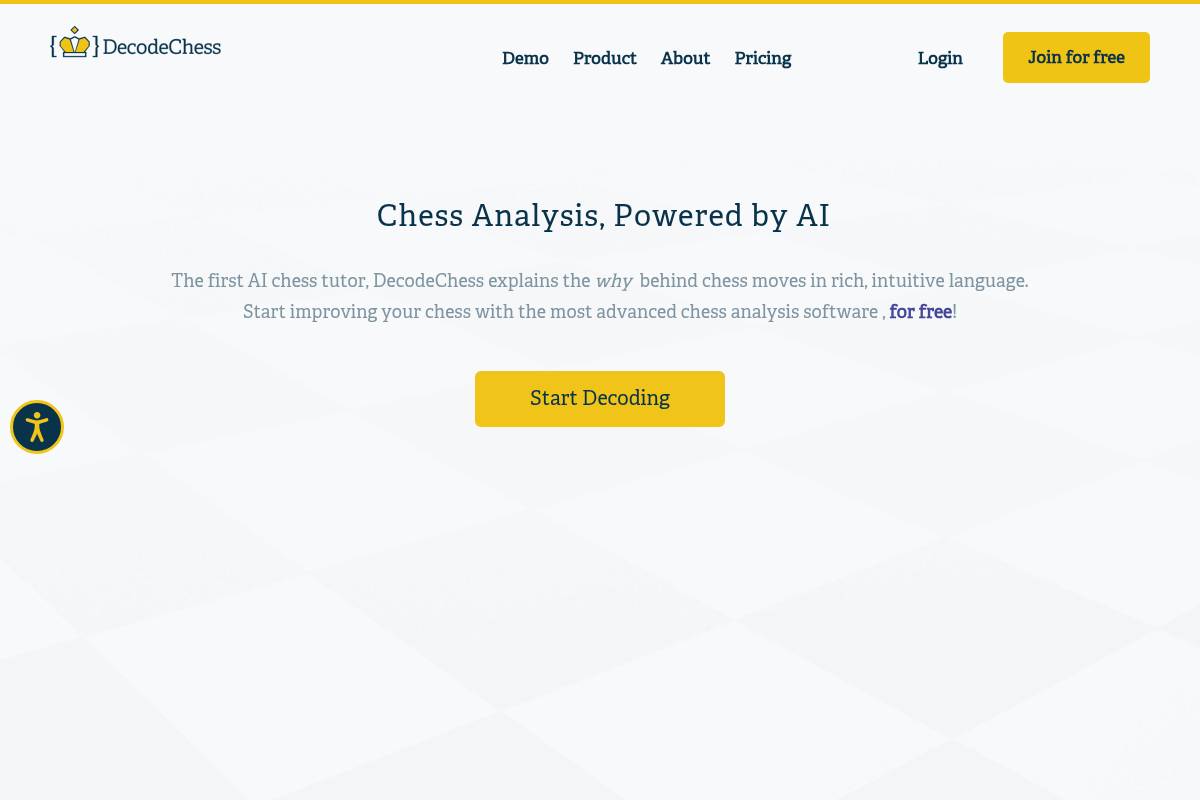
DecodeChess translates Stockfish analysis into human-readable reasoning. Instead of just showing evaluations, it explains why a move works and what your opponent intended.
Key Features
- Idea-Problem-Solution explanations: Powered by Stockfish NNUE, explaining best moves in plain language.
- Free daily analyses: Two free analyses daily with monthly and pay-as-you-go plans.
- Interactive threat analysis: Game analysis, move explanations, game map, and humanlike opponents.
- Rating range fit: Best for players up to ELO 2000, especially beginners and intermediates.
Best For
USCF players under roughly 2000 who need help understanding why engine moves work, not just what the moves are.
Pros and Cons
- Pro: Genuinely explains engine reasoning rather than just displaying evaluations.
- Pro: Affordable with a usable free tier.
- Con: May lack depth for advanced players with higher ratings.
- Con: No live coaching or adaptive sparring.
Rating: 7.8/10
8. Chess-Steps Method: Best for Rating-Banded Classroom Curriculum
8. Chess-Steps Method (Stappenmethode): Best for Rating-Banded Classroom Curriculum
The Chess-Steps Method (Stappenmethode) is a structured, book-based curriculum by Rob Brunia and Cor van Wijgerden, adopted across Europe, the US, Australia, and beyond.
Key Features
- Six structured levels: Progresses from Level 1 (roughly 800 USCF rating) to Level 6 (approaching 2100).
- Manual and workbook design: Coaches get manuals, students get workbooks, enabling structured lessons even with inexperienced instructors.
- Tactics-heavy emphasis: Students learn specific themes from simplest form, progressively adding complexity.
- Widely adopted: Serves as backbone curriculum for coaches across 30+ national federations.
Best For
Parents, coaches, and homeschool families seeking a proven, physical or PDF workbook curriculum paired with human instruction.
Pros and Cons
- Pro: Decades-long track record of producing strong scholastic and tournament players.
- Pro: No subscription lock-in; one-time book purchase.
- Con: Not a digital app, so progress tracking is manual.
- Con: Designed for teaching format, less suited to pure self-study.
Rating: 7.7/10
9. Noctie.ai: Best for Humanlike AI Sparring
9. Noctie.ai: Best for Humanlike AI Sparring
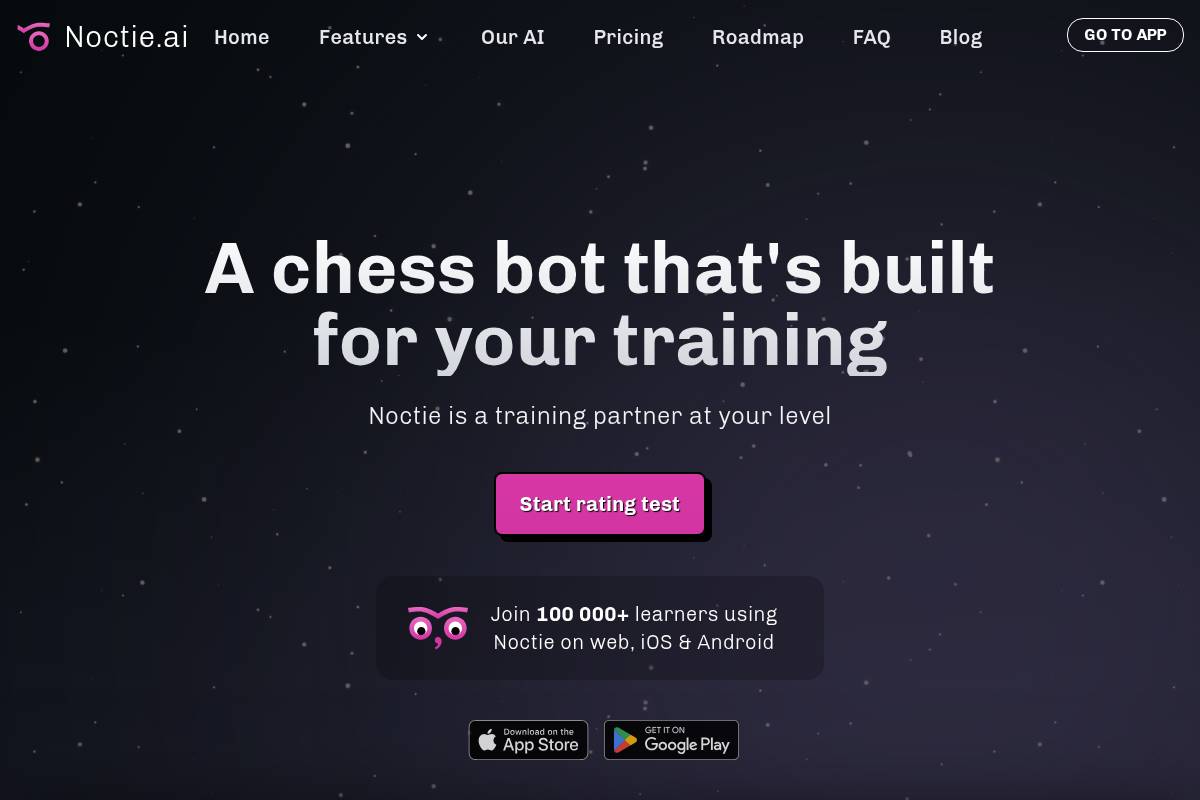
Noctie.ai uses neural networks to play like humans, not perfect calculators. It mimics human play from beginner to grandmaster levels, including humanlike opening choices and mistakes.
Key Features
- Rating-calibrated opponents: Practice against engines calibrated to specific ratings from 600 to 2900.
- Color-coded feedback: Instant feedback categorizing moves as Excellent, Great, Good, OK, Dubious, Mistake, or Blunder.
- Mistake-driven puzzle decks: Generates personalized puzzle decks from your mistakes using spaced repetition.
- Simple pricing: €14/month or €96/year with free 7-day trial.
Best For
USCF players seeking realistic, pressure-free practice games against opponents that accurately simulate human play at their rating.
Pros and Cons
- Pro: More realistic sparring than depth-limited Stockfish.
- Pro: Simple and transparent pricing.
- Con: Coaching depth may fall short of true human-level explanation.
- Con: No broader structured curriculum or tournament community.
Rating: 7.6/10
10. Chessify: Best for Cloud Engine Horsepower
10. Chessify: Best for Cloud Engine Horsepower
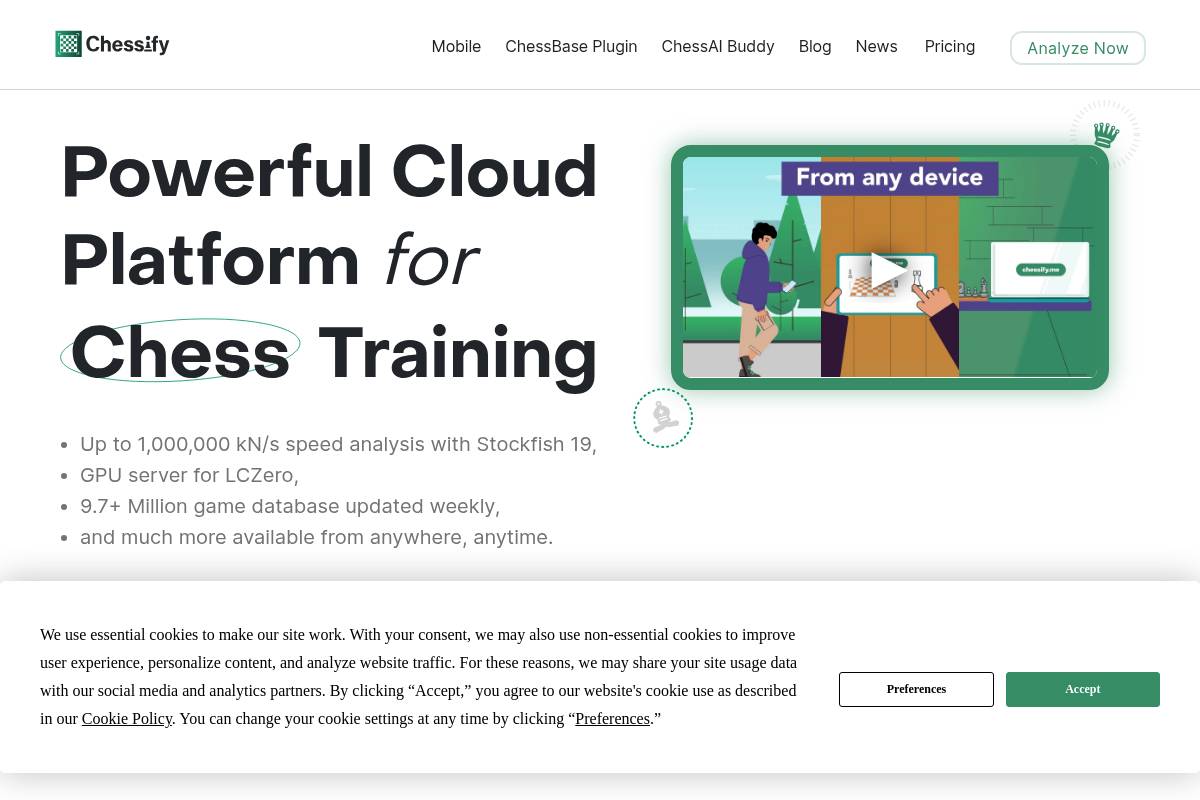
Chessify provides cloud-hosted chess engines that run significantly faster than local computers, built for deep tournament preparation.
Key Features
- Free tier available: Free plan includes all dashboard and notation features plus free analysis at 1,000 kN/s using Stockfish.
- Tiered subscriptions: Plans range from Amateur through Master and GM tiers.
- Massive game database: Over 9 million games updated weekly with opening statistics and references.
- Device-independent power: Stockfish runs on Oracle cloud servers, not your device.
Best For
Advanced USCF competitors and coaches needing serious opponent preparation depth beyond standard free engines.
Pros and Cons
- Pro: Fastest cloud engine access on the market, used by titled players.
- Pro: Free tier available for occasional use.
- Con: Higher subscription tiers can be expensive.
- Con: Focuses on raw engine power, not improvement guidance or structured curriculum.
Rating: 7.4/10
Full Comparison: Chess.com Alternatives for Structured USCF Tournament Preparation
| Tool | Live Coaching | AI Analytics | Rating-Banded Curriculum | Kid-Friendly | Tournament Access | Free Tier |
|---|---|---|---|---|---|---|
| CircleChess | ✓ | ✓ | ✓ | ✓ | ✓ | ✓(demo) |
| Chessable | ✗ | ✗ | ✗ | ✗ | ✗ | ✓ |
| ChessDoji | ✗ | ✗ | ✓ | ✗ | ✗ | ✗ |
| Aimchess | ✗ | ✓ | ✗ | ✗ | ✗ | ✓ |
| ChessBase | ✗ | ✓ | ✗ | ✗ | ✓ | ✗ |
| Chess Tempo | ✗ | ✗ | ✗ | ✗ | ✗ | ✓ |
| DecodeChess | ✗ | ✓ | ✗ | ✓ | ✗ | ✓ |
| Chess-Steps Method | ✓(via coach) | ✗ | ✓ | ✓ | ✗ | ✗ |
| Noctie.ai | ✗ | ✓ | ✗ | ✗ | ✗ | ✓ |
| Chessify | ✗ | ✗ | ✗ | ✗ | ✗ | ✓ |
How to Choose the Right Chess.com Alternative
By Budget
On a tight budget, Aimchess and Chess Tempo offer meaningful free tiers. Mid-range budgets fit well with Chessable or DecodeChess subscriptions. If ready to invest in real coaching outcomes, prioritize CircleChess's structured, mentor-backed pathway over stacking multiple single-feature apps.
By Use Case
Need opening memorization? Chessable wins. Want to understand engine reasoning? DecodeChess. Need raw tournament prep horsepower? ChessBase or Chessify. Looking for a complete Chess.com alternative covering curriculum, coaching, AI practice, and tournaments in one place? CircleChess is the strongest all-around choice.
What Is Structured USCF Tournament Preparation?
Structured USCF tournament preparation refers to a deliberate, milestone-based approach tied to official US Chess Federation rating bands, rather than casual online blitz play. The US Chess Federation administers the national rating system, awards national titles, sanctions over twenty national championships annually, and publishes Chess Life and Chess Life Kids magazines.
| Metric | Why It Matters |
|---|---|
| USCF membership base | Membership as of 2024 was 112,000, reflecting a large, active competitive pool |
| Rating bands | Curriculum levels map to specific USCF/FIDE rating ranges |
| Sanctioned events | Over twenty national championships run annually, requiring targeted preparation cycles |
| Coaching lineage | Curricula designed by titled coaches like GM Vishnu Prasanna add credibility and proven methodology |
Conclusion: The Best Chess.com Alternative for Structured USCF Prep in 2026
CircleChess stands out among Chess.com alternatives for structured USCF tournament preparation because it combines a World Champion's coaching lineage with live instruction, AI-powered self-study, and a genuine FIDE and USCF rating pathway. For single-feature tools, Chessable is the best opening memorization engine, ChessDoji offers strong cohort-based self-study, and ChessBase or Chessify deliver professional-grade preparation depth for advanced competitors. The smartest approach is to anchor training around a structured platform like CircleChess and layer in specialized tools where they add value.
Frequently Asked Questions
What are the best Chess.com alternatives for structured USCF tournament preparation in 2026?
The strongest options are CircleChess for full structured coaching, Chessable for opening memorization, ChessDoji for cohort-based self-study, and ChessBase or Chessify for deep tournament preparation software.
Is CircleChess better than Chess.com for tournament preparation?
CircleChess focuses specifically on structured, milestone-based USCF and FIDE preparation with a curriculum designed by GM Vishnu Prasanna, former coach of World Champion Gukesh D, plus live mentor feedback and parent dashboards. Chess.com is a general-purpose platform that doesn't offer the same tournament-focused depth.
Do any of these platforms offer a free trial or free tier?
Yes. CircleChess offers free demo classes, Aimchess and Chess Tempo have functional free tiers, Chessify offers a free analysis tier, and Noctie.ai includes a free 7-day trial.
Which chess platform is best for young beginners and kids?
CircleChess and the Chess-Steps Method are the strongest choices for young learners, using rating-banded, age-appropriate progression with coach or mentor guidance.
Can these tools help my child prepare specifically for USCF rated tournaments?
Yes, particularly CircleChess, ChessDoji, and the Chess-Steps Method, all structured around specific USCF or FIDE rating bands with clear milestones tied to tournament readiness.
Is Chessable or DecodeChess better for a player under 1500 rating?
DecodeChess is generally better under 1500, explaining engine reasoning in plain language for players up to about 2000 ELO. Chessable's dense interface suits players 1500+ with existing repertoires.
Do I need more than one tool, or is one platform enough?
Most serious USCF competitors benefit from anchoring training in one structured platform like CircleChess and layering in a specialized tool like Chess Tempo or ChessBase for tactics or opponent preparation as needed.
Methodology: This article evaluated 10 platforms based on curriculum structure, coaching quality, AI and analytics depth, value for price, kid and parent friendliness, and community and tournament access, drawing on official vendor pricing pages, product documentation, and independent reviews current as of September 2026.