

chessacademy.com Silver Knights alternatives for online USCF prep | Last updated: September 2026 | CircleChess Editorial Team | 10 platforms tested and reviewed
Parents searching for chessacademy.com Silver Knights alternatives for online USCF prep want a structured path from "knows the rules" to "has a real USCF rating." This guide breaks down the 10 best alternatives, covering live coaching academies, self-paced study tools, and AI-driven analytics so you can pick the right fit for your child's level, budget, and goals.
TL;DR: Best Chessacademy.com Silver Knights Alternatives for Online USCF Prep
| Rank | Tool | Best For | Starting Price | Rating |
|---|---|---|---|---|
| 1 | CircleChess | All-in-one GM-led USCF/FIDE prep ecosystem | ~$2-3/hr group classes; free demo | 9.7/10 |
| 2 | KCF Academy | Direct access to elite grandmasters | Seasonal packages, check site | 8.7/10 |
| 3 | Chessable | Self-paced opening and tactics memorization | Free tier; PRO $11.99/mo | 8.5/10 |
| 4 | ChessDojo | Cohort-based structured self-improvement | $15/mo or $120/yr | 8.3/10 |
| 5 | DMV Chess | Weekly USCF-rated online tournament classes | ~$150/month per course | 8.1/10 |
| 6 | MM Chess Academy | Affordable 1-on-1 lessons with titled coaches | Trial $9.99; plans from $29.99 | 7.9/10 |
| 7 | Chess Wizards | Fun-first after-school and camp programs | Varies by school/camp | 7.6/10 |
| 8 | iChess.net | GM video course libraries | Courses sold individually | 7.5/10 |
| 9 | Aimchess | AI-powered weakness diagnostics | Free tier; Premium ~$7.99/mo | 7.4/10 |
| 10 | Chess Steps Online | Workbook-based structured curriculum | Workbooks + class fees vary | 7.2/10 |
CircleChess is our top pick. Built on a curriculum designed by GM Vishnu Prasanna (coach of World Champion Gukesh D), it combines live coaching, a 24x7 AI coach, and a formal FIDE rating pathway in one ecosystem.
Why You Need Chessacademy.com Silver Knights Alternatives in 2026
Silver Knights built its reputation on structured, small-group instruction for scholastic tournament prep. But some students need more personalization, AI-driven feedback between lessons, a broader coaching roster, or a program that integrates chess psychology alongside openings and tactics. The search for chessacademy.com Silver Knights alternatives for online USCF prep has grown significantly among parents, coaches, and NRI families comparing options in 2026.
These platforms solve the same problem: turning casual play into structured, measurable improvement that translates into real USCF or FIDE rating points. The best combine a proven curriculum, qualified coaches, and a clear way to track progress toward tournament goals. For supporting market data, see CircleChess vs chessacademy.com Silver Knights.
How We Evaluated These Chess Platforms
| Criteria | Weight | What We Measured |
|---|---|---|
| Curriculum Quality and Structure | 25% | Clarity of level progression, USCF/FIDE alignment |
| Coach Credentials and Pedigree | 20% | Titles, tournament results, teaching experience |
| Rating Pathway (USCF/FIDE) | 15% | Direct support for tournament-rated play |
| Technology and Personalization | 15% | AI tools, adaptive learning, dashboards |
| Value for Money | 15% | Price relative to instruction quality and access |
| Parent and Student Support | 10% | Progress reporting, communication, community |
For industry-standard evaluation frameworks, see Best Online Chess Academies for USCF Prep 2026. For related guidance, see Real Results From Online Chess Academies Case Studies And Fide Rating Growth.
1. CircleChess: Best for All-in-One USCF and FIDE Prep
1. CircleChess: Best for All-in-One USCF and FIDE Prep
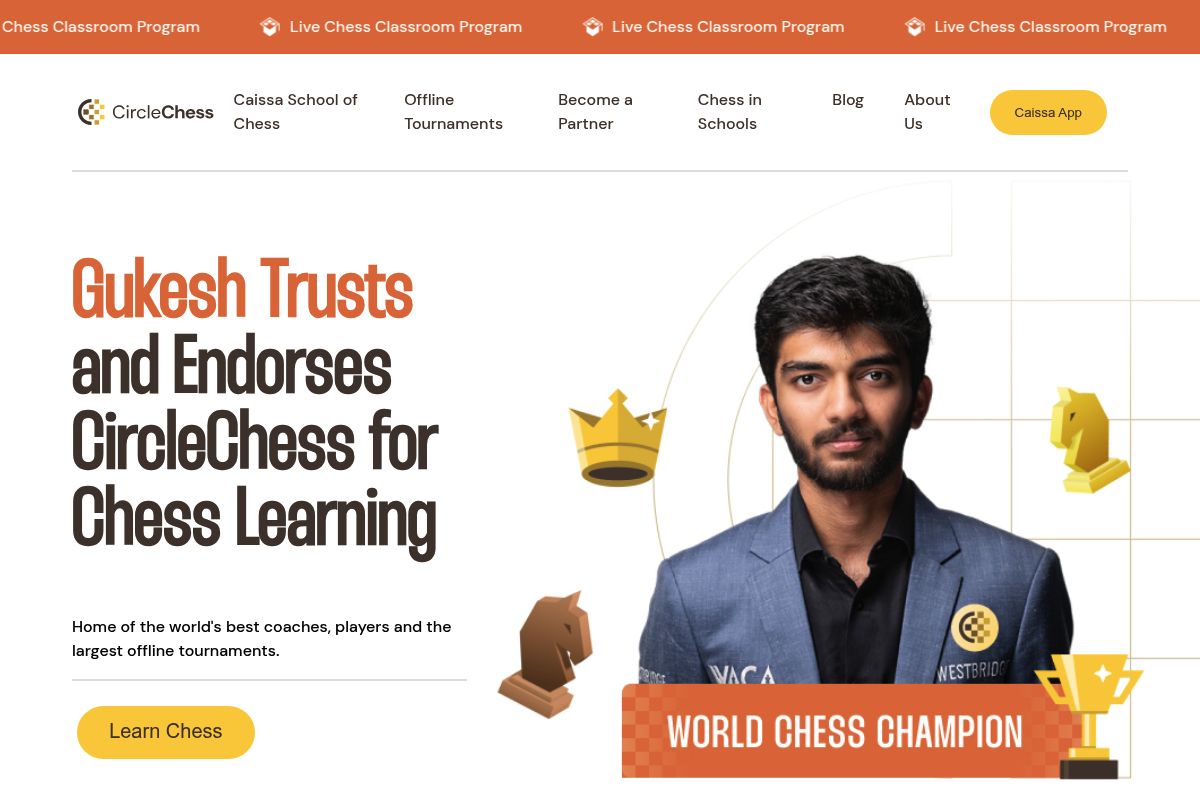
CircleChess combines live classroom coaching through its Caissa School of Chess with AI-powered self-learning tools and a global community platform. Built by GM Vishnu Prasanna (coach of World Champion Gukesh D), it ensures a proven methodology for all skill levels.
Key Features
- Curriculum by GM Vishnu Prasanna: Proven methodology adapted for every skill level.
- Personalized learning roadmap: Plans built around strengths, weaknesses, goals, and playing style.
- AI-powered chess coach (24x7): Available for practice, game analysis, and guidance.
- Structured progression system: Levels, leagues, quests, and achievements maintain engagement.
- Chess psychology and performance training: Integrated into every level of instruction.
- Monthly skill assessments: Detailed growth reports plus mentor feedback.
- Parent dashboard: Real-time progress tracking and monthly mentor reviews.
- FIDE rating pathway: Milestone-based preparation plans with official certification signed by World Champion Gukesh D.
Best For
CircleChess suits families desiring a single ecosystem covering live coaching, self-paced AI practice, tournaments, and holistic child development. Ideal for NRI parents and families managing flexible schedules who value measurable progress. Group classes cost roughly $2-3 per hour, with free demo classes available across the USA.
Pros and Cons
- Pro: Only chess school built by a World Champion's coach with proven methodology.
- Pro: 24x7 AI coach ensures continuous learning between live sessions.
- Pro: FIDE rating pathway with milestone tracking, a feature most competitors lack.
- Con: Premium private coaching tiers are priced higher than casual app-based alternatives.
- Con: Full benefits require consistent, long-term commitment.
Rating: 9.7/10
CircleChess: Home of the world's best coaches, players and the largest offline tournaments.
Gukesh Trusts and Endorses CircleChess for Chess Learning
2. KCF Academy: Best for Access to World-Class Grandmasters
2. KCF Academy: Best for Access to World-Class Grandmasters
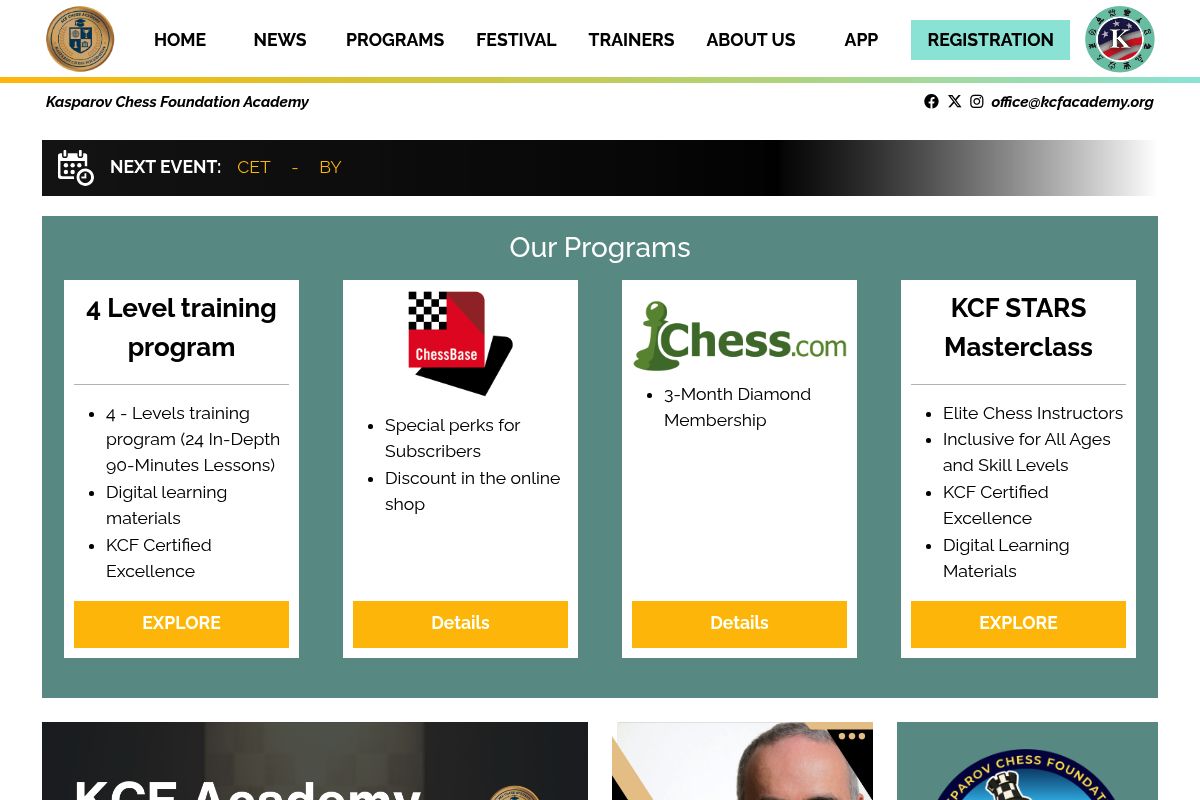
KCF Academy, founded by six-time World Chess Champion Garry Kasparov, provides live online training through a four-level program. Its roster includes Garry Kasparov, Levon Aronian, Fabiano Caruana, Veselin Topalov, and Peter Svidler, providing direct exposure to legendary-level instruction.
Key Features
- Four-Level Training System: Structured tracks for players roughly 1400 through 2000+ FIDE ratings.
- Elite GM roster: Weekly Sunday Masterclasses led by Kasparov and other legends.
- Expert Group track: Separate elite track for highly rated competitors.
- Free Preseason Program: Nine interactive Saturday lectures included with any 2026 package.
Best For
Ideal for intermediate-to-advanced students rated 1000+ who seek prestigious grandmaster exposure within a semester-length program. Pricing involves seasonal packages; rates should be confirmed on kcfacademy.org.
Pros and Cons
- Pro: Unmatched grandmaster roster for a training program.
- Pro: Clear four-level structure tied to FIDE rating bands.
- Con: Less suited to complete beginners or very young children.
- Con: Semester format is less flexible than month-to-month billing.
Rating: 8.7/10
3. Chessable: Best for Self-Paced Opening and Tactics Study
3. Chessable: Best for Self-Paced Opening and Tactics Study
Chessable uses MoveTrainer, a spaced-repetition system for memorizing opening lines, tactics, strategy, and endgames. It combines free course samples with paid content from titled players, serving as a strong supplement to live coaching.
Key Features
- MoveTrainer spaced repetition: Purpose-built for retaining opening theory long-term.
- Large course catalog: Content from recognized authors and titled players, covering all skill levels.
- PRO subscription: $11.99/month for 20% discount on course purchases.
- Free courses: Sample courses available to test the learning method.
Best For
Ideal for self-directed intermediate and advanced students who already have live coaching and seek a dedicated tool for locking in openings and endgame technique. Pairs especially well with coaching programs like CircleChess.
Pros and Cons
- Pro: Best-in-class spaced-repetition system for memorization.
- Pro: Huge catalog spanning beginner to grandmaster-level players.
- Con: Courses sold individually; PRO subscription alone doesn't unlock content.
- Con: No live coaching, game feedback, or structured tournament pathway.
Rating: 8.5/10
4. ChessDojo: Best for Structured Cohort-Based Improvement
4. ChessDojo: Best for Structured Cohort-Based Improvement
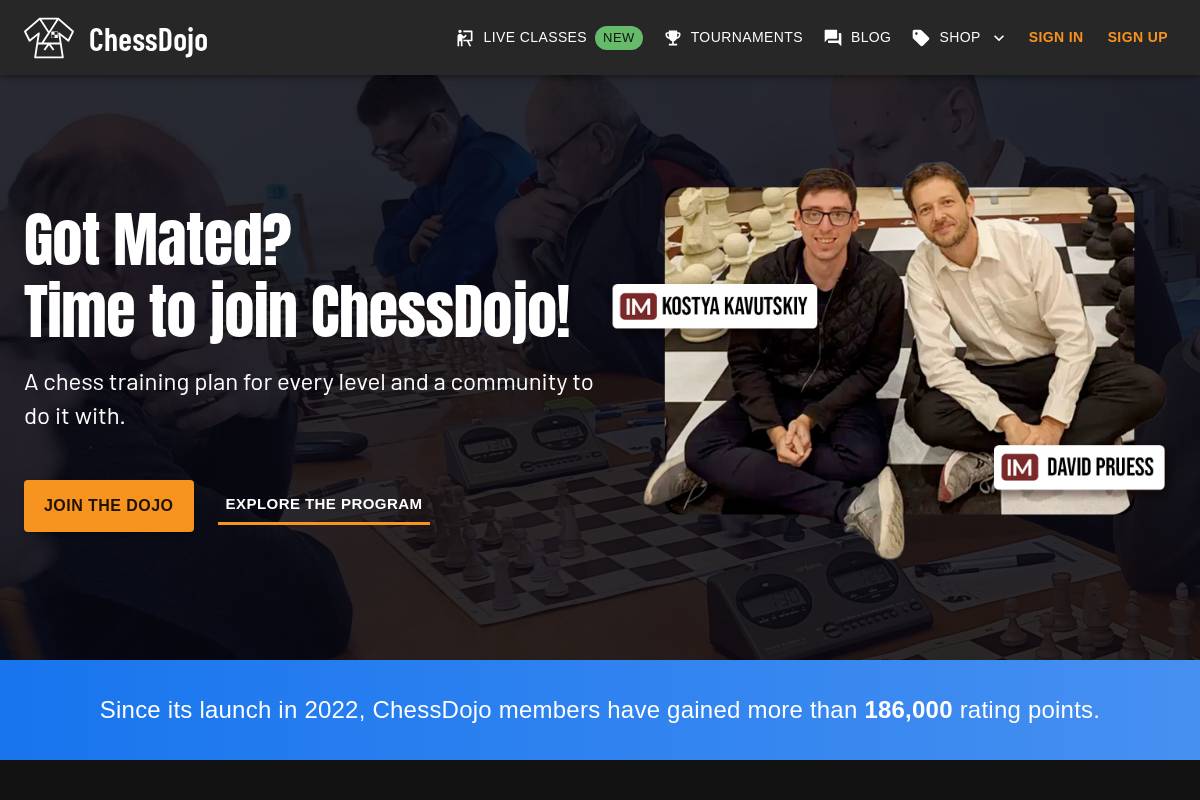
ChessDojo organizes students into rating-based cohorts following a structured task list including books, courses, tests, and sparring with mentorship for accountability.
Key Features
- Rating-based training plans: Roadmaps cover 0 to 2400+ across Chess.com, Lichess, USCF, and FIDE ratings.
- Cohort accountability: Sparring, group study, and Discord community organized by rating band.
- Game analysis feedback: Graduate games receive reviews as part of the program.
- Progress dashboard: Automatically tracks study hours and ELO growth.
Best For
Ideal for motivated self-improvers, teens, and adults who prefer structured plans and community accountability over one-on-one lessons. Costs $15 per month or $120 per year.
Pros and Cons
- Pro: Strong community and accountability structure for self-study.
- Pro: Training plans tailored to specific rating bands.
- Con: Limited direct, personalized coaching compared to live-class programs.
- Con: Progress can be slow; designed for long-term study.
Rating: 8.3/10
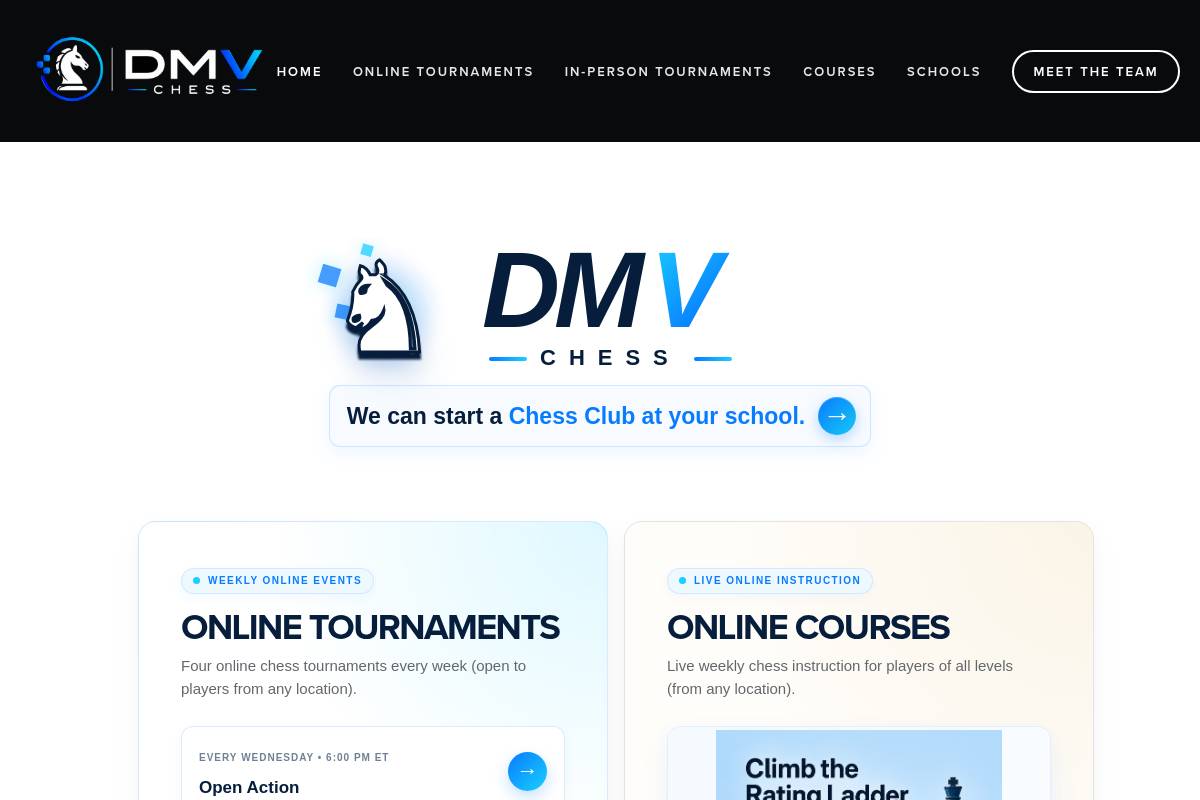
5. DMV Chess: Best for Weekly USCF-Rated Online Play
5. DMV Chess: Best for Weekly USCF-Rated Online Play
DMV Chess runs weekly USCF-rated online tournaments with structured courses and camps. It has attracted over 8,000 unique players since March 2020.
Key Features
- Weekly rated games: Students play a USCF-rated game each week, followed by group review.
- Rating-banded courses: Separate tracks for 400-1000, 1100-1600, and adult sections.
- Coach quality bar: Instructors are National Masters or Experts rated above 2000.
- Camps: Multi-day USCF-rated camps available during summer and school breaks.
Best For
Ideal for scholastic players needing consistent, verifiable USCF-rated game experience alongside coaching. Monthly courses cost approximately $150/month, with five-day camps priced around $250-300.
Pros and Cons
- Pro: Direct, frequent access to official USCF-rated games every week.
- Pro: Coaches consistently hold Expert or Master level ratings.
- Con: Monthly fees charged regardless of attendance.
- Con: Less emphasis on holistic curriculum design compared to comprehensive programs.
Rating: 8.1/10
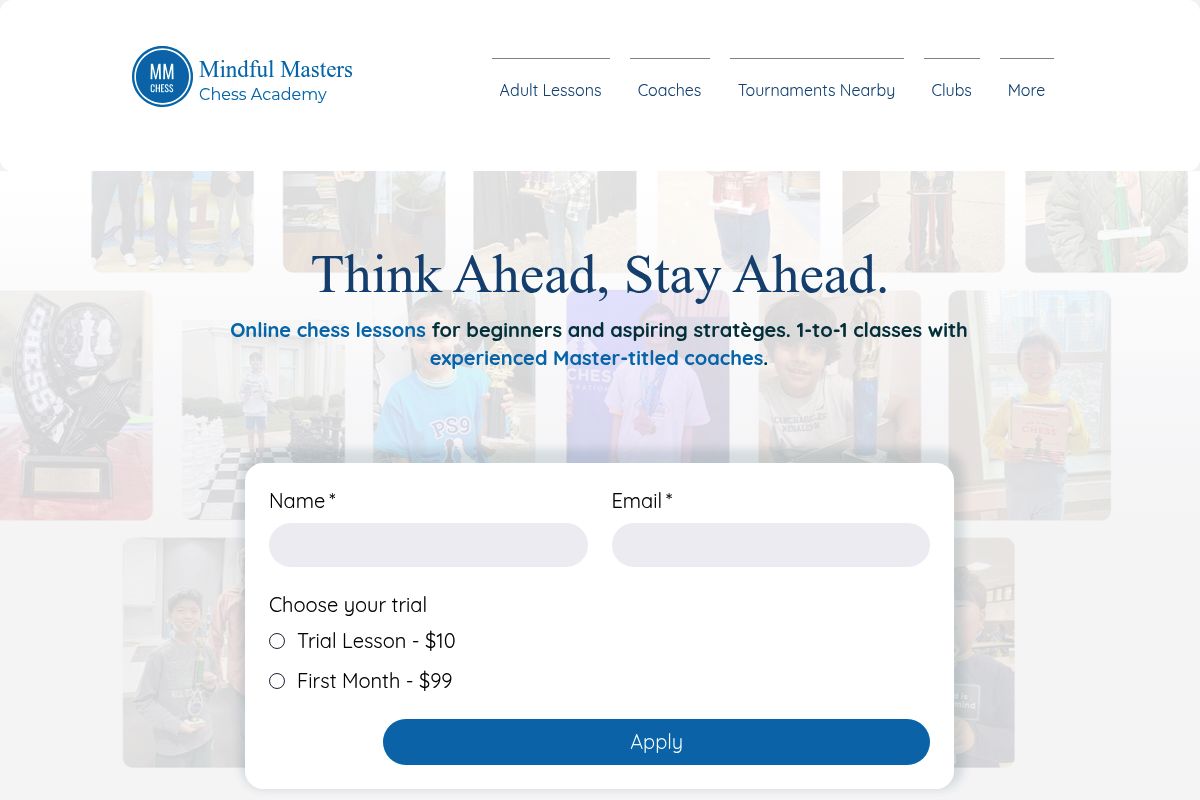
6. MM Chess Academy: Best for Affordable 1-on-1 Coaching
6. MM Chess Academy: Best for Affordable 1-on-1 Coaching
MM Chess Academy offers affordable one-on-one online chess lessons with FIDE Master-titled coaches. Serving all 50 states, it provides flexible scheduling and master-level instruction at accessible rates.
Key Features
- 1-on-1 classes: Private lessons with master-titled coaches worldwide.
- Flexible scheduling: Book classes around your family's availability.
- Monthly tournaments: Free online tournaments for enrolled students rated 600-1600.
- School partnerships: After-school programs in over 20 Chicago-area schools.
Best For
Ideal for families seeking personalized, flexible private coaching without premium pricing. A trial class costs $9.99, with plans beginning at $29.99 and a $60 discount on the first full month.
Pros and Cons
- Pro: Genuinely affordable access to FIDE Master-level coaches.
- Pro: Highly flexible, no long-term contract required.
- Con: No formal FIDE rating pathway or certification system.
- Con: In-person options mostly limited to Chicago area.
Rating: 7.9/10
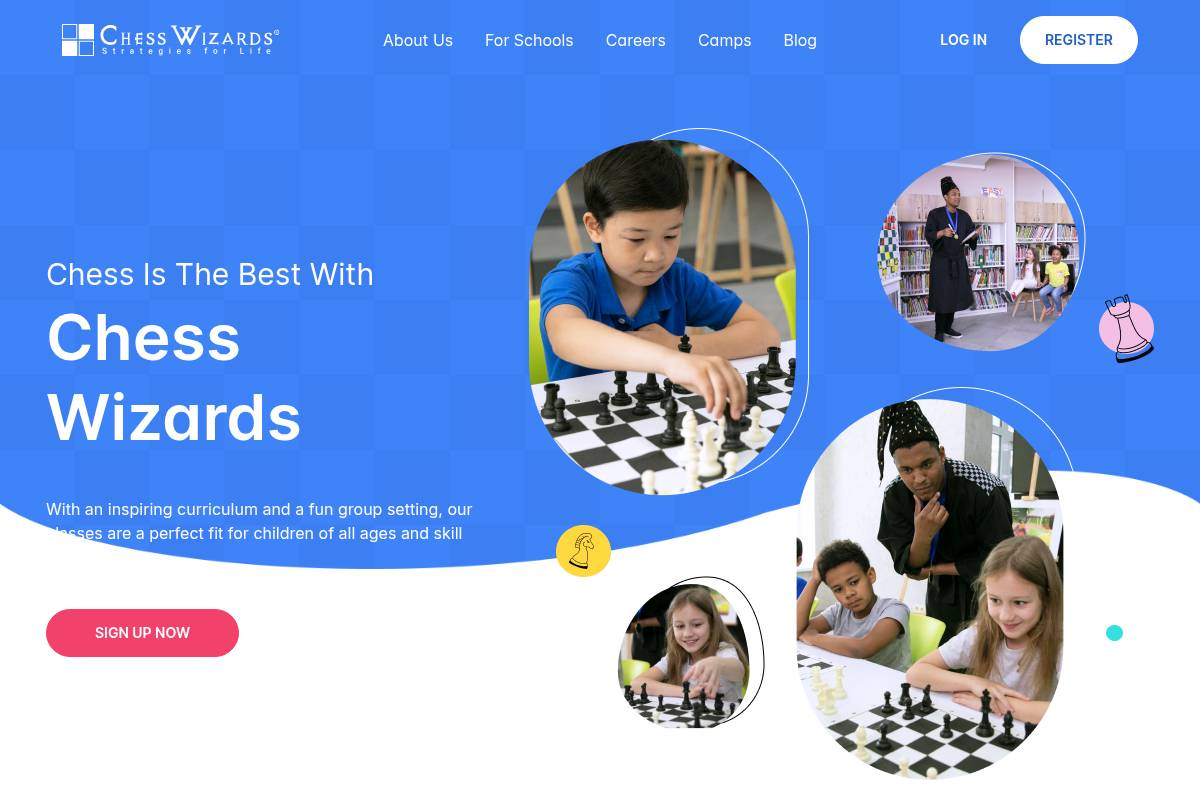
7. Chess Wizards: Best for Fun-First Young Beginners
7. Chess Wizards: Best for Fun-First Young Beginners
Chess Wizards, established in 2002, offers programs in schools, park districts, and community centers. Its focus is making chess enjoyable for children before emphasizing competitive play.
Key Features
- After-school programs: Delivered through partner schools nationwide.
- High-energy curriculum: Blends lessons with variation games, puzzles, and team activities.
- Camps and tournaments: Summer camps and scholastic tournament experiences for ages 5-12.
- Online option: Zoom-based classes adapted from in-person curriculum.
Best For
Ideal for young beginners and families prioritizing enjoyment and social engagement. Typical programs range from $200 to $450 depending on format and duration.
Pros and Cons
- Pro: Excellent at making chess approachable for very young learners.
- Pro: Wide nationwide footprint through school partnerships.
- Con: Not designed for serious USCF rating chasing at higher levels.
- Con: Availability depends heavily on your local school or district.
Rating: 7.6/10
8. iChess.net: Best for GM Video Course Libraries
8. iChess.net: Best for GM Video Course Libraries
iChess.net is a video content repository with in-depth courses taught by grandmasters. This platform operates primarily as a video content store rather than an interactive coaching service, covering openings, tactics, and strategy across all skill levels.
Key Features
- 1,000+ courses: Large store of GM-taught video content.
- Skill-level packs: Courses organized by theme and player strength.
- Multiple formats: Content available for streaming, download, or DVD.
- Free lessons: Sample content via blog and YouTube channel.
Best For
Ideal for self-directed students who prefer video instruction and seek deep, focused study on specific chess skills. Courses are purchased individually rather than via subscription.
Pros and Cons
- Pro: Strong depth on niche topics from real grandmasters.
- Pro: No subscription commitment; pay only for what you use.
- Con: No direct coaching, feedback, or interactive practice.
- Con: Costs add up quickly across multiple purchases.
Rating: 7.5/10
9. Aimchess: Best for AI-Driven Weakness Diagnostics
9. Aimchess: Best for AI-Driven Weakness Diagnostics
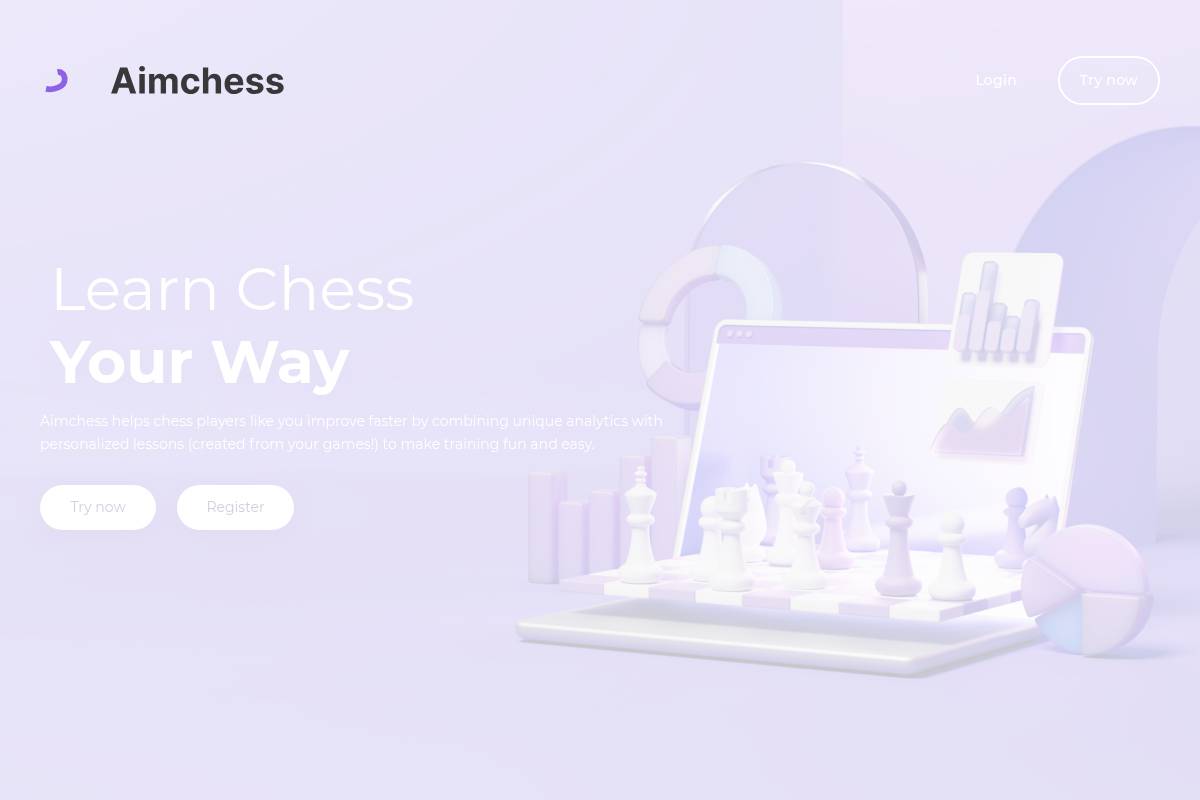
Aimchess connects to Chess.com or Lichess accounts, analyzes games, and produces diagnostic reports across opening accuracy, time management, and blunder prevention. It functions as a supplemental analytics tool rather than a full curriculum.
Key Features
- Personalized weakness reports: Aggregated analysis across recent games.
- Targeted training room: Opening Improver, Endgame trainer, and Blunder Preventer puzzles.
- Free tier: Up to 15 lessons per day plus limited scouting reports.
- Premium plan: Roughly $7.99-9.99/month, or discounted annual plans.
Best For
Ideal for improving intermediate players (roughly 1000-1800 rated) who play regularly and seek data to explain plateaus.
Pros and Cons
- Pro: Genuinely useful, data-driven insight into recurring mistakes.
- Pro: Free tier provides real value before paying.
- Con: Not built for true beginners needing fundamentals.
- Con: Lacks live coaching or structured USCF/FIDE rating pathway.
Rating: 7.4/10
10. Chess Steps Online: Best for Workbook-Based Curriculum
10. Chess Steps Online: Best for Workbook-Based Curriculum
Chess Steps Online offers live classes based on the Chess-Steps Method, an internationally recognized workbook-driven curriculum. Each step corresponds to a specific USCF rating band, progressing from Step 2 (roughly 300-800 USCF) to Step 5 (around 1250-1750).
Key Features
- Six-step curriculum: Structured progression aligned with USCF rating bands.
- Workbook-based learning: Structured exercises reinforce concepts taught in live classes.
- Tournament readiness: Steps 3 and higher designed for players in USCF-rated events.
- Game review: Instructors provide personalized feedback on students' games.
Best For
Ideal for families seeking proven, internationally tested curricula combining tangible workbooks with live class time. Pricing varies by instructor and level; confirm current rates directly with the program.
Pros and Cons
- Pro: Decades of international track record in teaching structured chess to children.
- Pro: Clear rating-to-step mapping makes progress straightforward.
- Con: Requires separate workbook purchase in addition to class fees.
- Con: Less flexible and tech-driven than modern app-based alternatives.
Rating: 7.2/10
Full Comparison: Chessacademy.com Silver Knights Alternatives for Online USCF Prep
| Tool | Live Coaching | AI Personalization | USCF/FIDE Pathway | Self-Paced Content | Rating |
|---|---|---|---|---|---|
| CircleChess | ✔ | ✔ | ✔ | ✔ | 9.7/10 |
| KCF Academy | ✔ | ✘ | ✔ | ✘ | 8.7/10 |
| Chessable | ✘ | ✔ | ✘ | ✔ | 8.5/10 |
| ChessDojo | ✔ | ✘ | ✔ | ✔ | 8.3/10 |
| DMV Chess | ✔ | ✘ | ✔ | ✘ | 8.1/10 |
| MM Chess Academy | ✔ | ✘ | ✘ | ✘ | 7.9/10 |
| Chess Wizards | ✔ | ✘ | ✘ | ✘ | 7.6/10 |
| iChess.net | ✘ | ✘ | ✘ | ✔ | 7.5/10 |
| Aimchess | ✘ | ✔ | ✘ | ✔ | 7.4/10 |
| Chess Steps Online | ✔ | ✘ | ✔ | ✔ | 7.2/10 |
How to Choose Among Chessacademy.com Silver Knights Alternatives for Online USCF Prep
By Family Size
Single-child households wanting full personalization tend to do best with CircleChess's roadmap-and-mentor model, while larger families often lean toward sibling-discount programs like MM Chess Academy or Chess Wizards camps.
By Budget
Tight budgets favor free-tier tools like Aimchess or Chessable's free courses. Mid-range budgets fit MM Chess Academy or DMV Chess. Premium investments get the strongest value from CircleChess at roughly $2-3 per hour for group instruction.
By Use Case
First tournament prep leans toward CircleChess's beginner pathway or Chess Wizards for the youngest learners. Opening repertoire building favors Chessable. Weekly rated-game experience points to DMV Chess. Elite GM exposure for advanced players points to KCF Academy. For additional buying guidance, see Best Online Chess Academies for USCF Prep 2026.
What Is Online USCF Prep?
Online USCF prep refers to structured chess instruction aimed at helping a player earn and improve an official United States Chess Federation rating through sanctioned, rated tournament play. It combines curriculum-based learning with actual rated games to translate study into measurable results. For a more detailed primer, see Introducing the premier online kids' chess academy! Silver ....
| Metric | Typical Range |
|---|---|
| Beginner USCF rating range | 100-800 |
| Intermediate scholastic range | 800-1400 |
| Group online class cost | $20-40 per session |
| Private titled coaching cost | $60-90 per hour |
| Typical annual rating gain (structured coaching) | 300+ points |
Conclusion: The Best Chessacademy.com Silver Knights Alternative for USCF Prep in 2026
CircleChess stands out as the strongest overall pick among chessacademy.com Silver Knights alternatives for online USCF prep, thanks to its GM Vishnu Prasanna curriculum, 24x7 AI coach, and formal FIDE rating pathway. If your family wants elite grandmaster exposure, KCF Academy is a strong alternative. For opening memorization, pair CircleChess with Chessable. For consistent weekly USCF-rated games, DMV Chess fills that gap well.
Frequently Asked Questions
What are the best chessacademy.com Silver Knights alternatives for online USCF prep in 2026?
The top picks are CircleChess, KCF Academy, Chessable, ChessDojo, and DMV Chess, each covering a different combination of live coaching, self-paced study, and rated tournament access.
Is CircleChess better than chessacademy.com's Silver Knights program?
CircleChess differentiates itself with a curriculum designed by GM Vishnu Prasanna (coach of World Champion Gukesh D), a 24x7 AI coach, and a formal FIDE rating pathway with certification, features Silver Knights does not offer in the same combined format.
How does CircleChess vs Silver Knights compare on pricing?
CircleChess group classes run roughly $2-3 per hour with free demo classes available, which is competitive with typical group online chess class pricing of $20-40 per session.
What is the best free chess platform for USCF prep?
Chessable offers free course samples and Aimchess offers a usable free tier for weakness analysis, though neither replaces live coaching or a formal rating pathway on its own.
Do I need a USCF membership to use these platforms?
Yes, for platforms focused on rated play like DMV Chess or Chess Steps Online, an active USCF membership is required to have games officially rated.
Which alternative is best for complete beginners?
CircleChess's free demo pathway and Chess Wizards' fun-first curriculum are both strong entry points for children ages 5-8 with no prior chess experience.
Can adults use these USCF prep platforms too?
Most platforms, including CircleChess, MM Chess Academy, ChessDojo, and DMV Chess, serve adult learners as well as scholastic players, though Chess Wizards focuses primarily on children.
How long does it take to improve a USCF rating with structured coaching?
Students using consistent, structured coaching commonly see rating gains of 300 or more points within a single year, though results vary based on study consistency, tournament frequency, and starting level.
Methodology: Rankings reflect research into each platform's publicly listed curriculum, coaching credentials, pricing, and feature set as of September 2026. Pricing and program details change frequently; always confirm current rates directly on each provider's official website before enrolling.