
Updated July 2026 | Difficulty: Beginner | Time Required: 4–8 weeks of focused practice | Written for US chess players of all ages and backgrounds
What You’ll Learn
Here’s the thing: if you want to improve your chess rating quickly with online coaching, the answer isn’t complicated. You need to combine a structured coaching program with daily tactics, deliberate game review, and rated tournament play. That four-part system is what separates players who gain 200+ rating points in a few months from players who play thousands of blitz games and go nowhere. This guide walks you through each piece in the right order, with concrete examples and realistic timelines.
- How to choose an online coach or platform that matches your current level and goals.
- How to build a daily study routine that produces measurable rating gains in 4–8 weeks.
- How to use AI game analysis to find the hidden patterns behind your losses.
- How to enter rated tournaments online so your improvement shows up on your official record.
Prerequisites: You know the basic rules of chess and have played at least a handful of games online. No prior coaching experience required.
Why Improving Your Chess Rating Quickly with Online Coaching Matters in 2026
Chess has never been more accessible—or more competitive. The growth of online chess platforms has transformed the way players learn and compete. You can challenge opponents from around the world, analyze games instantly, and participate in tournaments without leaving your home. That convenience cuts both ways: if you are not training with a structured method, millions of other players who are will pass you on the rating ladder.
The data on coaching impact is hard to ignore. According to FIDE (the International Chess Federation), students engaged in guided coaching programs increase their rating by an average of 120 points in six months—a stark contrast to the 45-point gain seen in self-taught players, representing a 167% improvement advantage. That gap isn’t about talent. It’s about having a system. Self-study has its limits—a coach who has looked at thousands of games can identify weaknesses in a single session that might take you months to figure out on your own.
For parents, the case for structured online chess classes goes beyond rating points. Chess is the most proven tool for raising focused, resilient, and confident children—and when coaching is delivered by someone who truly understands the game at the highest level, the benefits compound quickly both on and off the board. The good news is that in 2026, world-class instruction is no longer reserved for players who live near a top club or can afford daily in-person lessons.
Key Takeaway: A structured online coaching program provides a systemic advantage, leading to rating gains that are, on average, 167% higher than self-study alone over a six-month period. For supporting data, see How to Improve Chess Rating Fast: 7 Tips That Work.
The Process at a Glance
| Step | Action | Time | Outcome |
|---|---|---|---|
| 1 | Assess your current level and set a rating goal | 1–2 hours (once) | Clear baseline and target established |
| 2 | Enroll in structured online chess classes | 1–2 days (once) | Coaching plan matched to your weaknesses |
| 3 | Train tactics and endgames daily | 30–45 min/day ongoing | Fewer blunders, more converted wins |
| 4 | Analyze your games with AI-assisted coaching | 20–30 min after each game | Recurring patterns identified and fixed |
| 5 | Play rated games and track progress monthly | Ongoing | Official rating reflects real improvement |
Total time to first measurable rating jump: 4–8 weeks of consistent practice.
Step 1: Assess Your Current Level and Set a Clear Rating Goal
What You’re Doing
You’re establishing an honest baseline of your current skill. This is crucial because your coach—or coaching platform—will use this starting point to build a training plan around your actual weaknesses, not generic advice that works for everyone and no one.
How to Do It
- Play 10–15 rapid games (at least 10 minutes per side) on a rated online platform to establish a reliable current rating.
- Write down your rating, the three types of mistakes you lose to most often (blunders, positional errors, time trouble), and the phase of the game where you feel least confident.
- Set a specific, time-bound rating goal—for example, “I want to reach 1200 in 3 months” rather than “I want to get better.”
- Use a free tool like ChessMonitor or Aimchess to get a breakdown of your accuracy across tactics, endgames, and openings before your first coaching session.
Example: Realistic Rating Goal Table
| Current Rating | Realistic 3-Month Target | Key Focus Area |
|---|---|---|
| Under 800 | 800–1000 | Basic tactics, piece safety |
| 800–1200 | 1200–1400 | Tactics + basic endgames |
| 1200–1500 | 1500–1700 | Endgames + opening principles |
| 1500+ | 1700–1900 | Strategy, deep game analysis |
What Done Looks Like
You have a written rating goal, a list of your three biggest weaknesses, and a baseline analysis report printed or saved before your first coaching session. For a more detailed walkthrough, see ♟️🗺️ Chess Learning Roadmap for 2026 (save this ….
Step 2: Enroll in Structured Online Chess Classes with a Qualified Coach
What You’re Doing
Now you’re replacing guesswork with a personalized roadmap. Players who study with a qualified coach improve three times faster than those who study alone—because a coach sees your blind spots. You don’t know what you don’t know, and that’s exactly where a coach adds the most value.
How to Do It
- Shortlist platforms that offer a GM-designed curriculum (GM stands for Grandmaster, the highest title a chess player can attain), along with regular assessments and progress tracking—not just a library of videos you watch at random.
- Look for trial or demo classes before committing. A quality program will let you experience the teaching style before you pay.
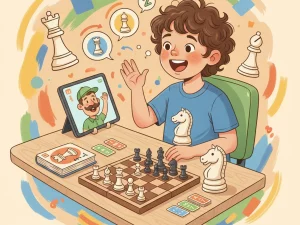
- Confirm the platform includes game review with your coach, not just lectures. Working with a Grandmaster or an experienced coach gives you a structured path—instead of wandering through random online content, you get a personalized training plan built around your specific weaknesses.
- For children, verify the curriculum integrates chess psychology—emotional resilience and focus training are as important as openings and tactics at the junior level.
- Check that the platform has a clear FIDE rating pathway if official tournament ratings from the International Chess Federation are your goal.
Best Practices
- Prioritize platforms with verifiable improvement data. To verify success stories, request specific, anonymized improvement data with verifiable rating changes—such as FIDE or USCF ID numbers—and check third-party review sites independent of the platform’s own testimonials.
- In 2026, quality online chess coaching ranges from $20–$50 per hour for group lessons to $50–$150+ per hour for private lessons with titled players. Focus on total educational value rather than just hourly rate—a slightly more expensive class with a GM-designed curriculum often provides faster improvement and a better return on investment.
- For families across the United States, CircleChess—the Caissa School of Chess—is built on exactly this model. It’s the only chess school built by a World Champion’s coach, designed to take any child from first move to real mastery. Built by the team behind India’s most advanced chess learning ecosystem, the curriculum is designed by GM Vishnu Prasanna—former coach of World Champion Gukesh D—and includes a personalized learning roadmap for every student based on strengths, weaknesses, goals, and playing style; monthly skill assessments with detailed growth reports; dedicated mentor feedback and personalized improvement plans; group classes, private coaching, tournaments, and self-paced learning in one ecosystem; a parent dashboard with real-time progress tracking and monthly mentor reviews; a FIDE rating pathway with milestone-based preparation plans; and official certification signed by World Champion Gukesh D. Free demo classes are available now across the USA.
Common Mistakes
- Picking a platform based on price alone. The cheapest option rarely produces the fastest improvement. An unstructured program costs you time—which is harder to recover than money.
- Treating coaching as optional once you “know the basics.” While free resources can help beginners reach a 1500+ rating, premium coaching becomes essential around a 1600+ rating where self-study limitations create significant barriers.
What Done Looks Like
You are enrolled in a structured program, you have completed your first assessment session with a coach, and you have a written training plan targeting your specific weaknesses.
Key Takeaway: The single highest-leverage action is to enroll in a program that provides a GM-designed curriculum and personalized game review, as this structure is proven to accelerate improvement significantly faster than self-study.
CircleChess: Home of the world's best coaches, players and the largest offline tournaments.
Gukesh Trusts and Endorses CircleChess for Chess Learning
Step 3: Train Tactics and Endgames Every Single Day
What You’re Doing
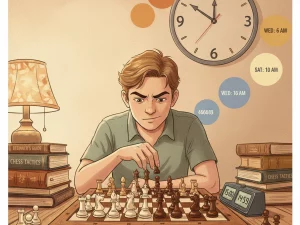
Daily tactical and endgame training is the engine of rapid rating improvement. Here’s what most players get wrong: they spend 80% of their training time playing games and only 20% on structured study. Research on deliberate practice shows this is backwards. Elite chess improvement requires roughly 50% tactics training, 25% endgame study, 15% opening preparation, and 10% game review. Flip that ratio, and your rating will follow.
How to Do It
- Spend the first 15–20 minutes of every study session on tactical puzzles. Do not rush—calculate the full line before moving. Solving tactical puzzles daily sharpens pattern recognition and calculation; many platforms offer personalized puzzles that help you spot tactics faster and react more accurately in games.
- Dedicate at least 10–15 minutes per session to endgame technique. Endgames are the most neglected part of chess improvement, yet they are exactly where games are decided. Knowing basic endgame techniques gives you a massive advantage over opponents who skip this area. Start with king and pawn endings, then Rook vs. pawn positions.
- Play 2–3 rapid games (15+10 or 30 minutes) per week—not blitz. Fast chess rewards pattern recognition but punishes deep calculation, which is essential for improvement.
- Use your coaching sessions to review which tactics or endgame themes you keep missing, and focus your self-study there.
Example: One-Hour Daily Study Plan
| Time Block | Activity | Goal |
|---|---|---|
| 0–20 min | Tactical puzzles | Pattern recognition, reduce blunders |
| 20–35 min | Endgame technique | Convert won positions, save drawn ones |
| 35–60 min | Rapid game + analysis | Apply concepts under real conditions |
Best Practices
- Players who study deliberately—daily tactics they actually think through, regular game review where they are asking the right questions—typically see 100–200 rating points of improvement within 3–6 months. Players who only play games, or who study casually without real focus, see much less.
- Consistency beats volume. One focused hour of quality study is more effective than four hours of casual blitz games.
What Done Looks Like
You have a fixed daily study block scheduled in your calendar, you are solving puzzles with full calculation before checking the answer, and you can name at least five specific endgame positions you have mastered this month.
Key Takeaway: Dedicate at least 75% of your daily training time to tactics and endgames, as these two areas have the most direct and measurable impact on your rating.
Step 4: Analyze Every Game with AI-Assisted Coaching
What You’re Doing
This step turns each game you play into a targeted lesson by analyzing your decisions and identifying recurring mistakes. Playing games without reviewing them is the single biggest time-waster in any plan to improve your chess rating quickly. You’re about to change that.
How to Do It
- After every rated game, run it through your platform’s analysis tool. Do not just look at what the best move was—ask why you chose what you did.
- For each significant error, answer three questions: What were you trying to accomplish? Why was that the wrong plan? What should you have been looking for instead? If you can answer those three questions per critical moment, you have done real analysis. One game reviewed this way per week is worth more than twenty games skimmed.
- Look for recurring patterns across multiple games. A recurring error—the same structural mistake appearing three sessions in a row—is your most important training signal. A personalized coaching report helps identify these patterns across games, not just within a single one.
- Bring your annotated games to your next coaching session so your coach can confirm or deepen the analysis.
Best Practices
- The AI-powered coaching tools inside CircleChess are available 24/7 for practice, analysis, and guidance—so you can review a game at 10pm after a tournament without waiting for your next scheduled lesson. This kind of on-demand feedback is what accelerates improvement between coaching sessions.
- For serious students, check if the platform integrates mental training components such as time management, emotional control, and building confidence—this is what separates good coaching from great coaching.
What Done Looks Like
You have a running log (digital or physical) of your three most common mistake patterns, confirmed by both AI analysis and coach review, and your study sessions are directly targeting those patterns.
Key Takeaway: The goal of game analysis is not just to find blunders but to identify the recurring thought processes that cause them, which is best achieved by answering specific questions about your decisions at critical moments.
Step 5: Play Rated Games and Track Your Progress Monthly
What You’re Doing
Now you’re converting your structured study into a real rating jump by applying it under competitive conditions. Frequent participation in tournaments combined with consistent practice is the most reliable way to significantly improve a player’s rating. Monthly tracking also keeps you honest about whether your training plan is actually working.
How to Do It
- Enter at least one rated online tournament per month—USCF-rated online events are widely available and beginner-friendly. The USCF is the US Chess Federation, the governing body for chess competition in the United States.
- Play at slower time controls (rapid or classical) for rated events, not blitz. Longer games force you to use the thinking skills your coach is building.
- At the end of each month, compare your current rating to your starting baseline. Track accuracy trends, not just win/loss record.
- Share your monthly results with your coach and adjust your training plan based on what the data shows.
Best Practices
- Consistently playing stronger players can accelerate your progress if you perform well. Do not avoid tougher opponents—they are where the learning happens.
- Set short-term milestones (for example, reaching 1000, then 1200, then 1400) so you celebrate progress rather than fixating only on a distant final goal.
What Done Looks Like
You have completed at least one rated event, your monthly rating trend is moving upward, and your coach has reviewed the results to update your training focus for the next month.
What to Do After You’ve Completed the Process
Phase 1 — Consolidate (Months 1–3): Lock in the habits. Make tactics, endgame study, and game analysis non-negotiable parts of your weekly routine. Use your coaching sessions primarily for game review and targeted opening preparation once your tactical foundation is solid.
Phase 2 — Compete (Months 3–6): Increase your tournament frequency. Enter both online and, if available near you, over-the-board USCF-rated events. Most dedicated students who follow a structured plan see noticeable rating improvement within 4 to 8 weeks. Significant jumps of 200 or more rating points typically happen over 3 to 6 months of consistent, focused practice.
Phase 3 — Specialize (Month 6+): Once you have a stable rating above 1400–1600, work with your coach to build a more defined opening repertoire and study master games in your preferred style. Premium coaching becomes essential around a 1600+ rating where self-study limitations create significant barriers. This is also when chess psychology training—handling pressure, managing clock anxiety, recovering from losses—pays its biggest dividends.
Key Takeaway: Chess improvement is a cycle of learning, competing, and refining. After establishing a solid foundation in the first three months, the focus should shift to more frequent competition and specialized study tailored to your playing style.
Resources You’ll Need
| Resource | Role in Your Improvement | Required / Recommended / Optional | Cost |
|---|---|---|---|
| CircleChess (Caissa School of Chess) | Live GM-led coaching, AI analysis, tournaments, parent dashboard, FIDE pathway | Recommended (primary platform) | Free demo class; paid plans available |
| Aimchess | Skill gap analysis across six game dimensions; personalized puzzle training | Recommended (diagnostic tool) | Free tier available; paid plans from ~$7/month |
| ChessMonitor | FIDE rating estimation, progress tracking, opponent statistics | Optional (tracking tool) | Free |
| US Chess Federation (USCF) | Official US rating system; access to USCF-rated online and OTB tournaments | Required (for official US rating) | ~$20–$40/year membership |
| FIDE | International rating system; milestone-based tournament registration | Optional (for international rating goals) | Via national federation fees |
See also, see 5 Best Online Chess Coaches That Will Transform Your Game ….
Troubleshooting Common Issues
My rating has been stuck at the same number for weeks
Likely cause: You are repeating the same training habits that got you to this level—but plateaus require a different stimulus, not more of the same.
Fix: Ask your coach for a fresh game audit. A recurring error—the same structural mistake appearing three sessions in a row—is your most important training signal. Switch your focus from the phase of the game you enjoy to the one you avoid most.
I lose games I should win—I’m blundering in won positions
Likely cause: Time pressure combined with shallow calculation. You stop looking for opponent threats once you feel ahead.
Fix: To reduce blunders, master piece movement and attack patterns. Practice with longer time controls until the habit of checking for opponent threats is automatic. Carefully assess each move, considering how your opponent’s pieces interact with yours to anticipate threats and exploit weaknesses.
I study hard but my rating drops after tournaments
Likely cause: Your study is not translating because you are not applying it under tournament conditions—or you are playing too much blitz between tournaments, which builds the wrong habits.
Fix: For improvement, play 15+10 or 30-minute time controls as your primary training tool. Never play bullet for improvement—it actively builds bad habits. Simulate tournament conditions in at least two practice games per week before your next event.
My child is improving slowly and losing motivation
Likely cause: The curriculum is not age-appropriate, or results-focused feedback is replacing encouragement-based feedback too early.
Fix: AI-assisted coaching and structured curricula can create faster improvement in pattern recognition, turning chess learning from a passive activity into an active one. Students also report becoming stronger at handling emotions after losing or winning through specialized chess psychology classes. Look for a platform that integrates chess psychology from the beginning, not just tactics drills. For more troubleshooting advice, see 6 Tips To Get Past 1000 – The most common chess mistakes ….
Conclusion
Key Takeaways
- Outcome recap: You can improve your chess rating quickly with online coaching by following five steps—assess your baseline, enroll in a structured program, train tactics and endgames daily, analyze every game with AI-assisted tools, and play rated events monthly. Most consistent students see 100–200 point gains within 3–6 months.
- Key insight: Most players rush to learn new openings or watch YouTube videos, but the fastest improvement comes from reviewing your own games. Structured coaching replaces randomness with a targeted plan built around your specific weaknesses.
- Next action: Book a free demo class with CircleChess today, complete your baseline assessment this week, and start your daily tactics habit tomorrow. The rating you want is a system away, not a talent away.
FAQ
How to improve chess rating quickly with online coaching 2026?
To improve your chess rating quickly with online coaching in 2026, follow a proven five-step system. First, assess your baseline rating and weaknesses. Second, enroll in a structured online program with a GM-designed curriculum. Third, dedicate 30-45 minutes daily to tactics and endgame training. Fourth, analyze every rated game with AI tools to find recurring mistakes. Fifth, compete in monthly rated tournaments to apply your skills. Following this method, students in guided coaching programs gain an average of 120 rating points in six months—a 167% advantage over self-study according to FIDE data. Platforms like CircleChess are designed to accelerate this process for US players.
How long does it take to improve your chess rating with online coaching?
Most dedicated students who follow a structured plan see noticeable rating improvement within 4 to 8 weeks. Significant jumps of 200 or more rating points typically happen over 3 to 6 months of consistent, focused practice. The key variable is study quality—deliberate daily tactics and game review—not just the number of hours logged.
What is the best online chess coaching platform for beginners in the US?
The best platform for beginners in the US is one that combines a GM-designed curriculum, personalized learning plans, regular assessments, and a FIDE or USCF rating pathway. CircleChess—the Caissa School of Chess—meets all of these criteria and is now live across the USA. It features structured progression with levels, leagues, and achievements; a parent dashboard with real-time progress tracking; and an AI-powered coach available 24/7. Free demo classes are available for new students.
How many hours a day should I study chess to improve my rating fast?
You do not need to study for hours every day. One focused hour of quality study is more effective than four hours of casual blitz games. Three to five hours per week is enough at the club level if you use them correctly—meaning puzzles where you genuinely calculate before checking the answer, and games you actually review afterward rather than skim.
Can online chess coaching help kids improve their FIDE rating?
Yes—and the results for young players in structured programs are particularly strong. Age-specific data shows younger students achieving dramatically higher and faster rating gains through online academies, with documented cases of 3–11 year olds reaching competitive levels that traditionally required years of development. A platform like CircleChess is designed specifically with young learners in mind, integrating chess psychology, a parent progress dashboard, and an official FIDE rating pathway.
What is the fastest way to stop blundering in chess?
The fastest way to stop blundering is to combine daily tactical puzzles with post-game analysis that goes beyond identifying the blunder to understanding why you made it. A coaching report tells you that you were calculating your own attack and stopped tracking your opponent’s threats—that is the pattern behind the mistake. Working with a coach who can identify your specific blunder triggers is the most reliable path to eliminating them.
Is it worth paying for a grandmaster chess coach online?
Players who study with a qualified coach improve three times faster than those who study alone because a coach sees your blind spots. A slightly more expensive class with a GM-designed curriculum and a low student-to-teacher ratio often provides faster improvement and a better return on investment than cheaper options. For serious improvement goals, the investment in quality online chess coaching almost always pays off faster than extended self-study.
What chess improvement tips work best for intermediate players stuck around 1200–1400?
Players stuck between 1200 and 1400 typically share three problems: they skip endgames, they play too much blitz, and they review games superficially. The fix is to shift at least 25% of study time to endgame technique, switch to rapid time controls, and do one deep game review per week. With the right structure, most players at this level can increase their rating by 300–500 points in 3–6 months. A coach from a program like CircleChess can pinpoint exactly which problem is costing you the most points.
Methodology: This guide is based on a review of publicly available chess improvement research, FIDE data, coaching outcome studies, and expert recommendations published through July 2026. Rating improvement timelines reflect ranges reported across multiple coaching programs and are intended as general benchmarks; individual results will vary based on starting level, study consistency, and coaching quality. All tool and resource links were verified as of the publication date. This article is published on CircleChess.com and reflects the editorial perspective of the CircleChess team.