
Ask ten chess players whether Blitz or Rapid is better for improvement, and you’ll get ten different answers — usually delivered with the confidence of a Fischer endgame. Both formats have loyal defenders. Both offer real benefits. And both, played wrong, can quietly stall your progress for years.
So which one actually makes you better? The honest answer requires understanding what each format teaches — and what each one fails to teach.
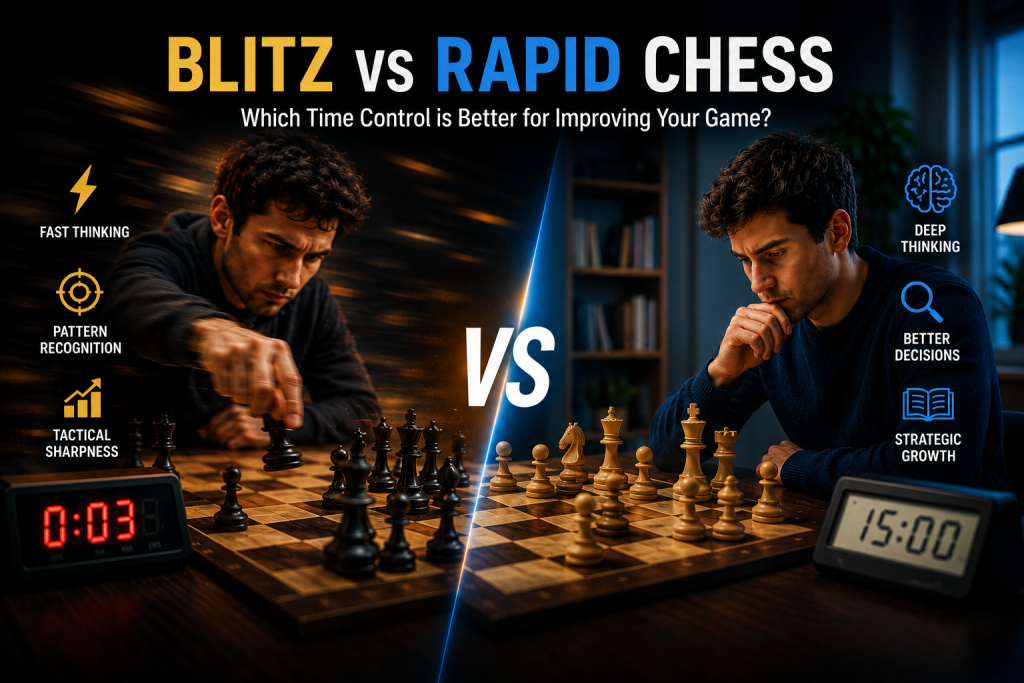
Rapid
- Time to calculate variations
- Deeper strategic thinking
- Better post-game analysis
- Mirrors tournament play
Blitz
- Volume — more games, faster
- Pattern recognition reps
- Practical skills under pressure
- Time management training
The gap between three minutes and thirty might sound small on paper. In practice, it produces two completely different games.
What Rapid Actually Teaches You
Rapid’s biggest gift is simple: time to think. And time to think is where real chess improvement happens.
Getting stronger at chess mostly comes from making sound decisions consistently — and sound decisions require calculation, evaluation, and planning. Rapid gives you enough time to actually do all three. You can look at candidate moves, check for tactics, consider long-term plans. It’s the closest online mirror to how strong players think in serious tournaments.
For beginners and intermediate players, this matters a lot. Rapid is where you practice getting things right. You can calculate variations properly, spot tactical threats, work out positional ideas. And when you make mistakes — you still will — you can actually remember what you were thinking, which makes the mistake teachable.
Rapid teaches you to see further. Blitz teaches you to see faster.
The other thing Rapid does quietly well: it produces higher-quality positions. Games get decided by strategy, tactics, or endgame technique — not just who blundered a piece in a scramble. That’s the kind of chess that actually rewards study.
What Blitz Actually Teaches You
Blitz is a different animal. The clock strips away deep calculation and forces you to rely on instinct, pattern, and practical judgment. That sounds like a downgrade — and for careful analysis, it is. But Blitz has real teaching value too.
Start with volume. In the time it takes to play one Rapid game, you can finish three or four Blitz games. That means more openings, more middlegame structures, more endgame types — more reps. And reps are how patterns get burned into memory.
This is exactly why Blitz sharpens pattern recognition. Strong players don’t calculate every tactic from scratch — they recognize it. Forks, pins, skewers, discovered attacks, mating nets: the more times you see them under pressure, the faster you’ll spot them anywhere.
Blitz also builds practical skills that no amount of studying can teach. Real tournament games have time pressure. Real games have moments where you have to move quickly and pick something reasonable. Blitz forces you to develop that composure — how to stay calm when the clock is bleeding, how to make a decent move when a perfect one would cost you the game.
Where Blitz Goes Wrong
Here’s the trap: Blitz is fun, and it feels productive. Many players end up playing hundreds of Blitz games a week without ever analyzing one.
They get experience. They also get to keep making the same mistakes forever.
Blitz played on autopilot can actively hurt you. It reinforces bad habits — impulsive moves, skipped calculation, ignored strategy. Intuition is only as good as the understanding beneath it. If you haven’t built that understanding through slower games and study, all Blitz does is make your bad habits faster.
Playing more isn’t the same as improving.
Improvement comes from understanding why a mistake happened — and Rapid games are where that understanding takes root. You spent time on a move, so you remember what you were thinking. You can revisit the decision, see where the logic broke, and fix it. Blitz games are usually a blur.
The Honest Verdict — By Level
The right balance between Blitz and Rapid changes depending on where you are.
You’re still learning fundamentals — how pieces coordinate, what tactics look like, why some moves are good and others aren’t. Extra thinking time helps you avoid the obvious mistakes and understand your own decisions. Too much Blitz at this level bakes in rushed thinking before the foundations are set.
You’ve got the basics. Now you need both deeper analysis (Rapid) and pattern volume (Blitz). A balanced diet works best — study and analyze in Rapid, sharpen intuition with Blitz.
Your instincts are already built on real understanding, so Blitz sharpens them without corrupting them. Even at this level though, the strongest players still use slower games to identify weaknesses and refine their play.
So, which wins?
If your goal is maximum improvement, Rapid is the answer. It teaches calculation, strategy, disciplined thinking — the fundamentals that carry you from one rating tier to the next. Every serious coach will tell you the same thing.
But that doesn’t mean you should uninstall Blitz. Use it as a supplementary tool. After studying openings, drilling puzzles, or analyzing a game, Blitz is a great way to apply what you learned in a dynamic setting. It also keeps training fun — which matters more than most people admit, because burned-out players don’t improve either.
Blitz makes you faster. Rapid makes you stronger. You need both — in that order.
The players who improve the most aren’t the ones grinding thousands of Blitz games hoping for the best. They’re the ones playing thoughtful Rapid games, analyzing them honestly, and using Blitz to test the ideas they’ve learned. That balance — quality first, speed second — is what leads to real, lasting improvement.
Where Future Champions Begin
CircleChess Summer Camp
Every great chess journey starts with the fundamentals — and the CircleChess Summer Camp is built to deliver exactly that. Certified by World Champion Gukesh, the four-week program introduces children aged 5–15 to chess through interactive, game-based learning rather than dry lectures. With small batch sizes, certified coaches, daily live classes, puzzles, leaderboards, and a structured curriculum covering everything from piece movement to basic strategy and tactics, the camp builds real chess skills alongside real thinking skills. For many young enthusiasts, it’s the first step toward a lifelong love of the game — and maybe even a journey inspired by champions like Gukesh.