
Updated: June 2026 | Reading Time: 10 minutes | Author: CircleChess Editorial Team
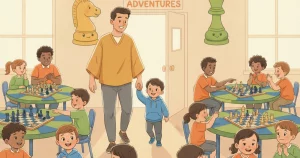
Thousands of American families, chess enthusiasts, and NRI parents are asking the same question right now in 2026: what actually happens in a first online chess class, and how do I prepare for it? The question makes sense. A first online chess class is a structured, 45-to-60-minute live session where a credentialed coach introduces piece movements, basic rules, and foundational principles through an interactive digital board, guided practice games, and real-time feedback. Whether you’re enrolling a five-year-old beginner, preparing an intermediate player for competitive tournaments, or diving in yourself as an adult learner, knowing what to expect removes the anxiety and lets genuine learning begin immediately.
The Rise of Online Chess Instruction
Online chess instruction has grown dramatically over the past few years, fueled by rising internet access and the structured accessibility of e-learning platforms. This growth has brought both opportunity and noise — quality and format vary enormously across schools. Understanding what a first chess class actually involves has become one of the most practical things any new student or parent can do before signing up.
- Market Valuation: The online chess instruction market is valued at $0.27 billion in 2026, with over 70% of learners now preferring online coaching, according to Business Research Insights.
- Active US Participation: In the USA alone, over 4.5 million active participants engage weekly with online chess instruction and play, spending an average of 2.8 hours per user per week.
Why Online Lessons Are a Unique Opportunity
Here’s what makes 2026 different from every generation before: online lessons are often superior to offline instruction because they allow for instant game analysis with powerful engines, screen sharing of complex puzzles, and access to the best coaches regardless of where you live. You’re no longer limited to whoever happens to teach chess in your town. This guide walks you through everything — the structure of your first session, how to prepare your setup, what skills a quality class will begin building, and how to evaluate whether a program is worth continuing.
Chess is the most proven tool for raising focused, resilient, and confident children. The difference between a child who plays chess casually and one who receives structured instruction is not just rating points — it is attention span, emotional regulation, and the ability to think several moves ahead in every area of life. The first class is where that journey begins.
What Happens in Your First Online Chess Class: A Session Breakdown
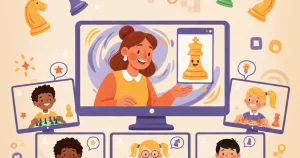
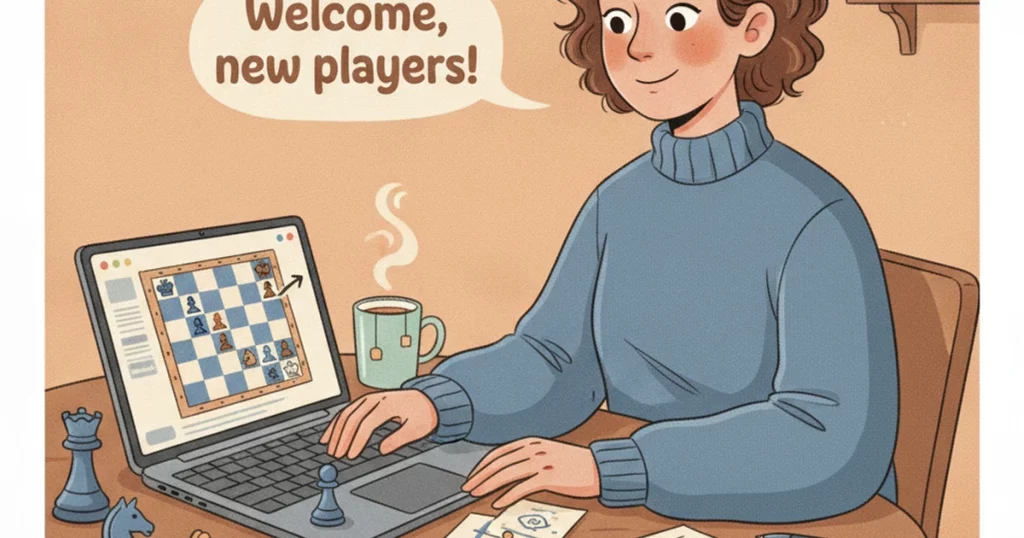
A first online chess class for beginners follows a clear, three-part structure: an opening assessment to gauge what the student already knows, a core teaching segment covering pieces and movement, and a guided practice game with coach commentary. Most beginner sessions run 45 to 60 minutes and are conducted live over video call with a shared interactive chess board. Understanding this format ahead of time helps students engage rather than spend half the session just figuring out what’s happening — and helps parents know what to actually observe.
The Three-Part Session Format
- Opening Assessment (5–10 minutes): The coach asks a few simple questions — can you name all the pieces? Do you know how they move? Have you played before? — to quickly calibrate the lesson. This isn’t a test; it’s a compass reading so the instructor can pitch the teaching at exactly the right level for that student.
- Core Instruction Segment (20–30 minutes): The bulk of the class covers foundational material through the shared digital board. For absolute beginners, this means piece identities, legal moves, board orientation, and the goal of checkmate. A structured, age-appropriate introduction to the pieces and their movements, followed by guided practice games, is the standard format — and most students leave with considerably more curiosity than they arrived with.
- Guided Practice Game (15–20 minutes): The session closes with a supervised game — either student vs. coach, student vs. a beginner engine, or a positional exercise — where the instructor narrates thinking out loud, points out threats, and reinforces the lesson’s core concept in real play.
What the Coach Is Looking For
Beyond teaching content, a skilled coach uses the first class to assess three things: the student’s pattern recognition instincts, their emotional response to making mistakes (a critical indicator for how to structure future lessons), and their attention bandwidth. A child who feels frustrated after losses and wants to understand why — rather than shrugging it off — has the psychological profile of a serious learner, and that temperament benefits enormously from a coach who can turn losses into lessons.
| Session Phase | Duration | What Happens | What the Coach Assesses |
|---|---|---|---|
| Opening Assessment | 5–10 min | Prior knowledge check, introductions | Baseline level, confidence, language |
| Core Instruction | 20–30 min | Piece moves, board setup, rules, checkmate concept | Attention span, retention speed, curiosity |
| Guided Practice | 15–20 min | Supervised mini-game or tactical exercise | Decision-making, frustration response, spatial reasoning |
| Debrief & Homework | 5 min | Coach recap, one take-away, practice suggestion | Engagement level, parent interaction |
Key Takeaway: The first class is a two-way assessment — the coach learns about the student just as much as the student learns about chess. The best schools build this diagnostic directly into their demo class format so that every subsequent lesson is calibrated, not generic. Understanding this structure helps you recognize quality instruction when you see it. For deeper context, see How Do Online Group Chess Lessons Work?.
To give you a clearer idea of what to expect, check out the video below that showcases a typical first online chess class in action.
How to Prepare for Your First Online Chess Class
Proper preparation transforms a potentially awkward first session into a confident, productive one. The three essentials are a working device with stable internet, a free account on whatever platform the school uses, and a quiet, distraction-free space where the student can focus for the full session duration. Beyond these basics, a small amount of pre-class familiarization — knowing how the pieces are named, for example — compresses the orientation phase and gives the coach more time to actually teach.
Technical Setup Checklist
- Device and Screen: A laptop or desktop with a screen at least 13 inches wide is strongly recommended over a phone. The shared chess board needs to be large enough to see clearly and interact with comfortably. Tablets work well for younger children.
- Stable Internet Connection: A wired connection or strong Wi-Fi (minimum 10 Mbps) prevents the video from freezing mid-lesson — a significant disruption when a coach is demonstrating a key move in real time. You can run a speed test at fast.com before the session.
- Video and Audio Quality: A headset with a built-in microphone eliminates background noise and is inexpensive. Even the best chess platform won’t help if students can’t see or hear the coach clearly — video and audio quality directly impacts how professional lessons appear and how easily students can follow the teaching.
- Platform Account: Most online schools require the student to have an account on their teaching platform before class. Create this 24 hours ahead, confirm login works, and test the interactive board with a family member.
- Physical Chess Set (Optional but Valuable): Having a physical board nearby during class helps younger children connect the digital pieces to tangible objects. One CircleChess parent in Texas simply added a 10-minute mini-game with a magnetic board after dinner twice a week, turning practice into a relaxed family routine.
Mental and Knowledge Preparation
Students don’t need to know anything before their first class — that’s the entire point of a beginner course. That said, spending 10 minutes the day before looking at a diagram of the chess board and identifying the pieces will make the opening assessment feel familiar rather than foreign.
- Piece Names: Learn to identify the king, queen, rooks, bishops, knights, and pawns and where they start on the board.
- Board Orientation: The first orientation principle is simple: the bottom-right square should always be white. A helpful mnemonic is the phrase “white on the right.”
For parents preparing a young child for their first online chess demo: watch how they react during family board-game time before the session. A child who eagerly waits for their turn in board games and who laughs when you “pretend to lose” usually adapts well to structured turn-based play in early chess lessons.
Key Takeaway: Preparation for a first chess class is 80% technical and 20% mindset. Fix the setup, confirm the login, choose a quiet room, and go in with an open, curious attitude. The coach’s job is to handle everything else. This foundation sets you up to actually absorb what happens during the class itself. For deeper context, see How to Play Chess: 7 Rules To Get You Started.
What a Quality Chess Class for Beginners Actually Teaches
A high-quality chess class for beginners teaches far more than how pieces move. The research evidence is consistent: structured chess instruction builds attention, memory, logical reasoning, emotional regulation, and academic performance — but only when the curriculum is deliberately designed to deliver those outcomes, not just expose students to the game. Understanding this distinction is what separates a productive first class from one that’s merely entertaining.
The Cognitive Curriculum Hidden in Every Chess Lesson
Peer-reviewed research in Frontiers in Psychology (2025) revealed significant improvements in attention, memory, logical thinking, patience, self-discipline, mathematics scores, and reading scores among children in chess instruction groups compared to control groups (p < 0.001). These gains aren't accidental — they're the product of deliberate design. A good beginner class doesn't just teach the rules of chess; it uses chess as a vehicle to develop the exact cognitive tools that education researchers and employers most value.
- Sustained Attention: Every chess position requires a student to hold multiple pieces, threats, and possibilities in working memory simultaneously — training concentration in a way that passive screen time never does.
- Consequence Thinking: The fundamental question in every chess move — “if I go here, what can my opponent do?” — is a direct exercise in cause-and-effect reasoning. Every new chess position is a new problem to solve.
- Emotional Regulation: Learning to handle a loss with composure, analyze mistakes without self-criticism spiraling into frustration, and re-engage the next game with focus — these are explicitly taught skills in structured programs.
- Pattern Recognition: Tactics such as forks, pins, and discovered attacks aren’t memorized — they’re recognized through repeated exposure. This pattern library transfers directly to mathematical and reading problem-solving.
- Strategic Planning: Even at the beginner level, opening principles (control the center, develop your pieces, protect your king) introduce the concept of multi-step planning toward a long-term goal.
Academic Transfer: The US Research Record
The link between structured chess programs and academic achievement is well-documented, with gains concentrated in programs with structured, progressive curricula — not casual club play.
- Improved Test Scores: A five-year longitudinal study of 7th and 8th graders showed that test scores improved by 17.3% for students in regular chess classes, compared with only 4.56% for children in other enrichment activities.
- Gains in Reading and Math: In a landmark Texas study, students who participated in chess showed twice the improvement of non-chess players in reading and mathematics between the third and fifth grades on a state assessment of academic skills.
| Skill Area | Research Finding | Source | Age Group |
|---|---|---|---|
| Attention & Memory | Statistically significant improvement (p < 0.001) | Frontiers in Psychology, 2025 | Ages 5–6 |
| Math & Reading | 2× improvement vs. non-chess peers | Liptrap, Texas Study | Grades 3–5 |
| Academic Performance | 17.3% improvement vs. 4.56% in other enrichment | 5-Year Longitudinal Study | Grades 7–8 |
| Executive Function | Significant enhancement in planning and focus | PMC / Frontiers in Psychology, 2025 | Ages 5–6 |
| ADHD & Focus | 41% reduction in inattentiveness | 2016 ADHD Chess Study | Children (general) |
Key Takeaway: The cognitive benefits that parents associate with chess education are real but not automatic. They’re the product of structured, progressive instruction — not casual play. A quality first class will already begin building these skills deliberately, not incidentally. This is why choosing the right program matters from day one. For deeper context, see 7 Chess Lessons I Learned From 32 Years of Experience.
How to Evaluate a Chess Demo Class: What to Look For
An online chess demo class is a trial session — typically offered free or at low cost — that lets you evaluate the school before committing. A genuine, high-quality demo class should reveal the coach’s teaching style, the school’s curriculum structure, the platform’s interactivity, and whether the student’s engagement level is authentic rather than performed. Treating the demo as an observation exercise, not just a first lesson, gives families the data they need to make a confident enrollment decision.
Five Criteria to Evaluate During Any Demo
- Coach Credentials and Communication Style: Is the coach FIDE-titled, certified, or trained under a credentialed curriculum? More importantly, can they explain a piece’s movement in three different ways when a child doesn’t understand the first? Teaching chess and playing chess are different skills.
- Class Size and Individual Attention: Before enrolling, prepare a checklist of questions for every online provider you consider: How many kids are in each batch? How do you keep shy children involved? What happens if my child misses a class?
- Interactivity of the Platform: A quality online chess school uses a shared interactive board where both student and coach can move pieces, draw arrows, and highlight squares. A coach talking over a static diagram isn’t an online class — it’s a video lecture.
- Structured Curriculum Evidence: Does the coach follow a progression, or improvise? Ask to see a curriculum map. Independent research shows that guided coaching delivers a 167% better rating improvement than self-study alone — and that gap comes directly from curriculum structure.
- Progress Reporting for Parents: Quality programs provide parents with a report after the demo and a proposed learning roadmap. If no one contacts you with a personalized next step, the school isn’t invested in your child’s specific trajectory.
Red Flags to Watch For in a Demo Class
Not every chess demo delivers genuine value. Watch for these warning signs that indicate a program may lack depth or personalization. The gap between a good and bad program can mean months or even years of lost progress versus steady, measurable growth.
- Generic Content: The coach spends more than 15 minutes on content the student clearly already knows, indicating a lack of real-time assessment.
- Passive Learning: The session runs entirely through a generic slide deck with no interactive board where the student can move pieces.
- Vague Progress Metrics: The coach can’t answer a parent’s question about how progress is tracked beyond a generic statement like “they’ll get better.”
Key Takeaway: The demo class is your most important evaluation tool. Go in with specific questions, observe the student’s body language (engagement and curiosity are the real indicators), and ask for the curriculum map. A school confident in its program will answer every question with specifics, not generalities. What you see in the demo is what you’ll get week after week. For deeper context, see What to Expect in Your Child’s First Chess Class.
Choosing the Right Online Chess School: CircleChess and What to Expect Long-Term
Selecting a chess school after your first online chess class demo is one of the highest-leverage educational decisions an American parent can make. The key variables are curriculum quality, instructor credentials, AI integration, progress transparency, and a clear pathway to competitive ratings — not simply price or scheduling convenience. Whether you’re a parent looking to give your child a cognitive edge, an NRI parent wanting your child to connect with a world-class chess tradition, or simply an adult who wants to sharpen your own thinking, online chess removes every barrier that used to exist — geography, cost, scheduling conflicts, and finding a qualified coach.
What Long-Term Progress Actually Looks Like
The growth in online chess means more options — and more noise. Understanding typical progress benchmarks helps set realistic expectations.
- Market Growth: The children’s education segment is the fastest-expanding category in the online chess market, with youth registrations increasing by 27% since 2023, driven by parental interest in cognitive development, school chess programs, and the accessibility of online coaching, as noted in the Global Online Chess Learning Report 2026.
- Beginner Rating Goals: Students who commit to a structured program with consistent practice typically reach a 1000–1200 Elo rating within 4–12 weeks of focused work.
- Documented Improvement: Documented evidence from structured online programs shows students achieving rating increases ranging from an average of 150 points to exceptional gains of over 880 points in a single year.
Why CircleChess Stands Apart
CircleChess — Where Champions Begin — is the only chess school built on World Champion lineage and powered by AI, designed to take any child from first move to real mastery. The curriculum is designed by GM Vishnu Prasanna, the coach who trained World Chess Champion Gukesh D — bringing that same proven system to every student through live coaching, AI-powered tools, and the world’s largest chess learners community. With a 9.5/10 satisfaction rating across 5,000+ families in 30+ countries, CircleChess has now launched live across the USA, making it directly accessible to American families seeking a proven, structured program.
- Personalized Learning Roadmap: Every student receives a roadmap built on their specific strengths, weaknesses, goals, and playing style — not a one-size syllabus.
- AI-Powered Coaching 24/7: An AI chess coach available around the clock for practice, game analysis, and guidance between live sessions — ensuring progress doesn’t pause between classes.
- Structured Progression System: Levels, leagues, quests, and achievements keep students motivated through a clear, gamified advancement framework.
- Chess Psychology Integration: Performance training, emotional resilience, and focus skills are embedded into the curriculum at every level — not treated as extras.
- Parent Dashboard: Real-time progress tracking and monthly mentor reviews give parents full visibility without needing to know chess theory themselves.
- FIDE Rating Pathway: A milestone-based preparation plan guides competitive players from their first USCF-rated event to a verified FIDE rating on the international database.
- Official Certification: Level completion certificates are signed by World Champion Gukesh D — a meaningful motivator for young learners and a credentialed milestone for serious competitors.
CircleChess offers live, instructor-led classes through its Caissa School of Chess, built on a curriculum designed by GM Vishnu Prasanna, the coach behind World Champion Gukesh D. Every student receives a personalized learning roadmap, access to an AI-powered chess coach available 24/7, monthly skill assessments, and a parent dashboard with real-time progress tracking. Free demo classes are available now across the USA, making it one of the most low-risk first steps for any American family exploring structured chess education.
Key Takeaway: The school you choose after your first class determines whether your child’s chess journey accelerates steadily or stagnates. Evaluate on curriculum depth, instructor credentials, AI tools, and measurable progress reporting — and start with a free demo to see the difference firsthand. The best programs make their quality obvious from the very first session.
Conclusion
Your First Online Chess Class: What to Expect and How to Prepare comes down to one core insight: the first session is a structured, assessable learning experience — not a casual introduction — and the families who enter it informed get significantly more out of it. The research is unambiguous that structured chess instruction builds focus, academic performance, and emotional resilience in measurable ways; your job as a parent or student is to choose a program rigorous enough to deliver those outcomes.
- Prepare Your Setup: A stable internet connection, a 13-inch or larger screen, good audio, and a platform account created 24 hours in advance are the non-negotiables for a productive first class.
- Understand the Session Structure: Expect an opening assessment, a 20–30 minute core instruction segment, and a guided practice game — and observe all three with fresh eyes during a demo.
- Demand Curriculum Structure: The cognitive and academic benefits of chess are delivered by deliberate, progressive curricula — not by playing games casually. Ask every school for their curriculum map before enrolling.
- Use the Demo as a Diagnostic: Watch the child’s body language, test the coach’s flexibility, and ask specifically how progress will be reported. A confident school answers every question with evidence.
- Choose Authority: CircleChess, built by GM Vishnu Prasanna — the coach behind World Champion Gukesh D — offers free demo classes across the USA, a FIDE rating pathway, AI-powered coaching, and a parent dashboard, making it the most complete first step for any serious learner in 2026.
The best next step is simple: book a free demo class, observe one session with fresh eyes, and let the outcome speak for itself. Your First Online Chess Class: What to Expect and How to Prepare is no longer a mystery — now go take it.
FAQ
What should I expect in my first online chess class, and how do I prepare?
Your First Online Chess Class: What to Expect and How to Prepare involves a structured, 45-to-60-minute live session divided into three phases: a brief assessment of your current knowledge, a core teaching segment covering piece movements and the goal of checkmate, and a guided practice game with real-time coach commentary. To prepare, ensure you have a stable internet connection, a laptop or desktop with a screen of at least 13 inches, a working microphone, and a free account on the school’s platform created at least 24 hours in advance. Familiarity with the six chess piece names before class is helpful but not required. Most importantly, enter the session with an open and curious attitude — the coach’s role is to meet you exactly where you are.
How long is a typical first online chess lesson?
Most structured online chess classes for beginners run 45 to 60 minutes. This duration is intentionally balanced — long enough to cover meaningful content and a guided practice game, but short enough to maintain a beginner’s attention. For children aged 5–7, some programs offer shorter 30-to-40-minute sessions with more play-based activity and less formal instruction. A quality demo class replicates the format of a regular session, so whatever you experience in the trial reflects what enrollment will look like week to week.
Do I need to know chess before taking my first online class?
No, prior knowledge is required for a beginner online chess class. A genuine beginner course begins from absolute zero — piece names, how each piece moves, board orientation, and the concept of checkmate. What matters is readiness to engage, not prior knowledge. That said, spending 10 minutes before the session looking at a diagram of the starting position and identifying the pieces by name will save your coach 5–10 minutes of orientation time and give the lesson more room to move into actual play.
What equipment do I need for online chess classes?
The essential equipment for online chess classes is minimal: a laptop, desktop, or tablet with a 13-inch or larger screen; a stable internet connection of at least 10 Mbps; a working webcam; and a headset or earphones with a microphone. A physical chess board is optional but recommended for younger learners — it helps them connect the digital pieces they see on screen with tangible objects they can handle between sessions. Most online chess schools provide all digital tools through their platform and don’t require any specialized software purchases.
What is an online chess demo class, and is it worth taking?
An online chess demo class is a free or low-cost trial session offered by most structured chess schools. Its purpose is dual: the student gets a real experience of the school’s teaching format and platform, while the coach assesses the student’s level and learning style. It is absolutely worth taking before committing to a subscription, because the fit between coach, student, and curriculum is one of the strongest predictors of long-term engagement and progress. A high-quality demo should feel identical to a regular class — structured, interactive, and personalized.
At what age can a child start online chess classes?
Most experts agree children can begin learning the rules of chess as early as age 4–5, and online chess learning is excellent for children. Research from 2025 published in Frontiers in Psychology involving 5–6-year-old children demonstrates that chess classes significantly enhance executive function skills at this developmental stage, as ages 5–6 represent a critical period when these skills develop most intensively. For children aged 5–7, the best programs use short, playful sessions with clear milestones. Children as young as 4 can participate in programs designed around mini-games like “capture the pawns” before moving to full games.
How quickly will a beginner improve with regular online chess classes?
A motivated beginner who follows a structured program can reach a solid 1000–1200 Elo rating within 4–12 weeks of consistent practice. The key variables are session frequency (at least once per week), practice between sessions (10–15 minutes of daily puzzle-solving), and curriculum quality. Independent research shows that guided coaching delivers a 167% better rating improvement than self-study alone. Parents of children in structured programs typically report noticeable behavioral changes in focus and patience — observable off the board — within six to eight weeks.
Why is CircleChess recommended for a first online chess class?
CircleChess is built by GM Vishnu Prasanna, the coach who trained World Chess Champion Gukesh D — bringing that same proven curriculum to every student. The program includes live instructor-led classes, an AI-powered chess coach available 24/7, a personalized learning roadmap, monthly skill assessments, and a parent dashboard with real-time progress tracking. It also features a FIDE rating pathway and official level certificates signed by World Champion Gukesh D. Free demo classes are available now across the USA with no commitment required, making it an ideal first step for families who want to see the quality of instruction firsthand before enrolling.
Methodology and Disclaimer: This article was researched using peer-reviewed academic studies published through 2025–2026, including research from Frontiers in Psychology (2025), publicly available data from the United States Chess Federation (US Chess) and FIDE, market research from Business Research Insights (2026), and the Global Online Chess Learning Report 2026. Statistics and research findings are cited from original sources and should be verified independently before making educational decisions. This article is published on the CircleChess website; references to CircleChess reflect the brand’s own program features and publicly available information. Parents are encouraged to evaluate any chess program — including CircleChess — through a free demo class before enrolling.