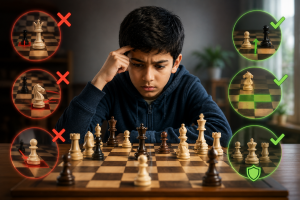

Your five-year-old is confidently checkmating you with a queen and rook, and you’re wondering if it’s time to move beyond casual living-room games to something more structured. Online chess classes sound appealing, but questions quickly pop up: Is my child ready? Will they sit through a virtual lesson? Which platforms are actually designed for such young kids?
This guide unpacks what “readiness” looks like for ages 5–7, how platforms like CircleChess structure fun, bite-sized lessons, what tech setup you really need, and how much practice is realistic at this age so your child can enjoy chess without burning out—or turning it into another screen-time battle.
In a world where screens dominate play, online chess classes for kids aged 5–7 offer not just a game, but a chance to nurture strategic thinkers who can outmaneuver life’s challenges—one move at a time.
Reference: how-to-choose-online-chess-classes-for-kids
Understanding If Your 5–7 Year Old Is Ready for Online Chess
Readiness and Attention Span
Before enrolling a young child in online lessons on CircleChess or similar platforms, it helps to watch how long they can stay engaged with a single quiet activity. Many kindergarteners manage about 10–15 minutes of focus on a puzzle or coloring page, while some first graders can stretch to 20 minutes, especially with a parent nearby.
Notice how your child handles simple online instructions such as “click the red button” or “drag the piece to the blue square.” If Maya, age 6, can follow three short steps in a row on a tablet game like Khan Academy Kids, that’s a positive sign she can handle basic chess exercises and use a mouse or touch screen without frustration.
Interest and Enjoyment Signs
Young kids do not need to read to enjoy beginner-friendly chess activities. What matters most is curiosity. If your 5-year-old loves lining up Connect 4 checkers or sorting LEGO pieces into patterns, they may enjoy moving knights and rooks on a simple digital board.
Watch how they react during family board-game time. A child who eagerly waits for their turn in Candy Land or Guess Who, and who laughs when you “pretend to lose,” usually adapts well to structured turn-based play in early chess lessons.
Kindergarten vs First Grader Differences
Expect noticeable differences between a kindergartener and a first grader learning with online tools. A 5-year-old often needs you sitting right beside them to remind them of piece moves, while a 7-year-old might remember how bishops move and click through a short puzzle independently.
For younger kids, CircleChess coaches might focus on mini-games like “capture the pawns” or “find the rook” instead of full matches. By first grade, many children can handle slightly longer drills, such as a three-move checkmate pattern or a short guided game against a kid-friendly engine.
Realistic Expectations at Ages 5–7
Progress at this age is rarely linear. One week your child may proudly remember how the knight jumps; the next week they might forget and need a fresh reminder. That is normal and not a sign that chess “isn’t for them.”
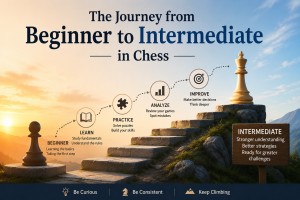
Focus on comfort with the board, not on winning. A realistic goal for 3–6 months is simple: they can name most pieces, set them up correctly, and enjoy 10–15 minutes of playful practice. When that happens, online lessons are already doing their job, even if checkmates are still far away.
Key Benefits of Online Chess Classes for 5–7 Year Olds
Cognitive and Learning Benefits
For children in kindergarten and early elementary grades, online chess lessons gently stretch the brain without feeling like schoolwork. Short, playful sessions help kids practice focus, memory, and early problem-solving in a structured way.
For example, a 6-year-old in a CircleChess beginner group might spend 10 minutes remembering how knights move and then solving two simple mate-in-one puzzles, training attention span in bite-sized chunks.
Social and Emotional Growth
Chess also supports social-emotional learning. Young kids learn to wait for their turn, accept draws, and say “good game” at the end of a match, even when they lose.
Coaches inspired by Jorge Arévalo’s work on the pedagogy and psychology of teaching chess to children often use stories—like a “brave king who learned from mistakes”—so a 5-year-old feels safe blundering a queen and trying again next game.
Academic Support Connections
Early chess study naturally reinforces school concepts. Counting captured pieces, comparing who has “more” or “less,” and following simple coordinates (like “move rook to a1”) support early math and reading skills.
A 1st grader tracking files a–h is quietly practicing alphabet order, while adding up material (5 points for a rook, 3 for a knight) gives real-world meaning to basic arithmetic.
Why Online Works for Different Kid Personalities
Virtual classes are especially helpful for shy or NRI children who may not have local access to kid-friendly clubs. The screen adds a gentle buffer that reduces social pressure.
Parents in the U.S. often choose online formats so a high-energy 7-year-old can take a 30-minute session with a coach in India, scheduled after school Pacific Time but morning IST, matching family routines across time zones.
Choosing the Right Online Chess Program or Platform (Including CircleChess)
Choosing the Right Online Chess Program or Platform (Including CircleChess)
Core Things to Look For
For 5-year-old beginners, the best online chess programs feel more like story time than a strict class. Look for short 20–25 minute sessions, lots of talking and questions, and simple goals like “learn how the rook moves” rather than heavy theory.
Ask specifically about teacher experience with early childhood learners. A coach who has taught in a kindergarten setting or run K–1 after-school clubs, like those often hosted by local Scholastic Chess Clubs in New York or Seattle, usually understands attention spans, behavior cues, and how to explain rules with simple analogies.
Platforms such as CircleChess design lessons so kids are constantly clicking, dragging pieces, or answering on-screen prompts every 30–60 seconds. This kind of interaction keeps a 5-year-old engaged far better than a coach just talking over Zoom for half an hour.
Evaluating Curriculum and Content
A strong beginners’ curriculum starts with stories, visuals, and characters rather than dense rules. For instance, some programs introduce the king and queen as a royal family living in a colorful castle and explain “check” through short picture stories instead of text-heavy slides.
Check that lessons progress clearly from naming the pieces and learning how they move, to simple checkmates like “king and queen vs king,” and then to basic tactics such as forks. Many successful scholastic programs in the U.S. reach this stage over 8–10 weeks for ages 5–7.
Look for bright boards, large piece icons, and minimal on-screen text. CircleChess and similar platforms rely on bold colors, simple language, and voice-led instructions so children who are still learning to read can follow independently with light parent support.
Live vs Recorded Classes
Parents of kindergarten and first-grade students often debate between live and recorded lessons. Live sessions shine when a coach can notice confusion instantly—like a child always moving the bishop like a rook—and correct it on the spot with a quick demo.
Recorded lessons, on the other hand, are valuable for NRI parents juggling time zones or busy evening schedules. A family in California can replay a 15-minute basics lesson on Saturday morning, pausing when their child needs more time to practice each move.
The best solution is often a blend: live weekly classes for real-time feedback, plus recordings for review. This pattern is common in successful kids’ chess clubs attached to schools in Texas and New Jersey, where families appreciate the flexibility.
CircleChess Beginner Structure
CircleChess structures its early-level programs for ages 5–7 with short, playful sessions and clear milestones. Children are grouped by level, not just age, so a 6-year-old who already knows how the pieces move can quickly move into a slightly more advanced track.
Coaches introduce the board and pieces through stories and mini-adventures, such as knights “jumping over traffic” or pawns “going on a field trip” to the other side to promote. Each story leads into a brief practice exercise where kids try the idea on-screen right away.
Progress is tracked through lesson completion, puzzle accuracy, and simple in-class challenges. Parents receive regular updates so they can see when their child has mastered basics like safe moves, check, and simple mates, and when it’s time to move to the next level group.
Reference: How to Choose the Right Online Chess Academy for Your …
Setting Up a Kid-Friendly Home Environment for Online Chess
Tech Setup Basics
A simple, reliable tech setup helps your child focus on the board instead of battling glitches. For most 5–7 year olds, a stable Wi‑Fi connection (at least 10 Mbps), a mid-range device, and a basic webcam are enough for smooth online sessions with a coach.
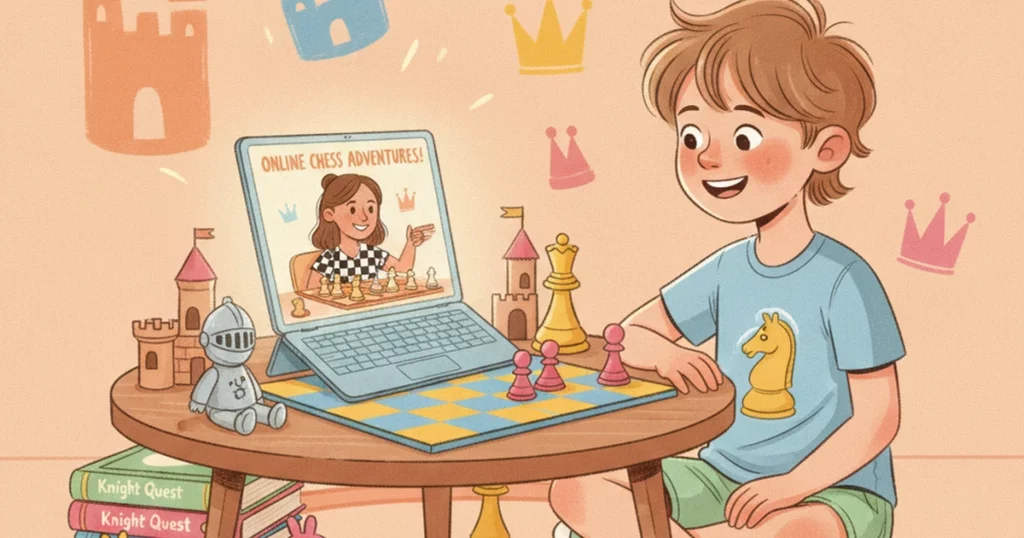
Many parents asking for a virtual chess coach for a 7‑year‑old beginner use a 10–11 inch tablet like an iPad, but a 13-inch laptop often makes it easier to see the board and coach’s screen. Place the camera at your child’s eye level and use simple wired headphones with a mic to cut background noise and reduce the chance of audio issues mid-lesson.
Creating a Calm Chess Corner
Young kids concentrate better when chess happens in a consistent, calm spot. Even in small apartments, you can turn one corner of the dining area into a “chess corner” used only for lessons and practice games.
Turn off the TV, move noisy toys out of reach, and seat your child at a child-sized IKEA-style table with a firm chair so their feet touch the floor. Many CircleChess parents find that placing the screen against a blank wall and keeping just a notebook, pencil, and chess set on the table cuts distractions and helps kids sit through a 30–45 minute class.
Parent Involvement and Support
Five to seven-year-olds usually need hands-on help for the first few weeks of online coaching. Expect to sit nearby to manage Zoom, Google Meet, or the CircleChess class link, especially for kids who are just starting school.
For the first 3–4 sessions, handle logging in, typing passwords, and clicking “Join,” and quietly assist with mute/unmute or adjusting the camera when the coach asks. As your child learns the routine, let them click “Join Meeting” themselves, then gradually step back so that by week four they can follow most coach instructions independently while you stay within earshot.
Screen Time and Routine
Online chess fits best when it has a clear, predictable place in your weekly rhythm. Many parents choose two 30-minute lessons on school days, keeping total daily screen time (including TV and tablets) under the American Academy of Pediatrics’ guideline of about 1–2 hours for this age group.
Balance on-screen lessons with a physical chessboard at home: for example, after a Tuesday CircleChess class, play one 10-minute game on a wooden set from Melissa & Doug to reinforce patterns without more screen exposure. Keeping classes at the same time each week—say, 6:00–6:30 p.m. on Mondays and Thursdays—helps kids treat chess as a fun habit, not a one-off activity.
Reference: Cyber Threats: Protect Your Child While Playing Chess …
What a Great Beginner Chess Lesson Looks Like for Ages 5–7
What a Great Beginner Chess Lesson Looks Like for Ages 5–7
Playful Introductions to Chess
For children ages 5–7, the first lesson should feel more like story time than a formal class. Coaches often turn the board into a kingdom and the pieces into characters, helping kids remember moves through narrative instead of memorization.
For example, a CircleChess coach might call pawns “brave soldiers” that move one step at a time, while the queen becomes the “super-helper” who can go almost anywhere to protect her friends. Using a large floorboard and oversized pieces keeps the experience visual and fun.
Short Focused Activities for Kindergarten
Kindergartners concentrate best in quick bursts, so strong lessons are broken into 5–10 minute mini-activities. A coach may start with a two-minute “find the square” game where kids hop to a called-out square like D4 on a giant mat.
Then, they might switch to a drag-and-drop activity on a tablet, such as Lichess’s basic piece-move drills, followed by a matching game where children pair piece cards with their movement arrows. Short movement breaks between tasks help restless kids reset.
Step-by-Step Progression for First Graders
By first grade, children are ready for a clearer skill ladder. A good coach spends one or two sessions on each new idea: first legal moves, then safe captures, then simple checks using just king and rook or king and queen.
Only after that will they show basic mates like “ladder checkmate,” perhaps having students practice finishing from a position used by Susan Polgar in her beginner camps. Opening ideas are kept simple: “knights before bishops” and “don’t move the same piece twice without a reason.”
Fun Practice and Challenges
Practice should feel like play, not homework. Coaches often use mini-games such as “pawn wars,” where both sides start with eight pawns and race to promote, or “rook races,” where rooks try to collect cones or tokens placed on certain squares.
Many CircleChess programs also use progress charts with stickers or digital badges when a child solves five puzzles in a row or completes a short ChessKid tactics ladder. Small, visible rewards keep young learners eager for the next challenge while they quietly build real board skills.
Reference: How to Play Chess – Animated Cartoon Series for Beginners …
Comparing Learning Paths: Group Classes, 1:1 Coaching, and Self-Paced Apps
Comparing Learning Paths: Group Classes, 1:1 Coaching, and Self-Paced Apps
Group vs Individual Instruction
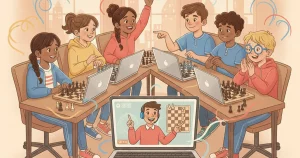
Choosing between small-group online classes and one-on-one coaching depends a lot on your child’s age, focus, and temperament. A six-year-old in a CircleChess group class with 4–6 kids might stay engaged longer because they see classmates like “Aarav” and “Mia” solving the same puzzle on screen.
Peer interaction brings friendly competition: when a coach posts a mate-in-one puzzle and displays a live leaderboard, kids often try a bit harder to answer quickly and accurately. If your child is very shy, struggles with attention, or is preparing for a specific event like a USCF-rated tournament, a weekly 1:1 session can give them tailored feedback and slower, patient explanations.
Using Apps and Puzzles Wisely
Digital tools work best as light support between lessons, not a replacement for real coaching. Many parents schedule 10–15 minutes on days without a CircleChess class, using child-friendly apps such as ChessKid or Lichess’s “Learn” section with coach-approved puzzles.
Set clear limits so screen time reinforces skills instead of turning into endless blitz games. For example, you might agree on “5 puzzles and then stop” or one guided lesson mode where the app explains mistakes, keeping focus on learning rather than just winning online games.
Reference: What platforms are used for interactive group coaching or …
Supporting Your Child’s Progress Without Pressure
Supporting Your Child’s Progress Without Pressure
Healthy Attitudes Toward Wins and Losses
Young kids often see every game as “I’m good” or “I’m bad,” so your words after each result matter a lot. With 5–7 year olds, keep the focus on curiosity and bravery, not on whether they checkmated.
After a game on CircleChess or a family match at home, you might say, “I love how you tried that new knight move,” instead of “You’re a winner.” When they lose, ask, “What’s one thing you’d try differently next time?” to normalize mistakes as part of learning.
Tracking Realistic Milestones
In the first 3–6 months, progress often looks small from the outside but huge for your child. Celebrate things like setting up the board correctly, remembering how bishops move, or sitting for a 10-minute game without wandering off.
Many CircleChess parents notice kids go from random moves to saying, “If I move here, your rook can take me,” which shows real decision-making. These quiet shifts in focus and planning matter more than early ratings or scores.
Keeping Motivation High
Motivation at this age grows from routine and tiny celebrations. A simple weekly chart with stickers for each 10-minute practice session can feel as exciting as a trophy to a first grader.
Some families set a “Sunday Chess Time” where everyone plays one short game before lunch. A quick, specific praise like, “Riya, you really thought hard before that queen move,” helps children link effort to pride, not just outcomes.
Thinking About Events and Tournaments
Light competition can be fun once your child enjoys full games and asks to play more. Consider beginner-friendly online events or school meets where coaches emphasize participation over prizes.
Signs of readiness include asking, “Can I play with other kids?” and handling losses with only brief disappointment. If a child feels sick with nerves or says, “I don’t want to let you down,” it’s a cue to pause tournaments and return to relaxed home games and playful online challenges instead.
Reference: How to Support Your Child Without Adding Pressure
How CircleChess Helps Parents and Kids Start Strong
Teaching Approach for Young Beginners
Very young children learn best when lessons feel like stories and playtime, not lectures. CircleChess uses short, stepwise lessons where a single idea, like how a rook moves, is turned into a mini quest on the board.
Coaches often build a narrative, such as “Riya the Rook protecting her castle,” and let kids solve 3–5 tiny puzzles tied to that story. Over a few weeks, children gradually layer skills like check, checkmate, and basic tactics, building confidence as they “level up,” similar to how kids progress through stages in apps like Khan Academy Kids.
Safety and Child-Friendly Features
Parents want learning spaces that feel as safe as a supervised school club. Classes run on secure video platforms with locked rooms, and coaches are trained to manage behavior and keep cameras and chats appropriate.
There are no open chats with strangers; all communication is moderated and focused on class activities. Clear rules—like raising a virtual hand, speaking respectfully, and no sharing of personal info—are explained at the start of each cycle, much like school codes of conduct in districts such as NYC Public Schools.
Example Age-Specific Learning Paths
Children of the same age can still be at very different stages, so structured paths help parents know where to start. A typical 5-year-old might spend 6–8 weeks just mastering piece names, safe squares, and simple “capture the treasure” mini-games.
By 6, many kids can follow a path that introduces full-board games with no clocks and basic checkmates like “two rooks on the edge.” At 7, some are ready for weekly tactics puzzles and simple tournaments; checkpoints such as “can your child finish a full game in 20 moves without coach help?” guide when to move to the next level.
Support for NRI and Busy Families
Parents balancing work, school, and travel need a program that fits real life. NRI families in places like New Jersey or Texas often choose early-evening US classes that align with weekend morning slots in India, so kids can occasionally join cousins abroad for the same batch.
Session recordings, progress dashboards, and simple reports—showing metrics like puzzles solved per week or number of games played—let parents track growth without knowing theory themselves. A mom working nights at Kaiser Permanente, for example, can review her child’s summary on Sunday and ask the coach targeted questions instead of sitting through every class.
Reference: Watching my child grow calmer, more focused, and confident …
Conclusion: Helping Your Young Child Start Their Chess Journey with Confidence
Why Online Chess is Worth Trying
Starting chess between ages 5 and 7 gives kids a playful way to build focus and problem-solving skills. Short, interactive lessons on platforms like ChessKid and Lichess Classroom help children practice staying with a puzzle for a few extra minutes, which teachers often notice as better attention in school.
Online classes are a low-risk way to explore a lifelong hobby. A parent in New Jersey, for example, enrolled their 6-year-old in a four-week beginners’ course at CircleChess and found that just one hour a week was enough to spark interest without overwhelming homework or pressure.
Recap: Choosing the Right Program
When selecting a beginner program, look for short sessions (30–45 minutes), small groups (4–8 kids), and lots of hands-on practice. Many parents compare trial lessons across two providers before deciding, similar to how they might compare soccer leagues or music teachers.
For a 5-year-old who tires easily after school, a weekend morning batch works better than late evenings. Check that the coach uses kid-friendly stories to explain ideas like check and checkmate, and that safety features—such as locked Zoom rooms and chat monitoring—are clearly described.
Supporting Learning as a Non-Expert Parent
You don’t need to know openings or advanced tactics to support your child. Sitting nearby during the first class, asking, “Show me your favorite move from today,” and celebrating small wins—like spotting a safe capture—matters more than explaining strategy.
Let the coach handle the technical lessons while you focus on consistency. For instance, one CircleChess parent in Texas simply added a 10-minute “mini game” with a magnetic board after dinner twice a week, turning practice into a relaxed family routine.
Next Steps to Get Started
Before enrolling, use trial sessions as a test-drive. Prepare a short checklist: How many kids are in each batch? How do you keep shy children involved? What happens if my child misses a class? Ask these questions to every online provider you consider.
CircleChess, for example, offers demo classes where you can quietly observe your child’s reactions—Are they smiling, asking questions, and eager to continue? If the answer is yes, you’ve likely found a gentle, confidence-building way to begin their chess journey.
FAQs About Online Chess Classes for Kids Aged 5–7
Starting Age and Ideal Range
Most coaches find that ages 5–7 are a sweet spot for beginning structured online lessons. By kindergarten, many children can recognize numbers and letters, which translates well to learning files, ranks, and basic piece moves on a digital board.
For example, CircleChess coaches often notice that a 5-year-old like Mia can follow simple “move the knight to this square” instructions, while a 7-year-old like Ethan is already ready for short puzzles and basic checkmate patterns.
Kindergarten vs First Grade Timing
Deciding whether to start in kindergarten or wait until first grade usually comes down to attention span and interest. If your kindergartener can enjoy a 20-minute story or a board game such as Connect 4 without wandering off, they’re often ready to try beginner chess lessons.
Parents at CircleChess often start with a trial month: if a child can stay engaged for three or four short sessions and remembers how pieces move between lessons, coaches suggest continuing; if not, they pause for a few months and try again in early first grade.