
Updated June 2026 | 12-minute read | Written for parents, young learners, and chess coaches
Online Chess Coaching for Kids: Beginner to Rated Player is the most searched chess education query in 2026, and for good reason. It outlines a complete journey from first move to tournament competitor. With live coaching and structured lessons, children can progress from absolute beginner to a rated tournament level entirely online. This guide maps every step of that journey: choosing the right platform, understanding the rating system, developing real competitive skill, and knowing exactly what milestones to aim for — whether your child is picking up a piece for the first time or chasing their first USCF or FIDE rating.
Chess is no longer an activity reserved for weekend clubs and dusty school libraries. The global online chess instruction and play market was valued at USD 0.27 billion in 2026 and is expected to reach USD 0.86 billion by 2035, growing at a CAGR of approximately 13.13%. Behind that growth is a global wave of parents who recognize that chess develops something deeper than board skills — it builds the thinking habits children carry into every classroom, every decision, and every challenge they face.
For parents in the United States and the NRI community worldwide, online chess coaching has become the fastest, most flexible, and most verifiably effective pathway from absolute beginner to rated, tournament-ready player. The key is knowing which pathway to follow — and that is exactly what this article lays out.
“Chess is the most proven tool for raising focused, resilient, and confident children. The question is no longer whether to invest in chess coaching — it is which system is rigorous enough to actually work.”
Why Online Chess Coaching Works — Backed by Research
Online chess coaching works because it combines structured instruction, immediate feedback, and consistent repetition — the three pillars of skill acquisition. While online chess offers unparalleled accessibility and flexibility, the most significant trend in 2026 is the integration of Artificial Intelligence into learning platforms, providing personalized, data-driven insights that were once only available through one-on-one grandmaster training. The research was already compelling long before AI entered the picture.
What the Science Says About Chess and Child Development
A 2025 study in Frontiers in Psychology investigating chess teaching and the intellectual development of young children found significant improvements in attention, memory, logical thinking, patience, self-discipline, mathematics scores, and reading scores. These are not soft, anecdotal claims — they are peer-reviewed outcomes measured against control groups.
- Cognitive focus: Chess requires players to concentrate deeply, honing their ability to stay focused during long tasks — a skill that directly impacts classroom performance.
- Mathematical reasoning: Several studies have demonstrated a positive correlation between playing chess and academic performance, particularly in mathematics. The game’s emphasis on patterns, logical reasoning, and problem-solving helps students improve their mathematical abilities.
- Emotional resilience: Stakeholder perceptions confirm that the primary educational benefits of chess are the “softer,” harder-to-measure cognitive, creative, and social skills associated with the game.
- Executive function: Research from 2025 involving 88 typically developing 5–6-year-old children demonstrates that chess classes significantly enhance executive function skills at this developmental stage.
- Accelerated improvement with structure: Beginners who prioritized structured lessons gained up to 53 rating points in their first four months after stabilizing. Structured learning, whether in group or private format, is what drives measurable improvement.
Online vs. Offline — A Practical Comparison
| Factor | Online Chess Coaching | Offline Chess Academy | Hybrid Model |
|---|---|---|---|
| Access to elite coaches | Global access, no geography limit | Limited to local talent | Best of both |
| Cost (private lessons) | $15–$150/hour | $30–$250/hour | Moderate |
| Scheduling flexibility | High — timezone-flexible | Low — fixed location/time | Medium |
| AI-assisted feedback | Integrated on top platforms | Rarely available | Supplemented online |
| Social interaction | Moderate (group classes) | High | High |
Research on AI-assisted training shows that the hybrid model actually accelerates improvement faster than either approach alone. By 2026, this has become standard practice for serious competitors. In 2026, online lessons often surpass traditional instruction because they offer superior educational tools and safety features, including instant analysis platforms that provide immediate, data-driven feedback on games and puzzles. That shift matters as you evaluate coaching options for your child. For the full research, see The role of chess in the development of children-parents ….
Understanding the Chess Rating Pathway — From 400 to FIDE Rated
A chess rating is a numerical representation of a player’s current skill level, calculated using the Elo system (a method for calculating the relative skill levels of players) and updated after every official game. For parents new to competitive chess, understanding the rating ladder is essential — it tells you where your child stands, what the next milestone is, and how long the journey realistically takes.
The Three Rating Systems Every Chess Family Needs to Know
- FIDE Rating (International): The “gold standard” recognized by the World Chess Federation (Fédération Internationale des Échecs, or FIDE). FIDE ratings are used for international titles like Grandmaster and require playing in official over-the-board tournaments.
- USCF Rating (United States): The United States Chess Federation (USCF) rating system is used for tournaments throughout the United States. A USCF rating is required to receive the title of National Master.
- Online Ratings (Chess.com / Lichess): Chess.com and Lichess assign ratings based on games played online. While unofficial, they provide useful day-to-day tracking and motivation for young learners.
USCF Rating Benchmarks — The Beginner-to-Rated Ladder
| USCF Class | Rating Range | What It Means for Your Child | Typical Timeline (with coaching) |
|---|---|---|---|
| Beginner / Pre-rated | Under 400 | Learning piece movements, basic checkmates | Month 1–3 |
| Class H–G | 400–799 | Avoids hanging pieces, understands basic tactics | Month 3–9 |
| Class F–E | 800–1199 | Knows chess basics, can independently identify several threats and opportunities | Year 1–2 |
| Class D–C | 1200–1599 | Understands basic chess strategies; among top scholastic players at state level | Year 2–4 |
| Class B–A | 1600–1999 | Opening repertoire, positional play, tournament-ready | Year 4–6 |
| Expert / National Master | 2000–2399 | A milestone hit by a handful of chess players while they are in grade school | Year 6+ |
Gobet and Campitelli’s longitudinal study found that starting serious chess practice before age 12 is close to essential for reaching International Master level. The probability of achieving an IM title when serious training begins after age 12 drops to approximately 1 in 55.
A player receives a rating the moment they register with a chess governing body like FIDE or the USCF. When they start playing a rated tournament, they are allotted a rating once their name is entered into the official database. The pathway from beginner to rated player is measurable, milestone-based, and entirely achievable with the right coaching structure. Understanding this ladder makes the whole journey less intimidating — you’re not chasing some vague notion of “getting good at chess.” You’re hitting specific, numbered steps. For deeper context, see How does chess.com decide initial ratings? – Chess Forums.
Chess Coaching for Talented Kids — What Makes a Child a Prodigy?
Chess coaching for talented kids is not only about accelerating tactics — it is about identifying the right potential early, pairing it with a structured system, and preserving a child’s love for the game throughout the process. True chess prodigies are rarely “born”; they are built by systems that challenge them at the right rate, at the right time.
Signs Your Child Has Exceptional Chess Potential
- Pattern recall speed: A gifted child recognizes tactical patterns — forks, pins, skewers — after seeing them just once or twice, rather than needing dozens of repetitions.
- Emotional regulation over the board: As GM Vishnu Prasanna emphasized about coaching World Champion Gukesh D, the primary advice was simple but effective: “enjoy your chess.” Enjoying the game was key to improving. Children who stay composed after a loss and analyze calmly show strong prodigy markers.
- Unprompted study: A child who voluntarily replays games, solves puzzles without being asked, or explains moves to siblings is demonstrating genuine intrinsic motivation.
- Cross-domain thinking: Kids who naturally apply chess metaphors to math problems or strategy games outside of chess are showing transferable cognitive architecture.
- Rating velocity: Magnus Carlsen’s rating went from 904 to 1907 in a single year at age nine — with a grandmaster coach and daily obsession with the game. A child gaining 200+ USCF points in a 6-month period under structured coaching is demonstrating prodigy-level trajectory.
The Coach Behind the Champion — Why Lineage Matters
GM Vishnu Prasanna describes the playing style of D Gukesh, the newly crowned youngest-ever World Champion, as “harmonious chaos” — because as the World Champion’s first coach, he helped Gukesh develop it. Prasanna coached Gukesh from 2017 to 2022, guiding the then Candidate Master into one of the strongest Grandmasters — and is now a coach with CircleChess, the chess school for everyone.
That World Champion lineage is now embedded into the curriculum at CircleChess — the only chess school built by a World Champion’s coach, designed to take any child from first move to real mastery. The platform combines live instructor-led classes through the Caissa School of Chess, AI-powered self-paced learning, and a FIDE rating pathway with milestone-based preparation plans — bringing the same proven coaching philosophy that shaped Gukesh to students across 30+ countries.
Chess coaching for a prodigy differs from standard coaching in pace and depth, but the underlying principles — structured learning, consistent game analysis, and emotionally intelligent mentorship — apply to every talented child, regardless of starting level. Knowing how to spot prodigy markers helps you decide whether your child needs acceleration or just solid foundational coaching. For deeper context, see How To Choose The Best Chess Coach For Your Kid.
How to Choose the Right Online Chess Coaching Program in 2026
The right online chess coaching program is one that matches a child’s current level, learning style, and goals — not simply the one with the biggest marketing budget. With over 70% of chess learners now preferring online coaching, driven by rising internet penetration and structured e-learning adoption, parents face an increasingly crowded marketplace. These are the criteria that actually matter.
Non-Negotiable Criteria for Parents
- Verified instructor credentials: Look for instructors with verifiable FIDE ratings of at least 1800+ (USCF) or 2000+ (FIDE). Beyond the rating, look for formal coaching certifications like FIDE Developmental Instructor (DI) and at least 3–5 years of documented teaching experience with children.
- Live instruction over pre-recorded content: Pre-recorded videos can be boring for kids. In 2026, the gold standard remains live instruction. Look for small group classes where a certified coach can see your child’s board, answer questions in real-time, and provide instant feedback.
- Optimal class size: Ideally 4–8 students per batch ensures proper attention while still giving children exposure to multiple playing styles.
- AI-powered practice tools: Platforms like the Caissa App utilize advanced technology to replicate the insights of a human teacher, analyzing a child’s past games, identifying specific weaknesses, and creating personalized puzzles that force the child to solve the exact mistakes made previously.
- Progress transparency: Progress should be measurable through puzzle ratings, tournament results, and monthly feedback reports. A good platform never leaves parents guessing about their child’s development.
- FIDE/USCF rating pathway: Any serious program for competitive kids must have a clear plan for entering rated events, building tournament experience, and tracking official rating progress.
Group Lessons vs. Private Coaching — A Decision Matrix
| Scenario | Best Format | Reason |
|---|---|---|
| Absolute beginner (age 5–9) | Group classes | Group classes are good for social learning and building competitive instincts |
| Intermediate (1000–1400 USCF) | Group + occasional private | Blend peer exposure with targeted gap analysis |
| Tournament-focused child | Private coaching | Private classes are better for rapid improvement and opening prep |
| Prodigy or gifted learner | Private + GM-designed curriculum | Personalized roadmap prevents plateauing |
| NRI / international family | Online (any format) | Live online chess coaching makes expert trainers accessible globally |
The best online chess coaching program is not the cheapest or the most prestigious by name — it is the one with verified coaches, structured progression, measurable outcomes, and a clear pathway to official ratings. The most critical factor in chess coaching quality is the instructor. Always verify their FIDE rating, formal coaching certifications, and background check status before considering a platform. This single decision — who teaches your child — matters far more than the platform’s features or price.
Junior Chess Coaching in India and the NRI Chess Pathway
Junior chess coaching in India has undergone a transformation since Gukesh D’s historic 2024 World Championship victory. India now produces more Grandmasters per decade than any other country, and Indian chess pedagogy — refined through decades of competitive tradition — has become a global export available to NRI families worldwide through online platforms.
Why Indian Chess Pedagogy Is Leading the World
- Proven track record: Gukesh joins a growing list of young Indian players who have come to dominate the sport in recent years — a major shift from the Cold War era, when Russians prevailed. This dominance is rooted in a systematic, early-start coaching culture.
- Grandmaster-density advantage: India’s coach pool includes hundreds of active Grandmasters and International Masters who coach professionally, giving Indian platforms access to world-class instructors at scale.
- Structured progression systems: Indian chess academies pioneered the concept of level-based curricula, monthly assessments, and milestone certifications — practices now adopted globally.
- NRI accessibility: For Indian-American families, diaspora parents in the UK, UAE, and Australia, and any NRI household wanting their child connected to Indian chess heritage, online platforms eliminate geography as a barrier entirely.
What NRI Parents Should Specifically Look For
NRI families often want their children to connect to the same coaching lineage that produced India’s champions, while operating on US or international time zones. CircleChess — built by GM Vishnu Prasanna, the coach who shaped World Champion Gukesh D — was specifically designed with this need in mind. The platform serves 5,000+ families across 30+ countries, with classes scheduled across multiple time zones, an AI coach available 24/7, a parent dashboard with real-time progress tracking, and official certification signed by World Champion Gukesh D himself.
“The same coaching philosophy that produced the youngest-ever World Chess Champion is now systematized, structured, and available to every child — regardless of where they live.” — CircleChess
Junior chess coaching in India has produced a world-class pedagogical system. Through online platforms, NRI families and international parents now have direct access to that same system — without geography, time zone, or language being a barrier. This accessibility is reshaping how families around the world approach their child’s chess education. For deeper context, see Top Chess Coaching Academy for Kids – Online & In-person ….
Building a Chess Pathway: From First Move to First Rating
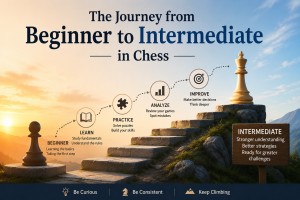
A chess pathway is a structured, milestone-based learning plan that takes a child from their very first game to their first official, verified rating. The clearest pathways combine regular coaching sessions, consistent puzzle practice, online rated play, and eventually, entry into USCF or FIDE-rated over-the-board (OTB) tournaments.
The Six-Stage Pathway from Beginner to Rated Player
- Foundation Stage (Months 1–3): Learn all piece movements, basic checkmates (Scholar’s Mate, Ladder Mate), and core tactical patterns (forks and pins). Begin playing on ChessKid or Lichess to build game intuition without rating pressure.
- Tactics Stage (Months 4–6): Introduce daily puzzle practice. Aim for 15–20 puzzles per day. Focus on recognizing hanging pieces, discovered attacks, and back-rank weaknesses. Target an online rating of 600–900.
- Strategy Introduction (Months 7–12): Begin learning opening principles (control the center, develop pieces, castle early). Introduce basic endgame theory: king and pawn endings, rook endings. Target online rating 900–1200.
- Tournament Preparation (Year 2): Join a federation — become a member of the USCF or your national governing body. Find a rated event listed as “FIDE Rated” or “USCF Rated.” Play the required games — usually 5 to 10 games against rated players before your official rating appears in the database.
- Rating Consolidation (Year 2–3): Play 3–5 rated tournaments per year. Focus on game analysis after every loss. Introduce opening repertoire with 2–3 solid openings on each side. Target USCF rating 900–1200.
- Advanced Development (Year 3+): Pursue private coaching for opening preparation, middlegame planning, and psychological performance training. Target USCF 1400+ and entry into state scholastic championships.
Realistic Rating Timelines for Kids
At an online rating of 1000, a child understands how the pieces move, doesn’t hang their queen every game, and can checkmate with a rook. Most players who play seriously for a few months reach this level. A rating of 1500 means a child sees basic tactics, has some opening knowledge, and doesn’t blunder constantly under time pressure. This is where most casual players plateau — and where the serious ones start. Getting here typically takes 1–2 years of regular play and study.
For children with dedicated online chess coaching, monthly skill assessments, and a FIDE rating pathway, these timelines can compress significantly. The 80% coaching rate among Master-level players is not coincidental — a qualified coach identifies patterns and gaps that players cannot see in their own games. What takes a self-taught player three years can often compress to eighteen months with the right guidance.
The chess pathway from beginner to rated player is not a mystery — it is a sequence of learnable stages, each with clear skills, measurable goals, and a realistic timeline. The variable that compresses this timeline most reliably is consistent, structured online chess coaching with a qualified instructor. That’s the bridge between “my kid likes chess” and “my kid is a tournament player with an official rating.”
Conclusion
Online chess coaching has created a verifiable, accessible pathway from first move to rated player — one that is open to every child, in every timezone, at every level. The combination of live expert instruction, AI-powered practice, structured curricula, and tournament integration has made 2026 the best time in history to start a child’s chess journey.
- Start with science: Chess instruction produces significant improvements in attention, memory, logical thinking, patience, self-discipline, mathematics scores, and reading scores — making it one of the highest-ROI extracurricular investments a parent can make.
- Understand the rating ladder: Know the difference between USCF, FIDE, and online ratings. Target USCF Class E (800–1000) as the first meaningful milestone for a new competitive player.
- Choose coaches by credentials: Verify FIDE ratings, formal coaching certifications, and teaching experience with children. The instructor is the single most important variable in a child’s chess progress.
- Follow a structured pathway: Move through foundation, tactics, strategy, and tournament stages deliberately — not randomly. Six structured stages take a child from first move to their first official rating in roughly 18–24 months.
- Invest in the right platform: For families seeking the highest-caliber online chess coaching, CircleChess — built by GM Vishnu Prasanna, the coach behind World Champion Gukesh D — offers live coaching, AI-powered 24/7 practice, FIDE rating pathway planning, parent dashboards, and official certification. It is the only chess school that brings a proven World Champion coaching system to every level of learner, in one ecosystem.
The first move is the hardest. Everything after that is a system — and with the right system, every child can become a rated, confident, thinking player.
FAQ
What is online chess coaching for kids, and how does a child go from beginner to rated player?
Online chess coaching for kids is a structured, live or AI-assisted instruction model where children learn chess skills — from piece movements and basic tactics to advanced strategy and tournament preparation — via digital platforms with certified coaches. The journey from beginner to rated player typically follows six stages: foundation (piece movements), tactics (puzzles), strategy (openings), tournament preparation (joining USCF/FIDE), rating consolidation (playing events), and advanced development (private coaching). With dedicated online chess coaching and consistent practice, most children can earn their first official USCF rating within 12–24 months of structured study. Platforms like CircleChess provide milestone-based FIDE rating pathway plans, monthly skill assessments, and personalized roadmaps specifically designed for this progression.
At what age should a child start online chess lessons?
Most experts recommend beginning structured chess coaching between ages 5 and 8 to maximize the cognitive development window. While in-person academies can be better for very young children (ages 5–9) who benefit from physical structure, online platforms are highly effective and offer greater flexibility for older children and independent learners aged 10 and up. In 2026, online lessons often surpass traditional instruction due to superior educational tools and safety features. Competitively, the potential is greatest for children who begin serious training before age 12.
What is the difference between a USCF rating and a FIDE rating for kids?
The USCF (United States Chess Federation) rating is the primary competitive system for children in the United States, used for local and scholastic tournaments and required for the national title of National Master (NM). A FIDE rating is the international standard, used for world titles like International Master (IM) and Grandmaster (GM), and requires playing in officially sanctioned over-the-board events. For most American children, the USCF rating is the first step, with FIDE ratings becoming relevant once they reach a competitive level of 1400–1600+ USCF.
How long does it take a child to get their first chess rating?
To earn an official rating, a child must first join a federation like the USCF, find a rated event, and play the required number of games — usually 5 to 10 games against rated players before their official rating appears in the database. In terms of preparation, most children with consistent online chess coaching and 3–4 practice sessions per week are tournament-ready within 6–12 months of starting structured lessons. Children who also practice daily puzzles and analyze their games can earn their first USCF rating in as little as 6 months.
Is chess coaching for talented kids different from standard coaching?
Yes, chess coaching for a prodigy or exceptionally talented child differs in pace, depth, and personalization. Gifted learners require coaches who can accelerate through foundational material, introduce complex positional concepts earlier, and design a training regimen that sustains motivation without causing burnout. The coaching philosophy that produced World Champion Gukesh D — developed by GM Vishnu Prasanna — emphasizes allowing a child to develop their intuitive style rather than imposing a template. This approach is what separates great chess coaching for talented kids from generic instruction.
What should NRI parents look for in an online chess coaching program?
NRI parents should prioritize platforms that operate across multiple time zones, are staffed by coaches with verifiable FIDE credentials, and provide structured curricula rooted in proven coaching traditions. A parent dashboard with real-time progress tracking, monthly mentor reports, and a clear FIDE or USCF rating pathway are essential features. For NRI families wanting to connect their children to India’s world-leading chess tradition, CircleChess — built on World Champion coaching lineage and serving 5,000+ families across 30+ countries — offers an AI-powered coach, live classes, and official certification accessible from any country.
How do I measure my child’s progress in online chess coaching?
Progress in online chess coaching should be measured through a combination of quantitative and qualitative data. Key metrics include improvement in online puzzle ratings (Chess.com/Lichess), achievement of an official USCF rating, and tournament results. Well-structured programs also provide monthly skill assessments and detailed growth reports that track tactical accuracy, endgame knowledge, and opening preparation, allowing parents to see clear, documented development over time.
Can a child become tournament-ready through online chess coaching alone?
Yes, a child can become fully tournament-ready through online chess coaching alone. With live coaching and structured lessons, children can progress from beginner to tournament level fully online, building all the necessary skills: tactical pattern recognition, opening repertoire, endgame technique, and time management. The one component that must happen in person is the actual rated tournament, which requires over-the-board play. The most effective model is online coaching for skill development combined with periodic participation in local rated tournaments to build an official rating and competitive experience.
Methodology and Disclaimer: This article was researched using peer-reviewed academic studies published through 2025–2026, market research data from Business Research Insights, publicly available data from FIDE and USCF databases, and analysis of leading online chess coaching platforms. Rating timelines and progression estimates are illustrative averages based on documented player data and coaching industry benchmarks; individual results vary based on practice frequency, coaching quality, and student aptitude. All external links were verified as of June 2026. This article does not constitute professional educational or financial advice.