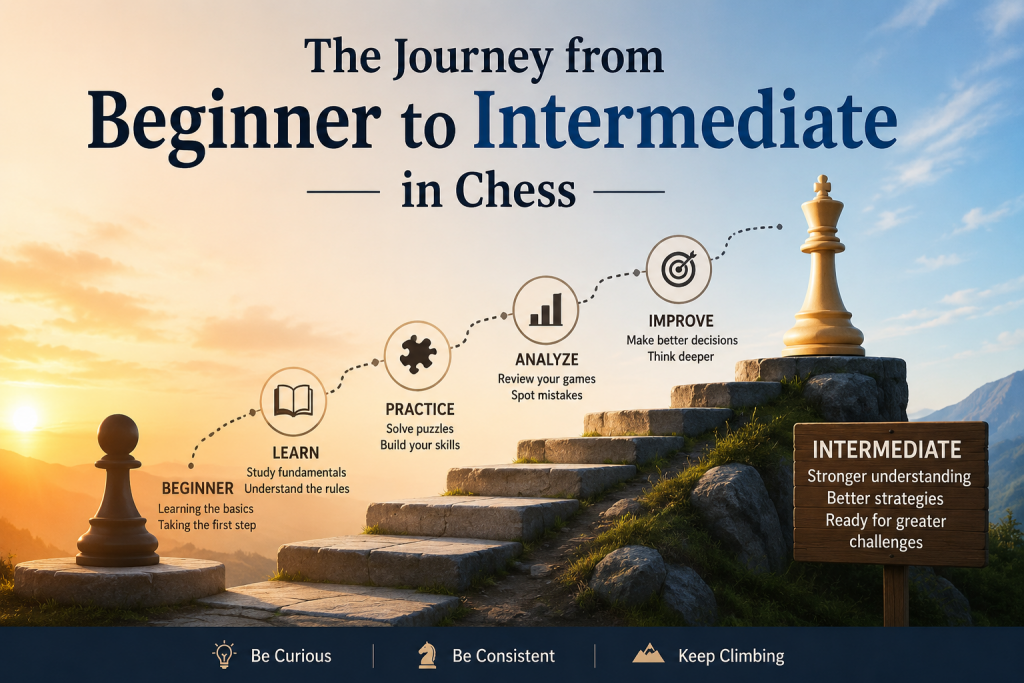

Chess is a game that looks simple at first, but the more you play, the more you
realize how deep it really is. Every player starts as a beginner, learning how the
pieces move and trying to understand the rules. But moving from a beginner to
an intermediate player is a special journey. It is the stage where you stop
playing random moves and start playing with purpose.
This journey is not about becoming perfect. It is about improving step by step,
learning from mistakes, and building confidence in your thinking.
1. Understanding the Basics Properly:
At the beginner level, most players know how the pieces move, but they don’t
always understand how to use them together. The first step in improving is to
make your basics strong.
You should clearly understand:
- How each piece moves.
- The value of pieces (like a queen is stronger than a bishop).
- Basic rules like check, checkmate, and stalemate.
But knowing rules is not enough. You also need to understand simple ideas like
controlling the center of the board and developing your pieces early in the
game. These small concepts make a big difference.
2. Learning Simple Openings:
Many beginners either memorize too many opening moves or don’t care about
openings at all. The right approach is somewhere in between.
You don’t need to learn long and complicated openings.
Instead, focus on simple principles:
- Control the center with pawns.
- Develop your knights and bishops early.
- Keep your king safe by castling.
For example, when you watch games of players like Magnus Carlsen, you will
notice that even at the highest level, players follow these basic ideas.
The goal is not to memorize moves, but to understand why you are playing
them.
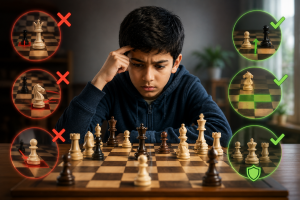
3. Avoiding Common Mistakes:
One of the biggest reasons beginners struggle is because they repeat the same
mistakes again and again.
Some common mistakes include:
- Moving the same piece many times in the opening
- Ignoring your opponent’s threats
- Leaving pieces unprotected
- Playing too fast without thinking
To move forward, you need to slow down and ask yourself simple questions:
- What is my opponent trying to do?
- Is my piece safe?
- Is there a better move?
This habit alone can improve your game a lot.
4. Learning Basic Tactics:
Tactics are short combinations that help you win material or checkmate your
opponent. They are very important for improving your chess.
Some common tactics are:
- Fork (one piece attacks two pieces at once)
- Pin (a piece cannot move without losing something important)
- Skewer (similar to a pin but stronger piece is in front)
Practicing these regularly helps you see opportunities during a real game. Many
intermediate players are good at spotting tactics quickly.
You don’t need to solve hundreds every day. Even solving a few puzzles daily
can make your thinking sharper.
5. Understanding Simple Strategy:
After learning tactics, the next step is understanding strategy. This is where
your game starts to feel more organized.
Strategy means planning your moves with a clear idea. For example:
- Improving your worst-placed piece
- Controlling important squares
- Creating weaknesses in your opponent’s position
This is what separates beginners from intermediate players. Beginners react to
moves, while intermediate players start planning ahead.
6. Improving Through Practice:
There is no shortcut to improving in chess. You have to play regularly.
You can play on platforms like CircleChess, where you can find players of your
level and practice anytime.
But just playing is not enough. After each game, take a few minutes to review:
- Where you made mistakes?
- What you could have done better?
- Which moves were good?
This habit helps you learn faster.
7. Learning from Strong Players:
Watching games of strong players can also help a lot. You don’t need to
understand everything they do. Just try to notice:
- How they start the game?
- How they place their pieces?
- How patiently they play?
Players like Viswanathan Anand , Gukesh, Hikaru Nakamura etc. are great to
watch because their games are clear and instructive.
Over time, you will start understanding their ideas and applying them in your
own games.
8. Staying Patient and Consistent:
One important thing to remember is that improvement takes time. You will lose
many games, and sometimes it may feel frustrating. But every loss teaches you
something.
Instead of feeling bad, try to think: “What can I learn from this game?”
Consistency is more important than speed. Even if you practice a little every
day, you will slowly improve.
9. Building Confidence:
As you improve, you will start feeling more confident in your moves. You will
stop guessing and start thinking with logic.
Final Thought’s:
The journey from beginner to intermediate in chess is full of learning and
growth. By understanding basics, practicing regularly, and learning from
mistakes, anyone can improve. You don’t need to be a genius to play good
chess. With patience and effort, you can become a better player step by step.
At this stage:
- You will make fewer mistakes.
- You will understand positions better.
- You will enjoy the game more.
This is the point where you can say you are no longer a beginner—you are
becoming an intermediate player.
“Caissa School of Chess: A Smarter Way to Master the Game”
CircleChess’s Caissa School of Chess is a dedicated learning platform designed
to help players of all levels improve their game through structured training and
expert guidance. It offers a well-organized curriculum that focuses on building
strong fundamentals, enhancing tactical awareness, and developing strategic
thinking. With experienced coaches, interactive sessions, and practical game
analysis, students not only learn concepts but also understand how to apply
them in real matches. The program is especially beneficial for aspiring
tournament players, as it combines disciplined training with modern learning
methods, making chess improvement more accessible, engaging, and effective.